Psychic Damage 5e: Spells, Immunity, and Mental Defenses
Psychic damage can sound like an exception to ordinary combat: an invisible assault on thoughts instead of a blade striking flesh. I find the most useful distinction is between that vivid description and the actual rules of the effect delivering it.
This guide uses 2014 D&D 5e rules. The revised Vicious Mockery appears in a separate comparison below.
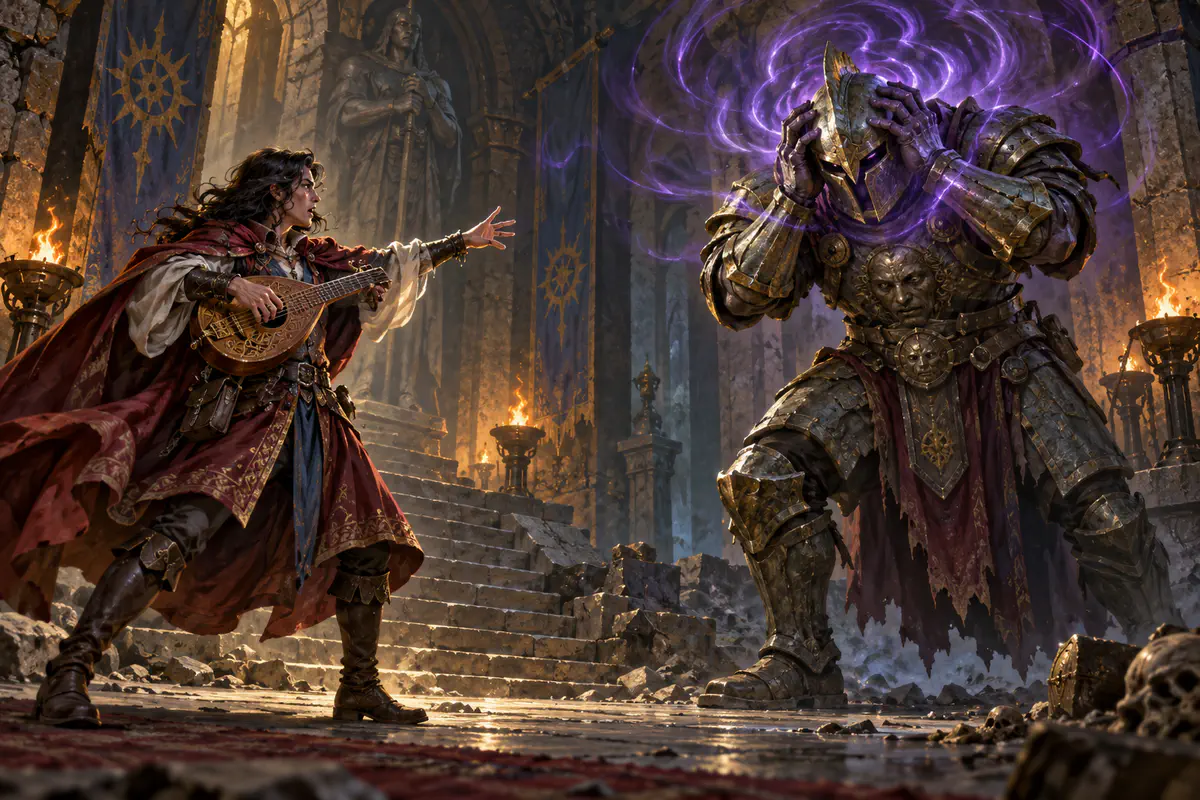
Psychic Damage 5e: Quick Answer
Psychic damage represents mental or psionic harm, but it reduces hit points normally. Psychic resistance halves it, immunity prevents it, and vulnerability doubles it.
The damage type does not automatically read thoughts, frighten, charm, stun, bypass every defense, or require a shared language. Targeting, saving throws, and extra effects come from the individual spell or ability.
A creature’s low Intelligence or unusual anatomy does not, by itself, grant psychic immunity. Check its stat block and the effect’s restrictions.
What Does Psychic Damage Represent?
Psychic harm can be described as crushing mental pressure, a psionic intrusion, an impossible sensory experience, or a magical insult that hurts beyond ordinary words. These descriptions can support very different character themes without changing the underlying rules.
A bard might weaponize distraction; an aberrant creature might overwhelm a victim’s thoughts. Neither description creates a new condition or a permission to choose what the target thinks. Apply only the effects the relevant ability specifies.
How Do You Resolve Psychic Damage?
Resolve the source’s attack roll or saving throw, calculate the damage, apply any relevant defenses, and then subtract the remaining damage from hit points.
For example, assume an effect rolls 17 psychic damage and allows half damage on a successful save. A successful save reduces that to 8. Psychic resistance then reduces 8 to 4 damage. A failed save with resistance would instead deal 8 damage.
Not every psychic spell deals half damage on a successful save. The 2014 Vicious Mockery deals no damage on success. Always use the spell’s own outcome rather than importing another spell’s procedure.
Which Spells Deal Psychic Damage?
Psychic options differ in much more than their damage dice:
| Spell | Why its individual rules matter |
|---|---|
| Vicious Mockery | Combines psychic damage with a limited attack-roll penalty |
| Dissonant Whispers | Can make a target use its reaction to move on a failed save |
| Mind Spike | Combines damage with a tracking effect and requires concentration |
| Shadow Blade | Creates a weapon that deals psychic damage through attacks |
These examples also show why psychic damage is not synonymous with an Intelligence saving throw. Different sources can use different saves, or an attack roll instead.
Does Psychic Damage Ignore Armor?
It depends on how the effect is resolved. Vicious Mockery uses a Wisdom saving throw, so it does not roll against AC. An attack with Shadow Blade still needs to hit AC despite dealing psychic damage.
Neither result comes from a universal armor-bypassing rule. A high AC may help against a psychic weapon attack, while a strong relevant saving throw may help against a psychic spell.
Likewise, psychic damage is not automatically silent or undetectable. A spell’s components and description still apply even if you imagine the resulting pain as entirely internal.
What Resists or Ignores Psychic Damage?
Use the creature’s actual defenses. The 2014 animated armor is an example of a construct with psychic immunity, but that does not make every construct immune. Creature type is not a substitute for reading the stat block.
Objects have psychic immunity under the 2014 object rules. This is separate from constructs, which are creatures. You cannot assume that a living construct, a suit of animated armor, and an ordinary empty breastplate all use the same defenses.
Psychic damage can be useful when a creature resists other types, but it is not guaranteed to work. Claims that it is universally reliable overlook specific immunities and spell-targeting restrictions.
Does Charm or Fear Immunity Stop Psychic Damage?
Not by itself. Charmed and frightened are conditions; psychic is a damage type. Immunity to one does not automatically grant immunity to the others.
A creature immune to being charmed can still take psychic damage from an effect that does not depend on charming it. Conversely, resistance to psychic damage does not protect against every charm or fear effect.
If an individual spell ties its damage to a condition or excludes particular targets, follow that wording. The distinction is between the spell’s explicit dependency and an assumed connection based on its theme.
Do Psychic Spells Require Hearing or a Shared Language?
There is no general language or hearing requirement for the damage type. The 2014 Vicious Mockery requires a target you can see within 60 feet that can hear you. The target does not need to understand you.
Other spells have different requirements. Do not copy Vicious Mockery’s hearing rule onto Shadow Blade, or assume that an effect involving whispers works on a deafened target without checking its description.
The same principle applies to low Intelligence: it only excludes a target when the effect explicitly establishes that restriction or another applicable rule does.
Can Psychic Damage Break Concentration or Kill?
Yes. Psychic damage is real hit-point damage. When a concentrating creature takes it, the normal Constitution saving throw to maintain concentration applies unless a feature says otherwise. The DC is 10 or half the damage taken, whichever is higher.
If resistance reduces 25 psychic damage to 12, the concentration save DC is 10. The mental nature of the attack does not change that save to Intelligence or Wisdom.
Psychic damage can also reduce a creature to 0 hit points, trigger the normal dying rules, and contribute to instant death through massive damage. It is not automatically nonlethal.
When Should You Choose Psychic Damage?
Choose the complete effect that fits the encounter. A saving throw spell may help against high AC; a psychic weapon can help against a defense restricted to a different damage type. Neither is automatically best against every enemy.
Vicious Mockery’s attack penalty can matter even when its damage is modest. Dissonant Whispers offers a different tactical opportunity through reaction movement. Mind Spike’s concentration cost matters if you already need another concentration spell.
Compared with fire, poison, radiant, or force, psychic is simply another damage type with different available effects and enemy defenses. There is no general rule making it superior to those options or adding control effects to every psychic hit.
Psychic Damage: 2014 vs. 2024 Rules
Vicious Mockery changes materially. Its 2014 damage begins at 1d4, while its 2024 damage begins at 1d6, with the corresponding larger dice at later cantrip scaling levels.
Its targeting also changes. The 2014 version uses a target you can see that can hear you. The 2024 description targets a creature you can see or hear and does not retain the earlier explicit target-hearing requirement.
Both versions use a Wisdom save and impose disadvantage on the target’s next attack roll before the end of its next turn on failure. Choose one version of the spell rather than combining the most favorable parts of both.
Psychic Damage FAQ
Does psychic damage reveal a creature’s thoughts?
No. Reading thoughts requires an effect that explicitly permits it. Damage alone provides no access to memories, secrets, or intentions.
Are undead automatically immune to psychic damage?
No. Read the particular undead creature’s damage immunities and traits. Undead type alone does not grant psychic immunity.
Does psychic resistance protect against force damage?
No. Force is a separate damage type, even when both effects are described as supernatural pressure.
Rules Sources
This guide uses the official 2014 combat rules, 2014 Vicious Mockery, and the object, monster, and spellcasting rules in SRD 5.1. Spell examples also refer to the 2014 Player’s Handbook and Xanathar’s Guide to Everything (2017). The comparison uses the official 2024 Vicious Mockery description.