Hail of Thorns 5e: Damage, Timing, and Concentration
I like the choice Hail of Thorns puts in front of a Ranger: keep pressure on one enemy, or turn a well-placed shot into a small burst against a cluster. The spell rewards timing and positioning, but casting it does not guarantee the attack will hit or spare a nearby ally.
This guide uses the 2014 spell. The 2014 vs. 2024 comparison separates the verified revised duration and concentration changes.
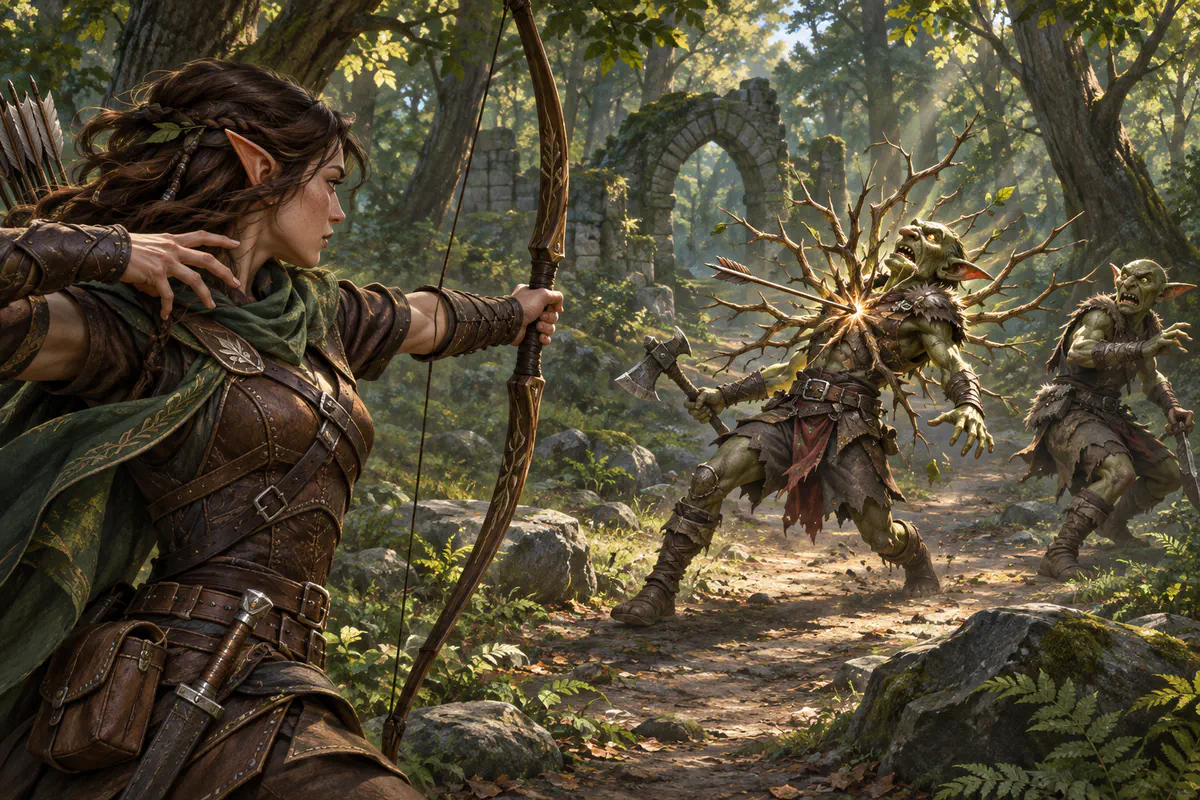
Hail of Thorns 5e — Quick Spell Reference
| Casting Time | 1 bonus action |
|---|---|
| Range | Self |
| Components | V |
| Duration | Up to 1 minute |
| Concentration | Yes |
| Ritual | No |
| Classes | Ranger |
| Source | Player's Handbook (2014), pg. 249 |
Cast First, Then Land One Ranged Weapon Hit
In 2014, cast Hail of Thorns before the attack you want to enhance. While concentrating, the next hit against a creature with a ranged weapon attack triggers the spell’s burst. You can cast it with your bonus action and take the Attack action on the same turn; the spell does not supply that action or an extra attack.
A miss does not trigger the thorns. You may try again with another attack while the spell remains active, including a second attack from Extra Attack or an attack on a later turn. However, losing concentration or reaching the one-minute limit can end the spell before a hit ever occurs. The slot is already spent when you cast it.
It triggers only once. The official Sage Advice clarification confirms that the spell lasts until the qualifying hit or the end of concentration, whichever comes first. It is not a minute of explosive arrows, and maintaining concentration does not create further bursts after the hit.
For example, a level-5 Ranger casts the spell, misses the first longbow attack, and hits with the second. The second attack triggers one burst. A later attack needs another casting to produce more thorns.
The Weapon Hit and the Dexterity Save Are Separate
The original attack resolves normally. Then the creature hit and every creature within 5 feet of it must make a Dexterity saving throw against your spell save DC. The thorns deal 1d10 piercing damage on a failed save, or half the rolled damage, rounded down, on a successful save.
The primary target makes that save too. Being hit by the arrow does not automatically fail the save, and succeeding does not cancel the weapon hit. Nearby creatures can take the spell’s damage without being hit by the arrow at all.
A Ranger normally uses 8 + proficiency bonus + Wisdom modifier for this DC, separate from the Dexterity-based longbow attack modifier. With Wisdom 14 and proficiency +2, the spell DC is 12 even if the Ranger’s weapon attack bonus is much higher.
Example: a longbow hit deals 8 damage, and the spell’s damage roll is 7. A primary target that fails takes the normal 8 plus 7 piercing damage from the burst; one that succeeds takes the normal 8 plus 3. An adjacent creature makes its own save and takes either 7 or 3 from the thorns, without the longbow’s damage.
The burst does not restrain, knock prone, poison, or create difficult terrain. Its piercing damage is not a condition or an ongoing patch of hazardous plants.
Which Attacks Trigger the Thorns?
The 2014 trigger is a ranged weapon attack, not any attack made from a distance. Bows, crossbows, and slings can qualify. Throwing a dagger or javelin also makes a ranged weapon attack; the weapon need not belong to the ranged-weapon equipment category.
A ranged spell attack does not qualify. Neither does hitting an object: the trigger specifically requires a creature. The spell’s Self range describes the spell you cast on yourself; it does not limit the later weapon attack to 5 feet or give the weapon additional range. Use the weapon’s normal range and attack restrictions.
A critical weapon hit doubles the attack’s damage dice under the ordinary critical-hit rule. Do not double the separate, saving-throw-based Hail of Thorns burst. It is not another copy of the weapon’s attack damage roll.

Keep Allies Out of the Burst
The spell does not let you select only enemies. An ally within 5 feet of the creature hit must save too; so must you if your position puts you there. A crowded melee can make a seemingly good shot expensive for your own party.
Choose a target whose neighbors are enemies, or wait for allies to change position before casting. Because the next qualifying hit triggers the spell, you cannot assume you may hit one creature normally and reserve the already-cast thorns for a later hit. If the situation changes, you can end your concentration instead, but that does not refund the slot.
Apply ordinary cover rules to the relevant attack and area. Half or three-quarters cover can affect Dexterity saves, while total cover can block an area’s effect. Being nearby on a map does not override a solid barrier. Settle ambiguous three-dimensional positions with the DM before rolling.
Upcasting: More Damage, Not a Larger Burst
Each slot level above 1st adds 1d10, to a maximum of 6d10 under the 2014 spell. It does not enlarge the five-foot proximity requirement, extend the duration, change the save, or produce additional bursts.
| Slot level | Thorn damage on a failed save | Average before saves or defenses |
|---|---|---|
| 1st | 1d10 | 5.5 |
| 2nd | 2d10 | 11 |
| 3rd | 3d10 | 16.5 |
| 4th | 4d10 | 22 |
| 5th | 5d10 | 27.5 |
| 6th or higher | 6d10 | 33 |
The final row matters if another feature or multiclass slot lets you cast it above a Ranger’s usual fifth-level spell access. These are damage-roll averages, not expected damage against a particular creature; you still need the weapon hit, and each affected creature still saves. See upcasting for the difference between using a higher slot and gaining a higher class level.
Can Hail of Thorns Stack with Hunter’s Mark?
Not from the same caster under the 2014 rules. Both require concentration. Starting Hail of Thorns ends your concentration on Hunter’s Mark, even if the following shot misses. You cannot keep the mark until the thorns trigger and only then give it up.
Hunter’s Mark supports repeated weapon hits against one quarry. Hail of Thorns buys a single small area burst, potentially damaging several creatures. Pick the effect that suits the encounter rather than counting both sets of damage on one Ranger’s shot. The same concentration competition applies to spells such as Ensnaring Strike.
Casting Hail also uses the bonus action that might otherwise fund a two-weapon attack or another class feature. In 2014, casting a bonus-action spell restricts your other spellcasting that turn to a cantrip with a one-action casting time, but it does not prevent ordinary weapon attacks. Our bonus-action spellcasting guide explains that distinction.
Hail of Thorns: 2014 vs. 2024 Rules
The official spell catalog lists a material change: the revised spell is instantaneous and does not require concentration, while the legacy spell requires concentration for up to one minute. This removes the old concentration conflict with an existing Hunter’s Mark.
The main reference and cast-before-attacking examples above remain 2014 instructions. Use the revised entry’s own casting requirements when playing 2024. The full revised spell entry requires access to its Player’s Handbook; this comparison is limited to the duration and concentration changes verified in the public official catalog.
Hail of Thorns FAQ
Is there still a burst if the attack misses?
No. The spell waits for a qualifying hit while it remains active. If none occurs before it ends, you get no burst.
Can I cast it after seeing a hit in 2014?
No. The 2014 version must already be active when the hit happens. Do not import revised casting timing into the legacy spell.
Is it a persistent area like Spike Growth?
No. Hail of Thorns produces one burst. There is no lingering zone, repeated entry damage, or continuing restraint.
Rules sources: Player’s Handbook (2014), p. 249; Sage Advice Compendium; 2014 spellcasting rules. The full legacy entry was not publicly accessible during this check; its description was corroborated against the spell reference, with timing and key metadata independently checked in official sources. Tactical examples are original advice.