Gelatinous Cube 5e Guide: Engulf, Rescue, and Corridor Clues
Rules baseline: 2014 D&D 5e, SRD 5.1. Use the gelatinous cube stat block in the SRD, pages 337–338 for complete statistics. The patrol route, gate mechanism, objective, and retreat behavior below are original DM suggestions.
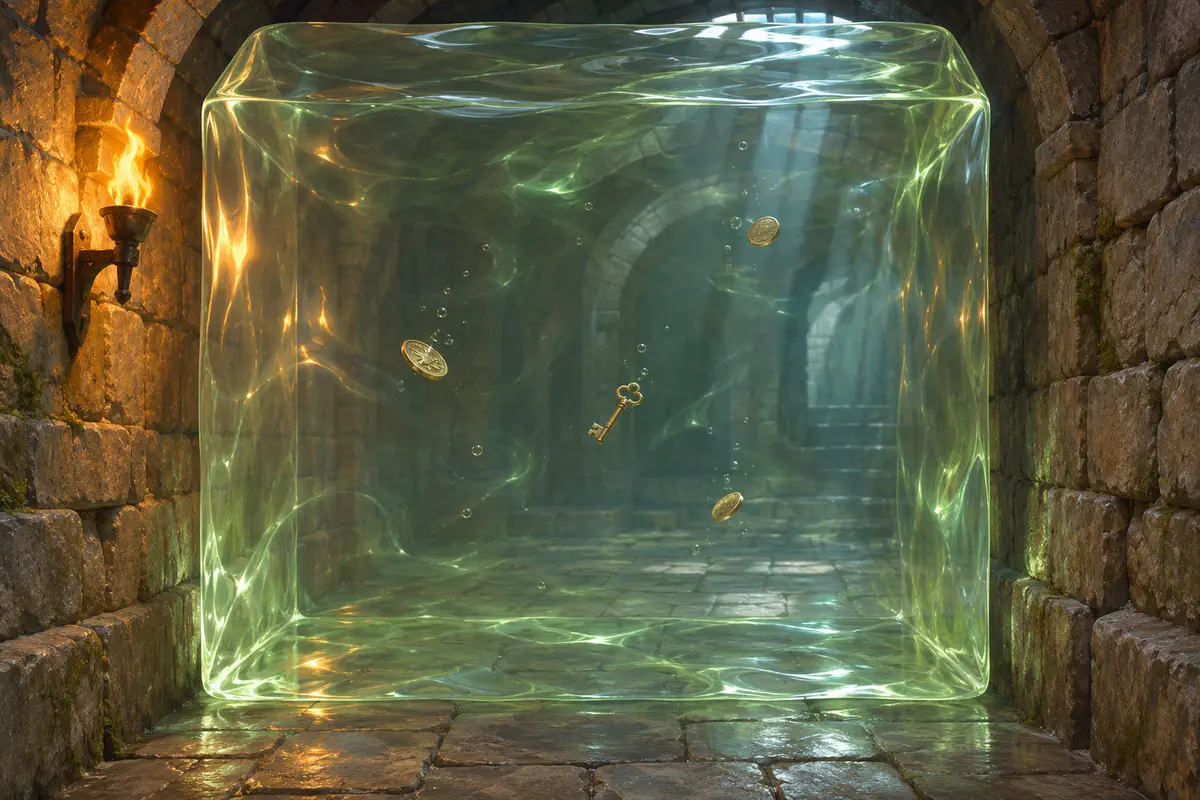
A gelatinous cube makes the dungeon itself feel dangerous. Its shape turns a narrow corridor into an approaching wall, while an engulfed ally changes the objective from dealing damage to getting someone out. Prepare an intersection and clear rescue procedures before placing the creature.
What to emphasize
The standard gelatinous cube is CR 2, occupies its full space, and has a speed of 15 feet. Its Transparent trait requires a DC 15 Wisdom (Perception) check to spot it while it has neither moved nor attacked. A creature trying to enter its space while unaware of it is surprised by the cube. Apply that specific trait alongside the 2014 initiative rules; do not give the cube an extra combat turn outside initiative.
Its Engulf action moves it up to its speed and can enter the spaces of Large or smaller creatures, allowing the printed DC 12 Dexterity save. This is separate from its normal movement. A successful save gives the target the stated choice to move 5 feet back or to the side; refusing that movement brings the failed-save consequences. Draw the available spaces instead of assuming everyone can dodge through a solid wall.
Engulf deals acid damage immediately. An engulfed creature is restrained, cannot breathe, and takes further acid damage at the start of the cube’s turns. It has total cover from outside the cube. Track these effects separately from ordinary melee damage; an ally’s attack cannot simply pass through the cube to target the victim.
Prepare the rescue procedure
An engulfed creature can spend its action attempting a DC 12 Strength check to escape. Success lets it move to a space within 5 feet of the cube. A rescuer within 5 feet can instead use an action and a DC 12 Strength check to pull out a creature or object. The rescuer takes 3d6 acid damage for making that attempt, even if the check fails.
These are the cube’s printed extraction options, rather than a generic grapple contest. Explain the action cost and acid danger when a character can judge what they are attempting. Put the recurring damage reminder on the cube’s turn in the initiative tracker.
Do not import another ooze’s traits. The cube does not split when struck by a sword and does not automatically dissolve armor after every hit. Use its actual stat block when players test a plan.
Make the corridor readable
Contrast dusty side passages with an unnaturally clean main hall. Coins suspended at different heights, slowly bending torch reflections, and debris ending in a straight line all suggest something occupies the space. These clues can prompt a closer look without automatically cancelling Transparent.
Once the cube moves, describe its position clearly. Leave a junction large enough for the party to retreat and a lever or gate they can inspect before committing. Dynamic environments work when players understand which parts of the room they can change.
Ready to run: the key in the cleaning patrol

Situation: one gelatinous cube patrols a sealed archive corridor. A brass key to a nearby records cabinet is suspended inside it. The cabinet also has a conventional lock, so obtaining the key is useful but not the only way to reach the records.
Layout: a 10-foot-wide northern corridor opens into a 30-foot-square junction with southern and eastern exits. The cube starts 30 feet north of the junction. An iron portcullis crosses the corridor mouth; its lever stands on the junction’s south wall. The locked cabinet is in the eastern passage, safely outside the cube’s initial position.
Opening: describe suspended coins above clean paving, with a brass glint among them. Resolve spotting the motionless cube using Transparent. The visible lever has a mechanical linkage to the portcullis; operating it without obstruction costs an action and needs no check in this scene.
Choices: the party can withdraw into the eastern passage, lower the gate while its opening is clear, or leave the key and attempt the cabinet lock with suitable tools. Use DC 15 Dexterity with thieves’ tools for that lock as a scene ruling. The portcullis blocks this cube in this encounter; it has no feature allowing it to flow through the bars. If the cube occupies the gate opening, the gate jams rather than providing free crushing damage.
If combat begins: roll initiative as the cube advances toward detected nearby creatures. Use movement and Engulf as printed, tracking each victim and the start of the cube’s turns. Characters can use the extraction rule to recover the key, accepting its action cost, check, and acid damage. The cube follows accessible prey but cannot open the gate or work its lever.
Finish: opening the cabinet yields the records. A lowered gate contains the creature while the party works. If they leave without securing it, tell them the corridor remains unsafe; clearing the archive can become a later task rather than a compulsory fight now.
Prepare for your party
Engulf’s recurring damage can overwhelm low-level characters. Use the encounter balancing guide and consider the party’s escape and healing resources. Easier: begin with the gate already lowered so they can inspect the threat safely. Harder: place a fragile document tube inside the cube alongside the key, making extraction desirable without increasing enemy numbers. Browse dungeon-style cave encounters or return to Monster Guides.