Bludgeoning Damage 5e: Weapons, Falling, and Resistance
I like bludgeoning damage because it connects familiar weapon attacks with hazards that feel completely different: a staff strike, a constricting snake, and a fall can all use it. Knowing the source matters just as much as knowing the damage type.
This guide uses 2014 D&D 5e rules, with 2024 weapon mastery discussed separately.
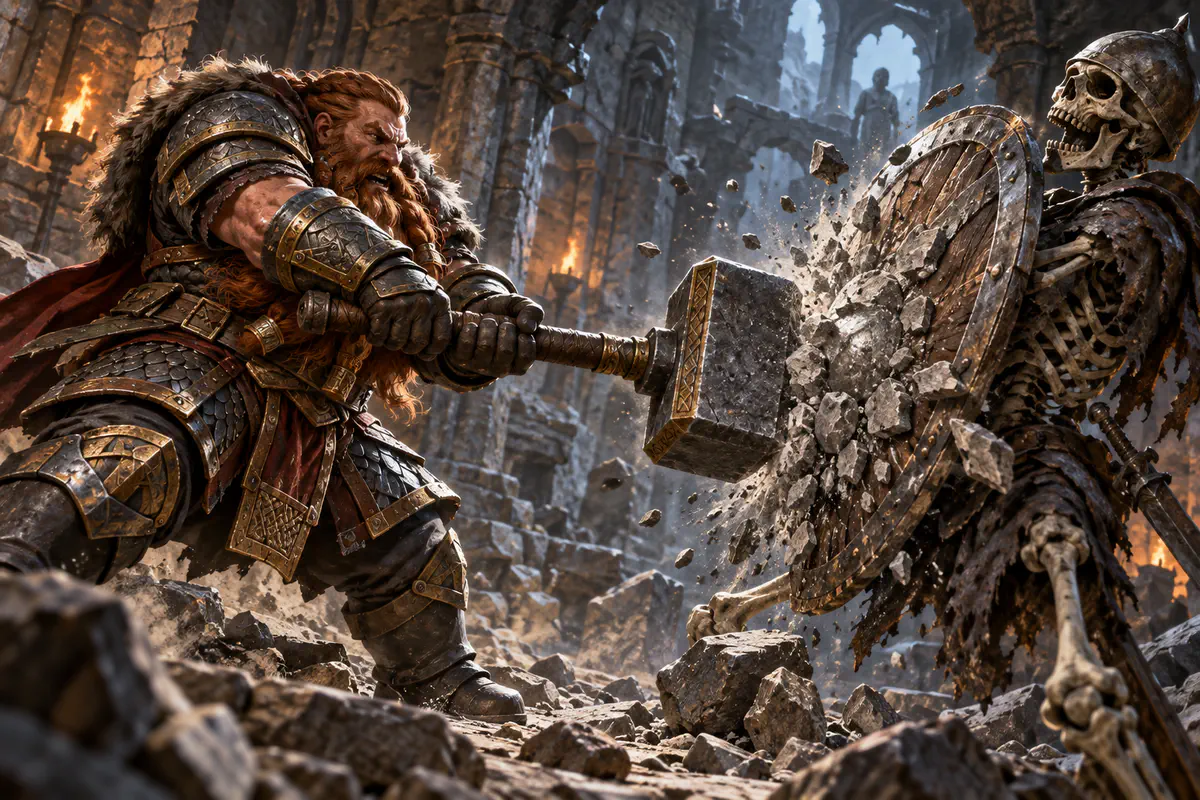
Bludgeoning Damage 5e: Quick Answer
Bludgeoning damage is harm from blunt impact or crushing pressure. Hammers, clubs, falling, and some monster attacks deal it. It has no automatic stun, knockback, or armor-breaking effect.
Resistance halves applicable damage, immunity prevents it, and vulnerability doubles it. Read any source restriction carefully: protection from bludgeoning damage from nonmagical attacks is narrower than protection from all bludgeoning damage.
Which Weapons Deal Bludgeoning Damage?
These are common 2014 weapon examples, before ability modifiers or other bonuses:
| Weapon | Damage |
|---|---|
| Club | 1d4 bludgeoning |
| Light hammer | 1d4 bludgeoning |
| Mace | 1d6 bludgeoning |
| Quarterstaff | 1d6, or 1d8 with two hands |
| Warhammer | 1d8, or 1d10 with two hands |
| Maul | 2d6 bludgeoning |
| Sling | 1d4 bludgeoning |
A sling is a useful reminder that bludgeoning damage can be ranged. A heavy-looking weapon is not necessarily bludgeoning: a morningstar deals piercing damage in the 2014 equipment table.
An ordinary unarmed strike also deals bludgeoning damage. Its default damage is 1 + Strength modifier, with features such as Martial Arts providing specific alternatives.
How Do Resistance and Vulnerability Work?
Assume a warhammer hit deals 11 bludgeoning damage after its damage roll and modifiers. A target with applicable resistance takes 5 after rounding down. A target with bludgeoning vulnerability takes 22 instead.
The 2014 skeleton has bludgeoning vulnerability. That makes a hammer useful against this particular stat block, but it does not establish a weakness shared by all undead or every skeletal creature.
Multiple sources of the same resistance do not stack. For more on overlapping defenses, see damage resistance.
Does Bludgeoning Resistance Reduce Falling Damage?
It can, if the resistance applies to the fall. Under the 2014 falling rules, a fall deals 1d6 bludgeoning damage per 10 feet, to a maximum of 20d6. The creature lands prone unless it avoids taking damage from the fall.
A 30-foot fall therefore deals 3d6 bludgeoning damage. If the total is 11, resistance to all bludgeoning damage reduces it to 5.
However, falling is not an attack. Resistance limited to bludgeoning damage from nonmagical attacks does not cover ordinary falling damage. A defense limited to weapon attacks is narrower still. The fact that a fall is nonmagical does not turn it into a nonmagical attack.
Can Spells Deal Bludgeoning Damage?
Yes. The damage type does not determine whether the source is magical. Ice Storm deals both bludgeoning and cold damage, while Catapult deals bludgeoning damage through a spell effect.
Resolve different damage types separately when a defense applies to only one. If an effect deals 8 bludgeoning and 13 cold damage against a target with resistance only to bludgeoning, it takes 4 + 13 = 17 damage.
Also check whether a defensive feature refers to attacks. A spell resolved with a saving throw is not an attack merely because it causes damage.
Do Magic Hammers Deal Force Damage?
Not automatically. A magic warhammer can still deal bludgeoning damage. Being magical and dealing force damage are different properties.
A magical attack may bypass a defense restricted to nonmagical attacks while remaining bludgeoning. It does not bypass a target’s unrestricted bludgeoning resistance simply because the weapon is magical. Specific items and traits can override these general interactions.
When Should You Carry a Blunt Backup Weapon?
A proficient backup weapon gives you an alternative when an enemy has a particular vulnerability or defense. A skeleton is a concrete reason to consider a club or hammer alongside a sword.
Compare the whole weapon, though: damage dice, proficiency, reach, available hands, and whether its attacks can overcome the target’s defenses all matter. A mundane hammer is not automatically an improvement over a magic sword against an enemy that resists nonmagical attacks.
Bludgeoning Damage: 2014 vs. 2024 Rules
The 2024 equipment rules add weapon mastery properties. For example, a warhammer has Push and a maul has Topple. You need a feature that unlocks the relevant mastery to use it, and each property has its own requirements.
Those effects come from the weapon’s mastery, not from bludgeoning damage itself. The 2014 weapons do not gain these properties by borrowing their revised descriptions.
Bludgeoning Damage FAQ
Is bludgeoning the same as force or thunder?
No. Force is a separate magical damage type, while thunder represents concussive sound. A hammer’s impact does not make it thunder damage.
Does a bludgeoning critical hit stun the target?
No. A normal critical hit changes damage dice. Stunning requires a separate feature or effect.
Can I knock someone unconscious with a hammer?
Under the 2014 knockout rule, when a melee attack reduces a creature to 0 hit points, the attacker can choose to knock it out. The option depends on a melee attack, not on choosing bludgeoning instead of piercing or slashing.
Rules Sources
See the official 2014 equipment rules, falling rules, combat rules, and SRD 5.1. The comparison uses the official 2024 weapon mastery rules.