Bard Guide 5e: Bardic Inspiration, Spells, and Complete Builds
A Bard can make an ally’s decisive roll succeed, take several foes out of a fight with one spell, and carry a negotiation when initiative never gets rolled. Your most important choices are what to concentrate on and when to spend Inspiration. You can cover many roles, but your spells known make it worth choosing a few to do well.

This guide uses 2014 D&D 5e for the rules and builds. The revised Bard has its own section below.
Bard quick build
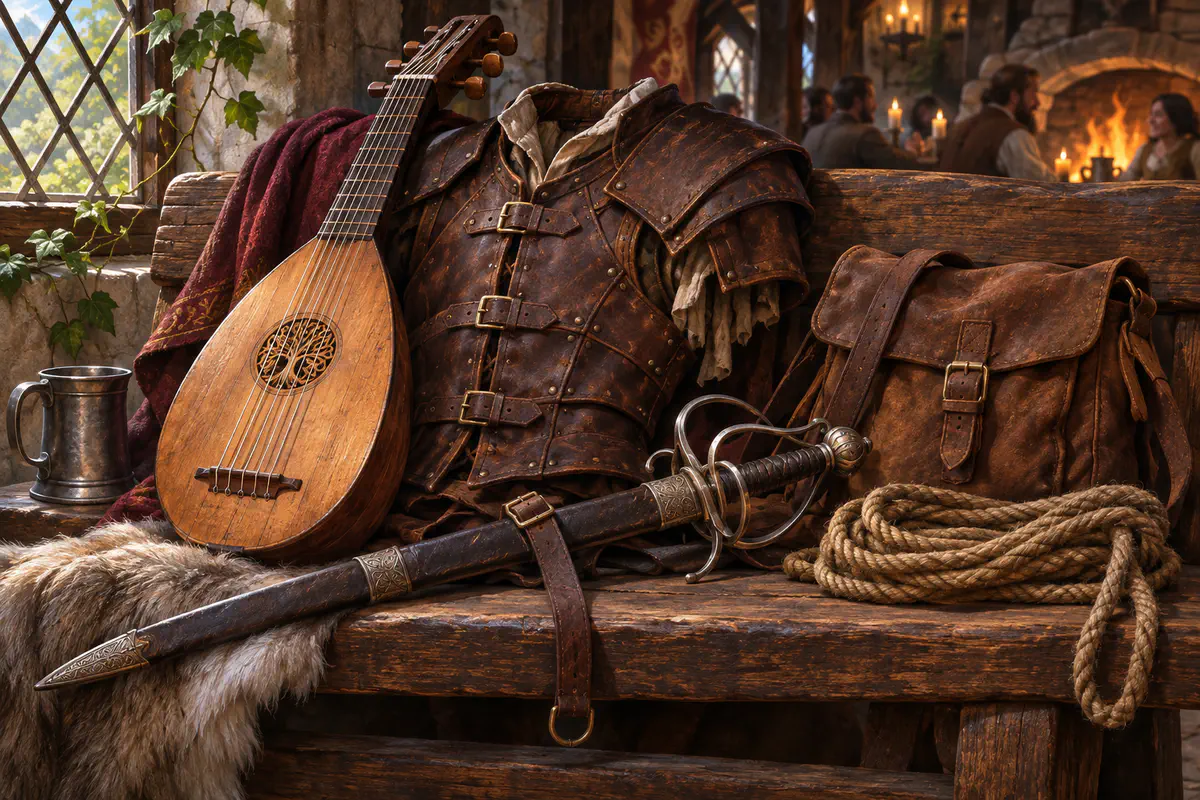
Start as a half-elf with Dexterity 16, Constitution 14, and Charisma 17. Take Persuasion, Perception, and Stealth. Learn Vicious Mockery, Minor Illusion, Healing Word, Dissonant Whispers, Faerie Fire, and Detect Magic. Wear leather, carry a rapier and a lute, and choose College of Lore at level 3. The first build below fills in the background, Expertise, and spell choices through level 5.
How to use Bardic Inspiration
Use a bonus action to give one other creature within 60 feet that can hear you an Inspiration die. It lasts up to 10 minutes. The recipient can add it to one ability check, attack roll, or saving throw after rolling the d20 and before the DM declares the result. A creature can hold only one Bardic Inspiration die at a time. You have uses equal to your Charisma modifier, with a minimum of one. At level 5, Font of Inspiration lets you recover them on a short or long rest. The die increases from d6 to d8 at 5, d10 at 10, and d12 at 15.
When the party has a minute before a fight, hand a die to the scout or the ally holding the front line. During combat, reserve your bonus action if someone might need Healing Word. You can cast an action spell and grant Inspiration in the same turn because Inspiration is a class feature. Casting a bonus-action spell invokes the 2014 rule that any other spell that turn must be a one-action cantrip.

Jack of All Trades adds half your proficiency bonus, rounded down, to ability checks that do not already include proficiency. Initiative qualifies. At levels 3 and 10, Expertise doubles your proficiency bonus for two chosen skill proficiencies each time. At level 2, Song of Rest adds healing for qualifying listeners who spend a Hit Die at the end of a short rest. Countercharm at level 6 takes an action and helps nearby creatures who can hear you with saves against charm or fear until the end of your next turn. If a dangerous enemy is about to act, ask whether shutting it down would be a better use of the action.
Ability scores, equipment, and spell choices
Put Charisma first, then Dexterity and Constitution. Dexterity protects a light-armored Bard, while Constitution helps you keep concentration. A lute or another musical instrument can serve as a focus for Bard spells. Keep a hand available for components. A focus can cover eligible material components, and the hand holding it can also perform somatic components for the same spell when it has a material component. A spell with somatic components alone still needs a free hand. Check component and focus rules if you carry a weapon and a shield.
You know a fixed set of Bard spells and can replace one when you gain a Bard level. Slots return on a long rest. You can ritual-cast a Bard spell you know if it has the ritual tag. Ritual casting trades ten minutes for the slot and still requires the spell’s components.
- Level 1 spells. Healing Word can get a fallen ally back up from range. Faerie Fire can help the whole party land attacks against targets that fail their saves. Dissonant Whispers can open up opportunity attacks if the target uses its reaction to leave an ally’s reach.
- Level 2 spells. Suggestion can redirect a creature that can hear and understand you if the request sounds reasonable. Heat Metal is especially useful against metal armor the target cannot remove quickly, but it spends concentration and later bonus actions.
- Level 3 spells. Hypnotic Pattern can split an enemy group. Place it clear of allies and tell the party which affected enemies to leave alone. Dispel Magic gives you a way to help while maintaining an existing concentration spell.
Bard progression by class level
| Level | Milestone |
|---|---|
| 1 | Spellcasting and d6 Bardic Inspiration |
| 2 | Jack of All Trades and d6 Song of Rest |
| 3 | Bard College, two Expertise skills, and 2nd-level spells |
| 4 | Ability Score Improvement or optional feat, third cantrip |
| 5 | 3rd-level spells, d8 Inspiration, and short-rest recovery |
| 6 | Countercharm and college feature |
| 7 | 4th-level spells |
| 8 | Ability Score Improvement or optional feat |
| 9 | 5th-level spells and d8 Song of Rest |
| 10 | Magical Secrets, two more Expertise skills, d10 Inspiration, and fourth cantrip |
| 11 | 6th-level spells |
| 12 | Ability Score Improvement or optional feat |
| 13 | 7th-level spells and d10 Song of Rest |
| 14 | Magical Secrets and college feature |
| 15 | 8th-level spells and d12 Inspiration |
| 16 | Ability Score Improvement or optional feat |
| 17 | 9th-level spells and d12 Song of Rest |
| 18 | Final pair of Magical Secrets |
| 19 | Ability Score Improvement or optional feat |
| 20 | Superior Inspiration restores one use if you roll initiative with none |
Choosing a Bard College
| College | Choose it for | Tradeoff | 2014-compatible source |
|---|---|---|---|
| Lore | Three extra skills at 3 and early spell access through Additional Magical Secrets at 6 | Cutting Words competes for your reaction and spends the same pool as regular Inspiration | SRD 5.1 |
| Valor | Medium armor and shields at 3, Combat Inspiration, and Extra Attack at 6 | Weapon attacks compete with spellcasting, and carrying a shield makes free-hand planning matter | 2014 Player’s Handbook |
| Eloquence | A face who also sets up crucial saving-throw spells | Unsettling Words uses a bonus action and spends Inspiration before you know how the target would roll | Tasha’s Cauldron of Everything |

Lore’s Cutting Words can reduce an attack roll, ability check, or damage roll made by a creature you see within 60 feet. Use it before the outcome is determined or the damage is dealt, as applicable. The creature must hear you and cannot be immune to charm. A saving throw is outside its scope. At level 6, Lore picks two extra Magical Secrets that do not count toward the normal spells-known limit. At levels 10, 14, and 18, every Bard gets two Magical Secrets that count in the class table. Choose spells you can cast at the Bard level you gain them. Counterspell and Revivify solve very different gaps at Lore 6. The former can benefit from Jack of All Trades when it calls for an ability check, while the latter needs its priced, consumed diamonds.
Three complete 2014 Bard builds
All arrays use 27-point buy and list Strength, Dexterity, Constitution, Intelligence, Wisdom, and Charisma. All start with a rapier, lute, leather armor, dagger, and diplomat’s pack plus background equipment. Level-5 HP uses fixed increases, and all three have slots 4/3/2, d8 Inspiration, and the same known-spell plan unless noted. Use the 2014 Player’s Handbook for Dissonant Whispers, Valor, and mountain dwarf.
| Bard level | Shared spell plan |
|---|---|
| 1 | Cantrips Vicious Mockery and Minor Illusion. Spells Healing Word, Dissonant Whispers, Faerie Fire, and Detect Magic |
| 2 | Add Thunderwave |
| 3 | Add Suggestion |
| 4 | Add Heat Metal and the Mage Hand cantrip |
| 5 | Add Hypnotic Pattern |
Half-elf Lore generalist
- Scores. Start 8, 15, 13, 10, 10, 15. Apply half-elf bonuses to Dexterity, Constitution, and Charisma for 8, 16, 14, 10, 10, 17. At 4 raise Charisma and Wisdom by one each, then at 8 raise Charisma to 20.
- Skills. Guild Artisan grants Insight and Persuasion. Pick Perception, Stealth, and Deception as Bard skills, Arcana and Investigation from half-elf, and History, Nature, and Performance from Lore at 3. Take Expertise in Persuasion and Perception. The background’s artisan’s tools and equipment are separate from your lute.
- At 5. AC 14, HP 38, spell save DC 15, spell attack +7, rapier +6 for 1d8 + 3, and four Inspiration uses per rest.
- Turn. Use Hypnotic Pattern to catch the rear ranks and give an Inspiration die to the ally holding the remaining front line. Use Cutting Words later if a hit threatens concentration. Charm immunity can sideline both the pattern and Cutting Words.
Mountain dwarf Valor guard
- Scores. Start 8, 14, 14, 8, 12, 15. Mountain dwarf increases Strength and Constitution for 10, 14, 16, 8, 12, 15. At 4 raise Charisma and Wisdom by one each, then raise Charisma to 18 at 8.
- Skills. Soldier grants Athletics and Intimidation. Pick Perception, Insight, and Persuasion as Bard skills, and take Expertise in Athletics and Insight at 3. Replace Heat Metal in the shared learning plan with Lesser Restoration.
- At 5. With purchased scale mail and shield after taking Valor at 3, AC 18 and HP 43. Spell save DC 14, spell attack +6, rapier +5 for 1d8 + 2, and three Inspiration uses per rest. Scale mail imposes disadvantage on Stealth.
- Turn. Start with a shield and empty weapon hand. Cast Dissonant Whispers on a foe already beside an ally, then give Combat Inspiration to the ally who is still exposed. Draw the rapier when you need it, and keep the free-hand requirement in mind on later turns. Extra Attack arrives at 6.

Human Lore investigator
- Scores. Start 8, 15, 13, 9, 11, 15. Standard human raises every score by one for 9, 16, 14, 10, 12, 16. Raise Charisma by two at both 4 and 8.
- Skills. Sage grants Arcana and History. Pick Investigation, Insight, and Perception as Bard skills. At Lore 3 pick Deception, Persuasion, and Stealth, with Expertise in Investigation and Insight.
- Spells and numbers. Learn Comprehend Languages in place of Thunderwave at 2, and Dispel Magic instead of Hypnotic Pattern at 5. AC 14, HP 38, spell save DC 15, spell attack +7, rapier +6 for 1d8 + 3, and four Inspiration uses per rest.
- Turn. Use Dispel Magic against a spell maintaining a barrier or threatening an ally and give Inspiration to the character poised to act once it drops. Keep enough slots for urgent spells because your two main rituals have little use once the fight starts.
Feats, multiclassing, and social play
An early Charisma increase raises your save DC and can add an Inspiration use. War Caster (2014 Player’s Handbook) is an option for a front-line Valor Bard if concentration or casting with occupied hands causes repeated problems. Resilient (Constitution) from the same book is attractive with an odd Constitution score and applies beyond concentration. If you are the main controller, consider when the next Charisma increase can fit.
Bard multiclassing requires Charisma 13 plus the other class’s requirements. A Sorcerer level taken after Bard adds options but does not grant Constitution save proficiency. Starting as Sorcerer does, at the price of different starting proficiencies and slower Bard milestones. A Warlock dip can supply a short-rest slot, but delays Bard spells, Expertise, and Magical Secrets.
In a negotiation, give the party’s speaker Inspiration before the uncertain part, then look for what the NPC actually wants. Expertise helps an achievable proposal land. If you rely on a spell to affect someone’s judgment, account for witnesses, components, and what happens when the spell ends.
2024 Bard changes
| Topic | 2014 Bard | 2024 Bard |
|---|---|---|
| Inspiration | Recipient spends it before the outcome is announced within 10 minutes | Recipient can use it on a failed D20 Test within 1 hour, and can see or hear the Bard when receiving it |
| Font of Inspiration | Short-rest recovery begins at 5 | Also lets you spend spell slots to regain uses |
| Skills and rests | Jack of All Trades and Song of Rest at 2, Expertise at 3 and 10 | Jack of All Trades and Expertise at 2, later Expertise at 9, and Song of Rest is removed |
| Countercharm | Action on your turn at 6 | Reaction at 7 to let the affected creature reroll a qualifying failed save with advantage |
| Magical Secrets | Two choices at levels 10, 14, and 18, from any class | Starting at 10, eligible prepared spell additions and swaps can draw from the Bard, Cleric, Druid, or Wizard lists. Revised Lore retains its separate level-6 feature |
| Later levels and builds | Ordinary improvement at 19, Superior Inspiration at 20 | Superior Inspiration at 18, Epic Boon at 19, and Words of Creation at 20. Use revised backgrounds for ability increases |
Both versions choose a college at 3. Check revised spell and feat text when converting a build, especially if the build relies on a 2014 spell interaction.
Bard FAQ
Can I inspire myself? Ordinary 2014 Bardic Inspiration targets another creature. Lore’s level-14 Peerless Skill lets you spend a use to help your own ability check.
Can I use Cutting Words and regular Inspiration on the same round? Yes, if you have the uses and your bonus action and reaction are available at the relevant times. They draw from the same pool.
Does damage end Hypnotic Pattern on everyone? It ends the spell’s effect on the damaged creature. Allies can focus on enemies who made the save while leaving affected enemies alone.
Rules sources. The 2014 rules and options use SRD 5.1, the 2014 Player’s Handbook, and Tasha’s Cauldron of Everything. The comparison uses SRD 5.2.1 and the official revised Bard overview. Builds and examples are original.