Scorching Ray 5e: Damage, Targets, and Upcasting
I’ve always liked Scorching Ray because it delivers exactly the kind of flashy, flexible fire magic its name promises. Instead of putting everything behind one large attack, the spell lets you launch three separate rays and choose whether to focus them on one enemy or spread them across several. That freedom is its biggest appeal, but the separate attack rolls also make its targeting, critical hits, and upcasting worth understanding clearly.
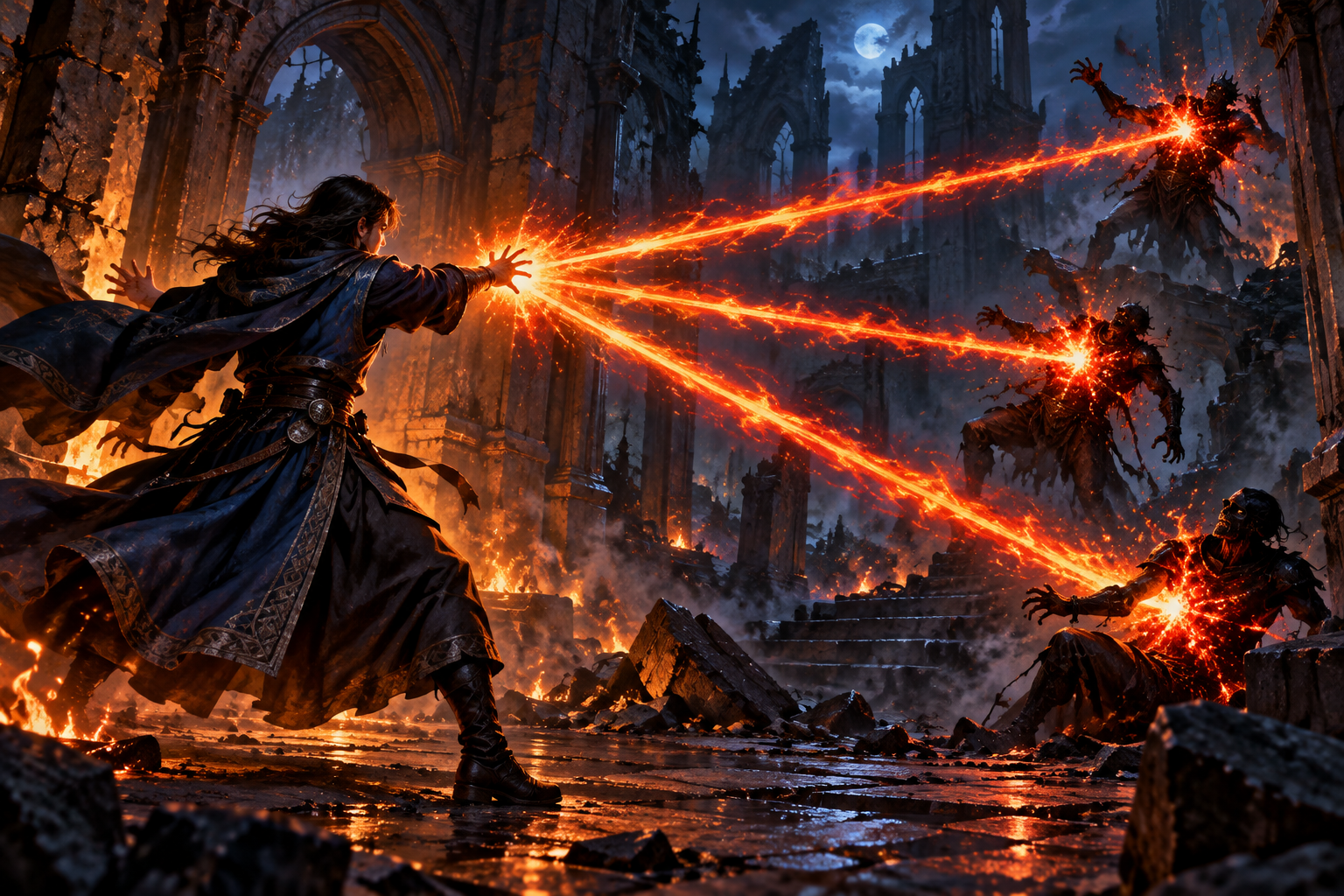
Scorching Ray 5e — Quick Spell Reference
| Casting Time | 1 action |
|---|---|
| Range | 120 feet |
| Components | V, S |
| Duration | Instantaneous |
| Concentration | No |
| Ritual | No |
| Classes | Sorcerer, Wizard |
| Source | Basic Rules (2014), pg. 273 |
How Scorching Ray Works
The caster creates three rays and makes a separate ranged spell attack for each one. A ray deals 2d6 fire damage on a hit and no damage on a miss. The spell has no saving throw and does not deal half damage when an attack misses.
The rays can all attack one target, attack different targets, or be divided in any other combination. Every target must be within 120 feet. Because each ray has its own attack roll, one ray can hit while another misses.
If all three rays hit the same target, the spell deals a total of 6d6 fire damage. Roll damage separately for each ray rather than treating the spell as one 6d6 hit.
Separate Attacks and Critical Hits
Each ray is its own ranged spell attack. Advantage, disadvantage, cover, and other attack-roll modifiers apply to each roll as appropriate. If a ray scores a critical hit, double the damage dice for that ray only; the other rays are unaffected.
Making a ranged spell attack while a hostile creature is within 5 feet of the caster normally imposes disadvantage, provided that creature can see the caster and is not incapacitated. This can affect every ray, even when the rays are aimed at a more distant target.
If several rays hit a creature that is concentrating, each hit is a separate instance of damage and can require its own Constitution saving throw to maintain concentration.
Splitting the Rays Between Targets
Dividing the rays can finish several weakened enemies, while concentrating them provides the greatest possible damage against one target. Separate attack rolls also reduce the spell’s all-or-nothing risk: a missed ray does not cause the other rays to miss.
Scorching Ray does not require the caster to see a target, but the normal rules for unseen targets and total cover still apply. Guessing an unseen target’s location can miss automatically, and a target behind total cover cannot be targeted directly.
Casting at Higher Levels
Using a spell slot of 3rd level or higher creates one additional ray for every slot level above 2nd. Each ray still deals 2d6 fire damage on a hit.
| Spell slot | Number of rays | Damage if every ray hits |
|---|---|---|
| 2nd | 3 | 6d6 |
| 3rd | 4 | 8d6 |
| 4th | 5 | 10d6 |
| 5th | 6 | 12d6 |
| 6th | 7 | 14d6 |
| 7th | 8 | 16d6 |
| 8th | 9 | 18d6 |
| 9th | 10 | 20d6 |
Upcasting adds attacks rather than increasing the damage of each ray. Every additional ray therefore requires another attack roll.
Limitations and Interactions
Fire resistance applies normally to the damage from each ray, and fire immunity prevents that damage. The spell does not state that it ignites flammable objects, so it does not gain the special ignition effect found in spells such as Fire Bolt.
Effects that add damage whenever a spell attack hits can apply to more than one ray if their own wording allows it. Effects limited to one damage roll, one attack, or one use apply only as their rules specify.
FAQ
Does Scorching Ray require concentration?
No. Its effects are instantaneous.
Can all three rays hit the same creature?
Yes. The caster can aim all the rays at one target or divide them among multiple targets.
Does Scorching Ray use one attack roll?
No. Make a separate ranged spell attack for every ray.
Does Scorching Ray deal half damage on a miss?
No. A ray deals damage only when its attack hits.
How many rays does a 3rd-level slot create?
Four. The spell creates one additional ray for each slot level above 2nd.