Arms of Hadar 5e: Damage, Reactions, and Escape Tactics
I like the tension built into Arms of Hadar: it rewards a Warlock for being close to danger, then offers a chance to get away. Its damage is only part of the decision. A failed Strength save also removes reactions briefly, but a successful save can leave the enemy ready to punish your retreat.
This guide uses the 2014 spell and tabletop rules, rather than a video-game adaptation.
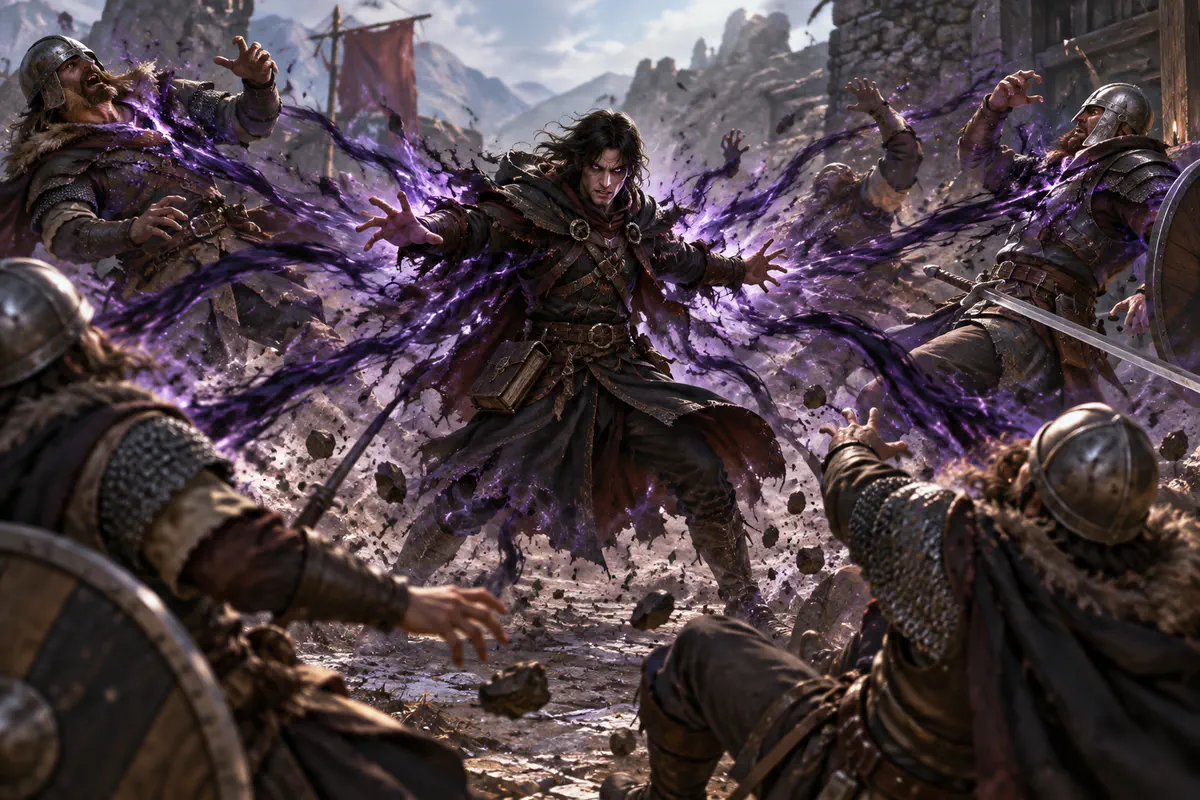
Arms of Hadar 5e — Quick Spell Reference
| Casting Time | 1 action |
|---|---|
| Range | Self (10-foot radius) |
| Components | V, S |
| Duration | Instantaneous |
| Concentration | No |
| Ritual | No |
| Classes | Warlock |
| Source | Player's Handbook (2014), pg. 215 |
Damage, Strength Saves, and Nearby Allies
Arms of Hadar produces a single close-range burst centered on you. Creatures in its 10-foot radius make Strength saving throws. A failed save deals 2d6 necrotic damage and prevents reactions until that target’s next turn. A successful save deals half the rolled damage, rounded down, and does not remove reactions.
It is a saving-throw spell, not a melee or ranged spell attack. Your spell save DC normally comes from your Warlock spellcasting ability: 8 + proficiency bonus + Charisma modifier. With Charisma 16 and proficiency +2, the DC is 13. Standing next to an enemy does not impose ranged-attack disadvantage on a saving throw.
Nearby allies are not automatically spared. The spell does not let you select only enemies, so check everyone’s position before casting. Total cover can exclude a creature under the general area-of-effect rules; being close enough on a flat map is not the only consideration. Our cover guide explains the relevant distinctions.
Necrotic damage is not poison, and losing reactions is not the poisoned, frightened, restrained, or stunned condition. Necrotic resistance changes damage; it does not by itself grant immunity to the separate reaction effect on a failed save.
When Does Reaction Denial End?
The limit ends when the affected creature’s next turn begins, not when your next turn begins. Initiative therefore matters. An ally acting before that enemy may exploit the reaction-free window; an ally acting after the enemy starts its next turn cannot assume the effect still protects them.
This can prevent an opportunity attack or another reaction whose trigger occurs during the window. It cannot undo a reaction already taken. An enemy also has an opportunity to Counterspell the casting before Arms of Hadar resolves, if the normal requirements are met; the spell does not preemptively switch reactions off before it has taken effect.
The tendrils do not remain as a zone. There are no repeat saves, ongoing attacks, grapples, or later damage ticks. The spell’s instantaneous duration and its brief reaction restriction describe different parts of the same resolution.

Can Arms of Hadar Replace Disengage?
It can make an escape possible while dealing damage, but it is not a reliable substitute for Disengage. Every enemy that would threaten your chosen path must either fail its save, lack an available reaction, or be unable to make the attack for another reason.
Example: two bandits are within 5 feet. One fails and the other succeeds. Both take damage, but only the first loses reactions. Walking out of the second bandit’s reach can still provoke. A third enemy outside the spell’s area is unaffected, even if your escape route later passes it.
Compare the choices before spending a scarce slot:
| Action | What it offers | What it does not guarantee |
|---|---|---|
| Arms of Hadar | Damage around you and reaction denial on failed saves | Safe movement past creatures that succeed or are outside the area |
| Disengage | Your movement avoids ordinary opportunity attacks for the rest of the turn | Damage, removal of other reaction types, or extra movement |
| Dash | More movement for the turn | Protection from opportunity attacks |
Your action is spent casting Arms of Hadar. You still need available movement to leave, and the spell does not end a grapple or increase your speed. If an enemy already has you grappled, removing its reaction does not release its grip.
Upcasting and Warlock Pact Slots
The damage adds 1d6 for each slot level above 1st. Radius, save ability, and the length of the reaction restriction do not increase.
| Slot level | Damage on a failed save | Average before saves/resistance |
|---|---|---|
| 1 | 2d6 | 7 |
| 2 | 3d6 | 10.5 |
| 3 | 4d6 | 14 |
| 4 | 5d6 | 17.5 |
| 5 | 6d6 | 21 |
A Warlock’s Pact Magic slots rise in level, so the spell uses that slot’s damage when cast through Pact Magic. That does not automatically make it your best use of a higher-level slot: the same slot could support another spell with stronger control or range. Count targets and consider their Strength saves before trading position for a larger burst.
These averages describe rolled damage before defenses, not expected damage against every creature. For example, rolling 7 damage means a successful save takes 3 before any additional applicable damage modifiers.
Arms of Hadar Versus Hunger of Hadar
Hunger of Hadar is a separate spell, not an upgraded form you get by increasing this spell’s slot. Arms is a brief, self-centered burst without concentration; Hunger creates a persistent area with its own range, damage timing, and concentration requirement.
Likewise, Arms does not push creatures like Thunderwave or choose a directional cone like Burning Hands. Its useful distinction is the combination of a surrounding burst and failed-save reaction denial. That is most attractive when it solves a problem you actually face, rather than when you deliberately run into danger solely to cast it.
Arms of Hadar FAQ
Does it require concentration?
No. Casting it need not end an existing concentration spell, although taking damage while moving through combat can still force concentration saves.
Can a target that succeeds still make an opportunity attack?
Yes, if its reaction is available and the ordinary trigger and other requirements are satisfied. Half damage is the only successful-save effect.
Can I choose a distant point for the burst?
No. Its origin is you. A higher slot does not extend its radius or move the origin to another creature.
Does Arms of Hadar immobilize enemies?
No. It has no speed reduction or restraint effect. A creature that loses reactions can still act and move normally on its own turn, subject to other effects.
Rules sources: Player’s Handbook (2014), p. 215; the official legacy listing requires book access, so its text was corroborated with a 2014 transcription. The licensed 2024 text was also checked; its central damage, save, scaling, and reaction-denial outcomes remain the same. General reaction and casting guidance follows the 2014 rules; examples and tactical comparisons are original analysis.
This work includes material taken from the System Reference Document 5.1 (“SRD 5.1”) by Wizards of the Coast LLC and available at https://dnd.wizards.com/resources/systems-reference-document. The SRD 5.1 is licensed under the Creative Commons Attribution 4.0 International License available at https://creativecommons.org/licenses/by/4.0/legalcode.