Owlbear 5e Guide: Creature Overview, Territory, and Forest Encounters
Rules baseline: 2014 D&D 5e, SRD 5.1. Use the for complete statistics. The territory, feeding response, layout, and morale below are original DM suggestions.
Monster overview
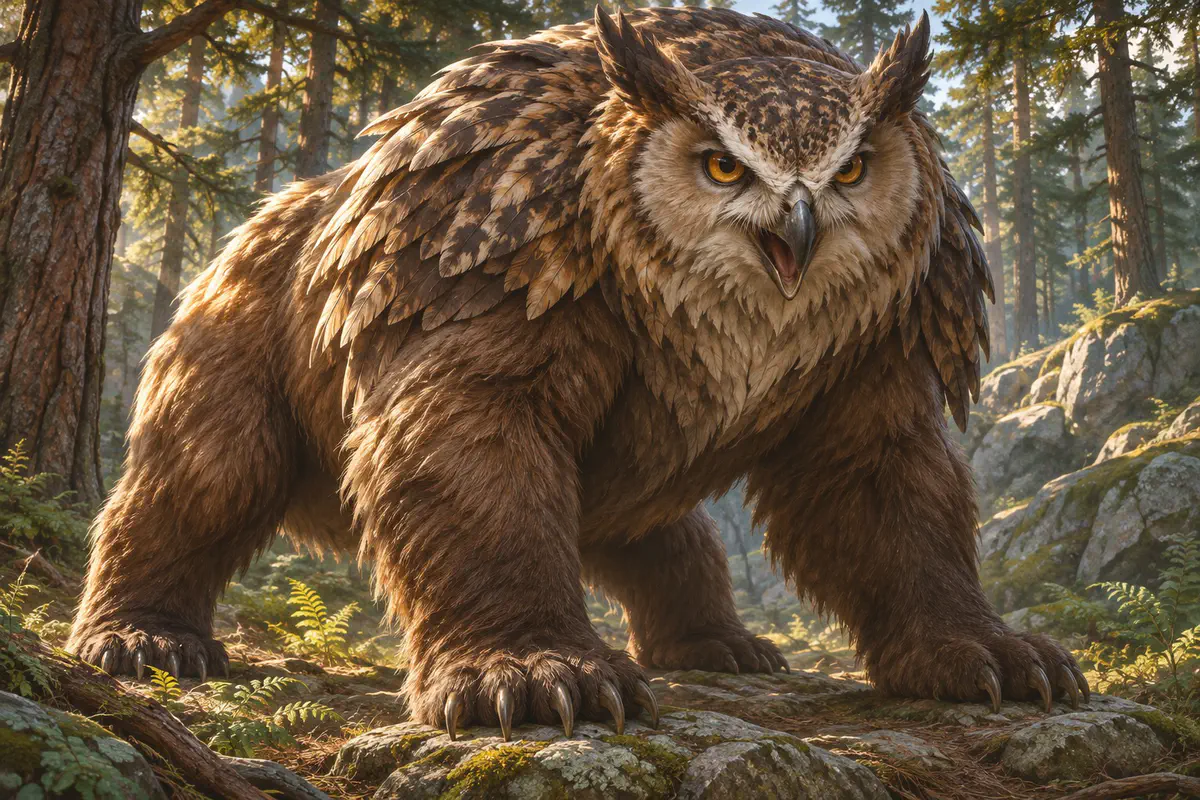
An owlbear combines the heavy body and claws of a bear with an owl’s broad head, hooked beak, and feathers. It is a Large monstrosity: a fantastic predator rather than an ordinary animal. Its appearance communicates strength immediately, while its sharp senses make it a convincing threat in woodland where travelers cannot see far ahead.
Use an owlbear when an adventure needs dangerous wildlife with a distinctly magical-world identity. Forest dens, overgrown ruins, and logging roads all give it room to hunt or defend territory. It need not be an enemy with a scheme. A hungry animal-like predator or a protective parent can obstruct a journey without becoming a villain the party must kill.
What to emphasize
The standard owlbear is CR 3, moves 40 feet, and uses Multiattack to make one beak attack and one claw attack. That speed makes casually outrunning it difficult for many adventurers. Its attacks do not automatically grapple or knock targets prone; resolve the actual attack entries rather than adding a bear hug for free.
Keen Sight and Smell grants advantage on Wisdom (Perception) checks using those senses. It does not automatically defeat every stealth attempt. Work out the cover, distance, wind, and method, then apply the normal stealth and hiding rules.
Creature type matters. The 2014 animal friendship and speak with animals spells target beasts; an owlbear is a monstrosity. A conventional 2014 druid’s Wild Shape also uses beasts. Describe its animal-like behavior freely while keeping those targeting requirements intact. A successful interaction can still come from an effective plan rather than an ineligible spell.
Establish territory before initiative
Show claw marks on trunks, feathers caught in bark, and a broad trail between a den and a feeding site. A protective adult can first display, hoot, and block an approach. That warning creates a decision before the party stands within claw range.
Decide what causes aggression and what ends it. Here, approaching the cub causes the adult to attack, while withdrawing from its clearing ends pursuit. Those boundaries are prepared behavior for this encounter, not limits on every owlbear’s senses or movement.
Food can redirect attention without taming the creature. State how much time an offering buys and what behavior would interrupt it. An Animal Handling check, if appropriate to your ruling, should resolve a specific uncertain interaction rather than turn a wild monstrosity into a permanent companion.
Ready to run: the cub beside the cart
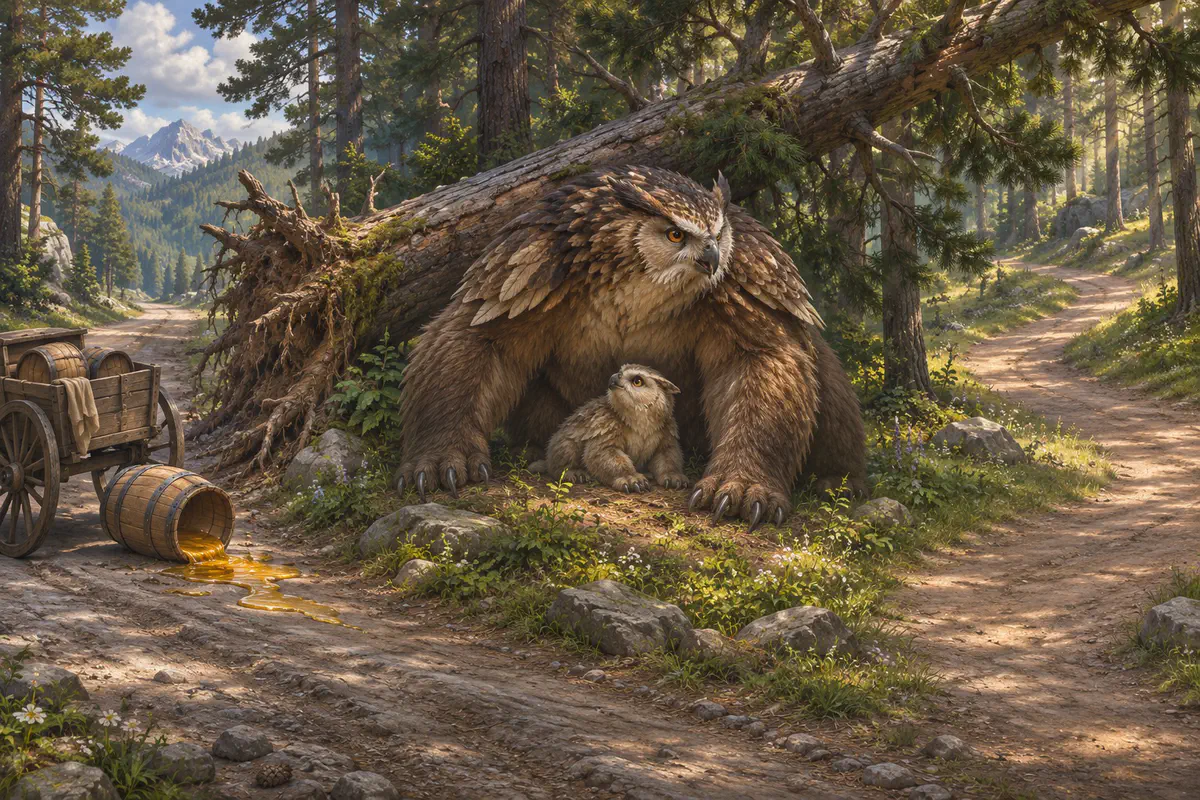
Situation: one adult owlbear guards its cub beside a fallen pine. A merchant abandoned a cart carrying honey when the pair emerged. The party can pass without recovering the cart, or help the merchant retrieve it. The cub is a noncombatant in this scene and contributes no attacks.
Layout: a 60-foot clearing contains a road along its western edge, the cart halfway down that road, and the fallen pine 20 feet east of the cart. A broad eastern trail skirts the clearing at least 40 feet from the pine, adding one hour of travel. Describe these distances from the southern approach.
Opening: the adult stands between the travelers and the cub, beating its claws against the fallen trunk. The merchant waits behind the party and identifies the detour. Nobody is surprised merely because the owlbear appeared in a forest.
Choices: taking the eastern trail without approaching the cub allows safe passage in this scenario. A substantial food offering placed well west of the cart draws the adult there for one minute if the party stays away from the pine. While it feeds, the merchant can lead the cart south; no check is needed for an unobstructed, unhurried withdrawal.
If combat begins: roll initiative. The adult uses its printed attacks against the closest threat to the cub. It stops pursuit when intruders withdraw beyond the clearing, provided they have not taken the cub. Announce the direction it is defending so retreat remains an understandable option.
Finish: recovering the cart earns the merchant’s agreed 25 gp reward. The detour costs time but preserves resources. Neither outcome makes the cub a pet, and the adult’s territory remains a fact for later journeys.
Prepare for your party
Check the encounter balancing guide before using this CR 3 creature against low-level characters. Easier: begin with the cart already outside the defended area. Harder: a broken wheel requires time to repair while the adult feeds. Record the bypass in the travel tracker and browse forest encounters for the next scene.