Astral Projection 5e: Silver Cords, Travel, and Risks
I’ve always found Astral Projection compelling because it makes planar travel feel like an expedition rather than a simple teleport. The party leaves its vulnerable bodies behind, crosses the Astral Plane in duplicated forms, and remains tethered to home by silver cords. That freedom comes with serious costs and risks, so the casting process and the ways the spell can end deserve careful attention.
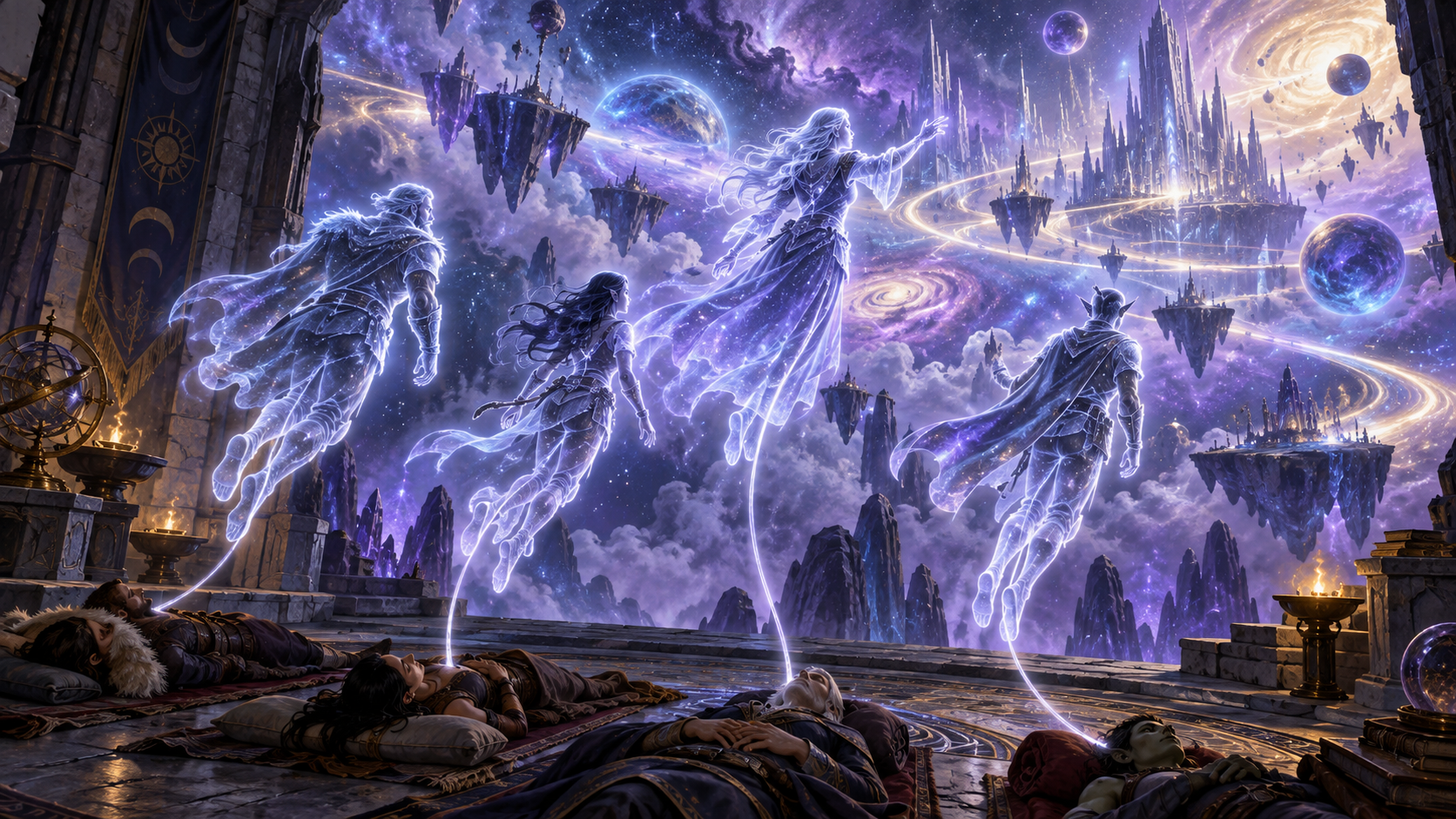
Astral Projection 5e — Quick Spell Reference
| Casting Time | 1 hour |
|---|---|
| Range | 10 feet |
| Components | V, S, M(one jacinth worth at least 1,000 gp and one ornately carved silver bar worth at least 100 gp for each affected creature; all are consumed) |
| Duration | Special |
| Concentration | No |
| Ritual | No |
| Classes | Cleric, Warlock, Wizard |
| Source | Player's Handbook (2014), pg. 215 |
How Does Astral Projection Work in 5e?
The caster and up to eight willing creatures within 10 feet project astral forms onto the Astral Plane. This allows a maximum of nine affected creatures when the caster brings eight companions. The casting fails without producing the intended effect if attempted while the caster is already on the Astral Plane.
Each creature’s physical body remains behind, unconscious and in suspended animation. It does not need food or air and does not age while the spell continues. Its astral form resembles the creature, replicating its game statistics and possessions, but it is a separate incarnation from the body.
The spell itself does not require concentration after it takes effect. Its duration is instead governed by its special ending conditions.
The spell projects only willing creatures, all of whom must be within 10 feet for the completed casting. A traveler brings along an astral copy of everything they are wearing and carrying; leaving an item beside the physical body keeps it out of that astral equipment.
Does Astral Projection Require Concentration?
Because the casting time is longer than one action, the 2014 spellcasting rules require the caster to spend an action on the spell each turn and maintain concentration throughout the full hour. If that concentration is broken, the spell fails and the spell slot is not expended, but the caster must start the casting over.
After the hour is successfully completed, concentration is no longer required. The caster can concentrate on a different spell while projected without ending Astral Projection.
How Much Does Astral Projection Cost?
Every affected creature requires its own jacinth worth at least 1,000 gp and its own ornately carved silver bar worth at least 100 gp. The spell consumes all of these components when cast, so including more travelers sharply increases the price.
| Affected creatures | Minimum component value |
|---|---|
| Caster only | 1,100 gp |
| Caster plus four companions | 5,500 gp |
| Caster plus eight companions | 9,900 gp |
The listed value is only a minimum. The required gems and carved bars must also be available; a spellcasting focus or component pouch cannot replace a material component with a stated price.

What Happens to the Physical Body?
Damage and other effects applied to an astral form do not affect its physical body and do not persist when the creature returns to that body. Conversely, attacking the unattended physical body does not directly reduce the astral form’s hit points. Reducing either the original body or the astral form to 0 hit points does, however, end the spell for that creature.
The suspended body is unconscious, not invulnerable. It should be left in a secure place and protected by creatures or defenses that are not traveling with the spell. Food, air, and aging are suspended, but the spell grants no general immunity to damage or other dangers.
The body remains on the plane where the casting took place until the astral form enters another plane or returns to the plane of origin. If enemies find that body, its unconscious condition makes it extremely vulnerable even though it does not need food or air.
Can a Silver Cord Be Cut?
Each astral form has a silver cord extending from between its shoulder blades. It trails for 1 foot before fading from sight and tethers that form to its physical body. An ordinary attack cannot simply target and sever the cord. It can be cut only by an effect that specifically says it can do so.
If the cord is cut, the creature dies immediately because its soul and body are separated. If the spell ends while the cord remains intact, the astral form returns to the physical body and the creature awakens.
The spell can end in several ways under the 2014 rules:
- The caster uses an action to dismiss it, ending it for the caster and the companions.
- A successful Dispel Magic cast on a creature’s astral form or physical body ends the spell for that creature.
- A creature’s original body or astral form falls to 0 hit points, ending the spell for that creature.
- An effect specifically cuts a creature’s silver cord, killing that creature.
If the caster returns to their body prematurely rather than dismissing the spell, the companions remain projected. Each must find a way to end the effect and return independently.
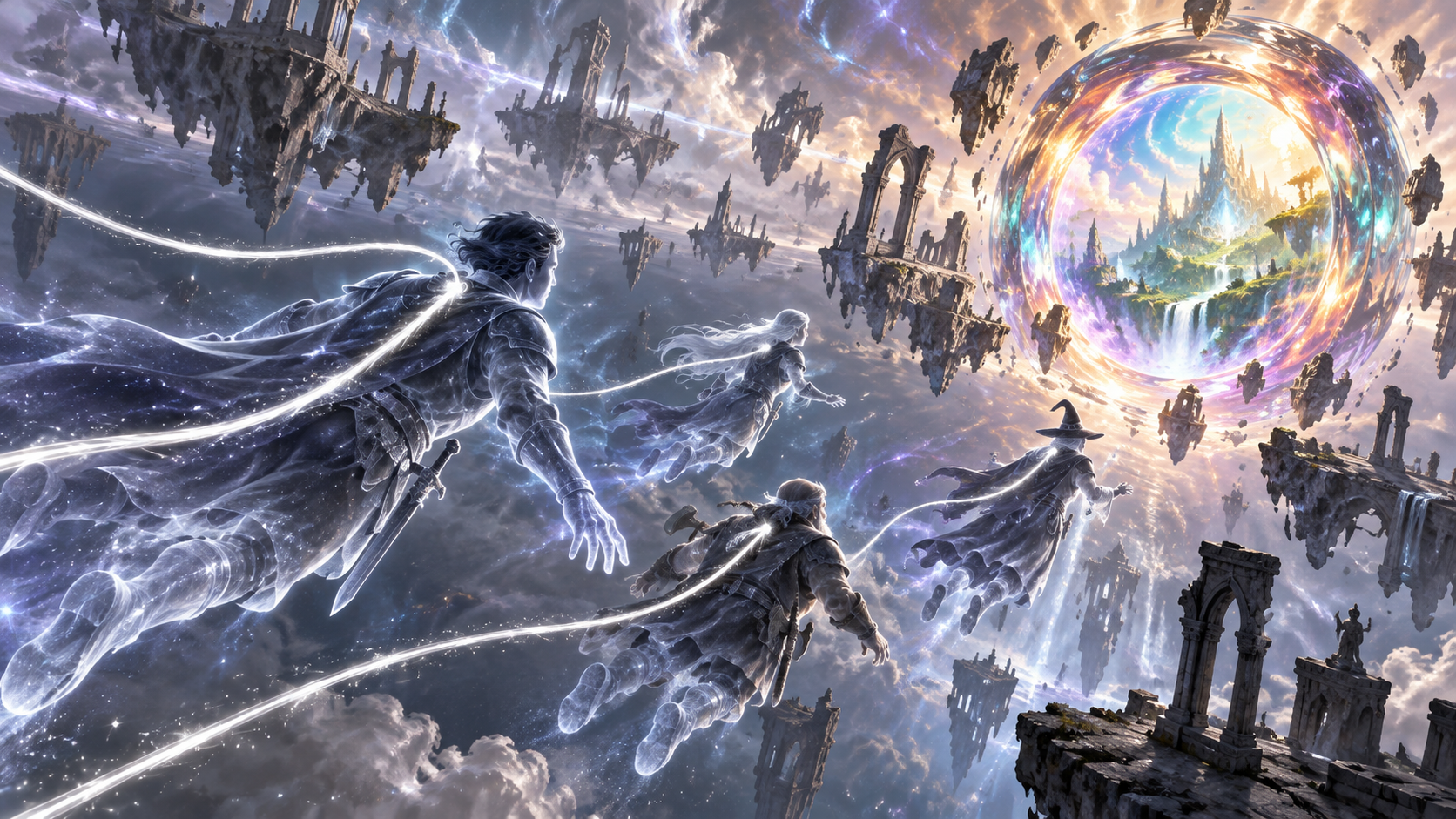
How Does Astral Planar Travel Work?
An astral form can move freely through the Astral Plane and pass through its portals to other planes. When a projected creature enters a new plane—or returns to the plane where the spell was cast—its physical body and possessions travel along the silver cord, and the creature re-enters that body at the destination.
This makes Astral Projection a group planar-travel method, but not an instant one. The spell does not state how quickly travelers will find a suitable portal or what they encounter on the journey. Those details depend on the Astral Plane, the adventure, and the DM’s adjudication.
Entering another plane is the important transition: the traveler’s original body and possessions move along the cord, and the astral form becomes a new physical body at the destination. The spell therefore does more than send a remote duplicate to spy; it can relocate the whole party across planes once a suitable portal is found.
Dispel Magic and Other Limitations
Astral Projection is a 9th-level spell, so ending it with Dispel Magic can be difficult. A 9th-level Dispel Magic succeeds automatically. When cast with a lower-level slot, its caster makes a spellcasting ability check against DC 19. The check targets the effect on one creature rather than automatically ending the projection for the entire group.
The spell has no higher-level benefit because 9th level is already the highest spell-slot level. It is also not a ritual, and its costly components are consumed on every completed casting.
Tactical Notes
The most important preparation is protecting the physical bodies. A concealed and defensible casting site, trustworthy guardians, and a plan for an early return are more valuable than treating suspended animation as protection.
The group should also decide how it will handle separation. A dispelled or defeated traveler returns alone, while an unexpectedly returned caster cannot simply dismiss the spell for companions who remain projected. The spell offers extraordinary reach, but its logistics are part of its risk.
FAQ
Does Astral Projection require concentration?
Not after it takes effect. The caster must maintain concentration during the one-hour casting process because of the general rules for long casting times, but the completed spell does not have a concentration duration.
Can an enemy cut a silver cord with a normal weapon?
No. A cord can be cut only when an effect specifically states that it can cut one.
Does damage to the astral form hurt the physical body?
No. Damage and other effects on the astral form do not affect the physical body or persist after returning. Reaching 0 hit points still ends the spell for that creature.
Can Dispel Magic end Astral Projection?
Yes. It can be cast against either the astral form or the physical body. Since Astral Projection is 9th level, a lower-level Dispel Magic requires a successful DC 19 spellcasting ability check.
Does the physical body travel to the destination?
Yes. When the astral form enters another plane or returns to the spell’s plane of origin, the creature’s body and possessions travel along the silver cord, and the creature re-enters that body.