How to Run Wilderness Travel in D&D 5e
A journey becomes interesting when the players choose how to reach their destination and those choices change what happens next. Rolling Survival every morning does not create that decision by itself. Give the party useful information, distinct routes, and a reason to care about the time or resources they spend.
This guide uses 2014 D&D 5e as its rules baseline. The journey procedure and example below are original DM tools, not additional official travel rules.
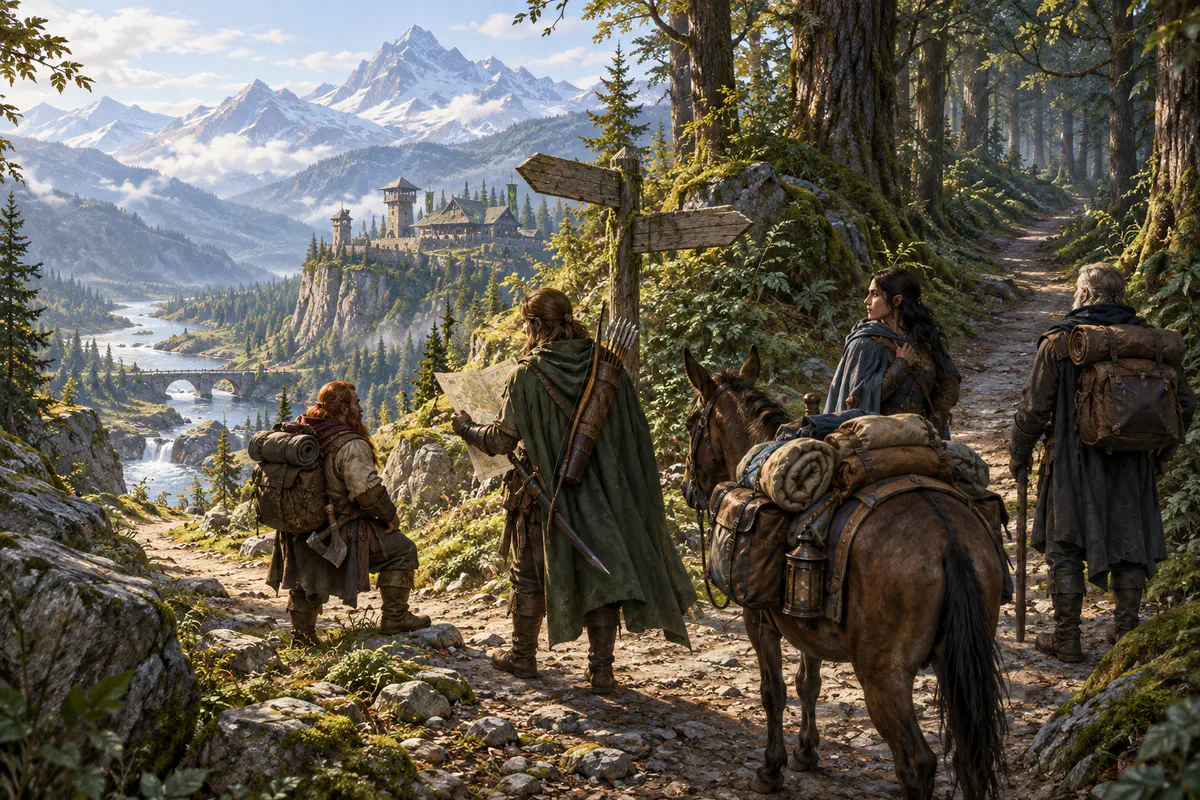
Wilderness travel: the quick procedure
- Establish the destination and what happens if the party arrives late.
- Offer two or three routes with visible tradeoffs.
- Ask for pace, navigation, and any special preparations.
- Describe ordinary progress briefly; play out the next meaningful obstacle.
- Resolve the players’ approach, update time and resources, and show the result.
- End the journey when its remaining decisions stop being interesting.
You can run a safe road in one sentence. A dangerous expedition might deserve several sessions. Match the attention you give travel to its importance in this adventure.
Start with a route decision
Avoid presenting three roads that all produce the same bandit fight. Change the demands of the journey: one route takes longer, one crosses hostile territory, and one requires leaving a wagon behind.
| Route | What the players know | Why choose it? |
|---|---|---|
| Maintained road | Longer; bridges and settlements | Reliable navigation, supplies, wagon access |
| Old forest trail | Shorter; a damaged river crossing | Speed, concealment, opportunities to negotiate with locals |
| Mountain shortcut | Exposed; no safe wagon passage | Avoid patrols, reach an unexpected entrance |
Do not conceal every disadvantage behind a check. A local guide can explain that the pass is exposed even if nobody rolls well. Checks can reveal additional details, such as where the shepherds keep an emergency shelter.
Connect routes to the adventure. A longer road might preserve resources but allow the villain to fortify the destination. Use time pressure when the deadline creates an actual choice, and tell players what their characters understand about it.
Use the travel rules when distance matters
In the 2014 rules, normal overland travel covers 24 miles in a typical day, fast travel 30, and slow travel 18. Fast pace reduces passive Wisdom (Perception) by 5; slow pace allows stealth when its circumstances permit. Difficult terrain halves the distance covered. These daily figures assume eight hours of travel; do not reconstruct them by multiplying rounded hourly distances.
Beyond eight hours, forced marching introduces Constitution saves and possible exhaustion. Do not add automatic exhaustion just because you describe rain or an unpleasant campsite. Apply the actual rules for whatever hazard is present. Likewise, resolve whether a rest qualifies under your table’s rules rather than treating every wilderness night as a lost long rest.
Use the 2014 travel rules or the travel section of SRD 5.1 when calculating a journey. If you use revised 2024 rules, check those separately rather than combining their pace and hazard procedures with this baseline.
Let characters choose useful jobs
Ask who is navigating, watching for threats, tracking, or foraging. Resolve conflicts when one person wants to do several jobs at once; do not grant every character every benefit automatically. The 2014 rules distinguish watching for danger from other travel activities.
A navigator’s failed check should change the journey in a way you can run: arriving at an unfamiliar river bend, losing an hour, or approaching from an exposed direction. Decide the consequence before rolling. If the route cannot plausibly be lost, skip the navigation check.
Track resources that create decisions
Before an expedition, agree on which supplies matter. Water, food, light, and transport capacity can be meaningful; recording every spoon rarely changes a choice.
A simple record can be enough:
| Track | Record | Update when… |
|---|---|---|
| Time | Current day and approximate hour | A route, obstacle, or rest changes arrival |
| Food and water | Actual provisions or agreed daily totals | The party consumes, finds, creates, or loses supplies |
| Transport | Who and what the animals or wagon carry | A crossing or terrain makes access relevant |
| Known danger | Patrol movements, weather, pursuit | Established events occur |
If a spell or class feature solves a resource problem, let it. The character has contributed. Shift attention to questions it does not solve: protecting a mule, finding a safe crossing, carrying an injured traveler, or arriving discreetly. Do not invent an immunity to the party’s solution simply to preserve your planned obstacle.
Choose encounters that change the journey
An encounter earns its place when it reveals information, changes a route, offers an opportunity, or asks the party to spend something meaningful.
A fallen bridge could require construction, a detour, or a negotiation for a boat. A wounded scout could offer a safer trail in exchange for an escort. Tracks could warn of something the players can avoid. Fighting need not be the default resolution.
Choose a scene from the forest, road, or mountain encounters and connect it to the current decision. If wolves attack, decide what they want and whether retreating, feeding them, or protecting the pack animals can end the scene. Do not run an unrelated battle simply because an hour passed.
For a sustained obstacle with several contributors, use the guidance on skill-only encounters. Make each action change the situation instead of asking for repeated rolls until somebody succeeds.
Ready-to-run journey: the medicine delivery
Premise: the party leaves Reedmarket at 8 a.m. carrying medicine to a ranger station. The messenger explains that a relief patrol departs at noon tomorrow; delivering beforehand lets that patrol carry the medicine onward. Arriving late still helps the station, but the party must organize another delivery.
Routes: the maintained road is 30 miles of easy terrain with a bridge and an inn. The forest path is 18 miles, of which 12 are difficult terrain and 6 are easy. Locals openly warn that its footbridge has washed away. This is an original adventure setup.
At normal pace, the road takes ten hours of walking, split across two days without forced marching. The forest route also takes ten hours: eight through difficult terrain and two on the easy section, before solving the crossing. The shorter distance is not automatically the faster route.
The crossing
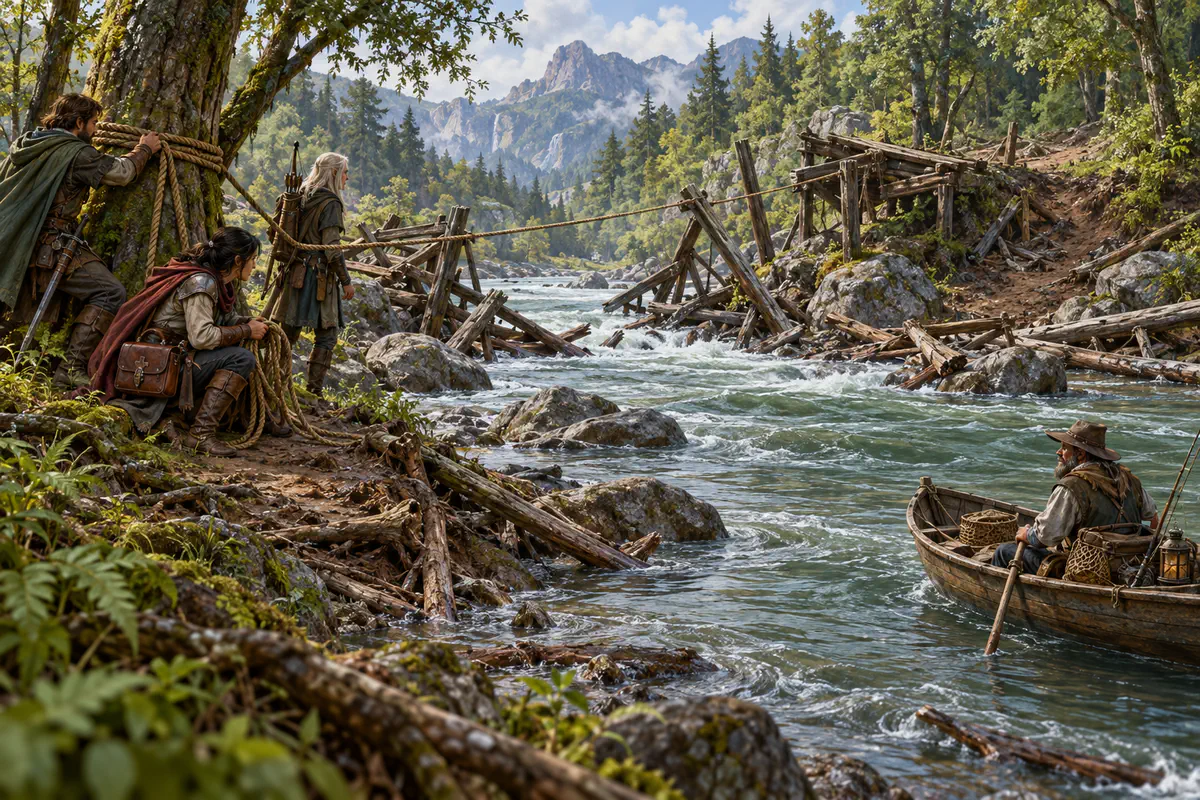
A 20-foot-wide stream separates two muddy banks. Floodwater has receded; a sturdy tree stands on each bank and a fisher waits downstream with a small boat. The broken footbridge is obvious without a check.
Offer these starting possibilities, then accept others:
- Hire the fisher: 5 gp buys passage for the party and medicine in 30 minutes. This price and timing are scenario details.
- Secure a rope crossing: allow one hour with suitable rope and a way to establish the far anchor. A prepared, secured crossing requires no check in these stated conditions.
- Find a ford: a DC 12 Wisdom (Survival) check finds one after an hour. Failure costs a second hour before the route rejoins the known crossing; explain that risk before rolling.
- Use magic: resolve the chosen spell’s actual range, targets, and carrying limits. A successful shortcut saves the time it genuinely saves.
Do not demand a dangerous swim after the party has built a secure solution. Conversely, someone attempting the stream without preparation needs an adjudication appropriate to the water; describe the current and downstream recovery options first.
Make the arrival reflect their choices
A party taking the road can rest at the inn after eight hours, then finish the remaining two hours of walking next morning. A normal long rest and an 8 a.m. departure puts arrival at 10 a.m., before the patrol leaves. The forest route adds its crossing time, so preparations matter. Fast pace can save time but changes awareness; use the pace rules if the party chooses it.
At the station, show the consequence: early delivery supplies the patrol, while late delivery creates a follow-up task. A missed deadline changes the next scene rather than erasing the adventure.
Common travel mistakes
Too many checks: roll when a plausible uncertainty has a consequence. Summarize routine progress.
Unknown deadlines: announce the information the characters have before asking them to trade safety for speed.
Every encounter attacks: include assistance, discoveries, negotiations, and threats that can be avoided. The social encounter guide can turn a roadblock into a conversation.
Punishing good preparation: rope, guides, maps, and magic should reduce difficulty when they address the problem. Let solving the journey be satisfying.
Journey preparation sheet
Before play, write: destination; deadline and consequence; two routes; known hazards; one person to meet; one obstacle; supplies that matter; and what changes on arrival. That is enough to run a short journey without preparing every mile.
Rules sources: 2014 travel and adventuring rules.
This work includes material taken from the System Reference Document 5.1 (“SRD 5.1”) by Wizards of the Coast LLC and available at https://dnd.wizards.com/resources/systems-reference-document. The SRD 5.1 is licensed under the Creative Commons Attribution 4.0 International License available at https://creativecommons.org/licenses/by/4.0/legalcode.