Barbarian Guide 5e: Builds, Subclasses, and Combat Tactics
A Barbarian wins fights by reaching dangerous enemies, surviving their attacks, and making every weapon swing count. Strength powers your offense, Rage helps you absorb punishment, and Reckless Attack lets you trade safety for accuracy. The interesting decisions are when to make that trade and how to keep enemies away from your allies.
This guide uses 2014 D&D 5e rules. The three builds use 27-point buy and identify any optional books or feats they require. Playing the revised class? Jump to the 2024 Barbarian comparison. Keep your class, feat, and subclass versions consistent with your table’s choices.

Barbarian quick build
For a straightforward 2014 character, start with a half-orc, Strength 16, Dexterity 14, and Constitution 16. Take Athletics and Perception from your class, choose Outlander for wilderness skills, and carry a greatsword plus javelins. Buy medium armor when you can afford it. At level 3, Bear Totem Warrior is a forgiving durability choice if your table allows the 2014 Player’s Handbook; Berserker is the SRD option, but its Frenzy has a substantial exhaustion cost.
Pick Barbarian if you enjoy committing to a target, making physical obstacles manageable, and protecting allies through positioning. Expect more difficulty with flying enemies and Wisdom saves. High hit points alone do not force an enemy to attack you.
Rage and Reckless Attack
How 2014 Rage works
You enter Rage with a bonus action on your turn. While raging without heavy armor, you gain advantage on Strength checks and Strength saving throws, a damage bonus on melee weapon attacks using Strength, and resistance to bludgeoning, piercing, and slashing damage. That resistance includes magical damage of those types; it is not restricted to ordinary weapons. See how resistance halves damage for rounding and overlapping protections.
Rage lasts up to 1 minute. Before Persistent Rage at level 15, it ends early if you fall unconscious or finish a turn without either attacking a hostile creature or taking damage since your last turn. Your attack does not have to hit. A thrown javelin attack can keep Rage running even though it does not receive the 2014 melee-only Rage damage bonus. You can also end Rage on your turn with a bonus action.
You have two uses per long rest at level 1, three at level 3, four at level 6, five at level 12, and six at level 17. Level 20 removes that limit. A short rest does not restore 2014 Rage uses, although it lets you spend Hit Dice to recover hit points.
While raging, you cannot cast spells or maintain concentration. An ally can still concentrate on a spell affecting you. Rage is also separate from Reckless Attack: you can use either feature without the other.
When to use Reckless Attack
From level 2, decide whether to use Reckless Attack when making your first attack on your turn. It gives advantage on your Strength-based melee weapon attack rolls for that turn. Attack rolls against you then have advantage until your next turn. It does not improve your 2014 opportunity attacks or thrown weapon attacks.
Use it when landing your attacks is likely to remove a dangerous enemy, when another source already gives enemies advantage against you, or when opponents mainly threaten you through saving throws. Be more cautious when several archers can focus on you, your hit points are low, or you already have advantage from another source. Multiple sources of advantage do not stack.
Accuracy example: with a +5 attack bonus against AC 15, an ordinary attack hits 55% of the time. Advantage raises that to 79.75%. That is a meaningful offensive gain, but Reckless may improve several enemy attacks in return. The right question is how much danger your extra accuracy removes before their turns arrive.

Ability scores, skills, and equipment
Ability score priorities
Put Strength first. Constitution improves hit points and Unarmored Defense. Dexterity 14 is a useful target for medium armor, initiative, and Dexterity saves; do not quietly abandon it in a shield build. Wisdom supports Perception and important saves against control effects.
| Ability | Practical target | Reason |
|---|---|---|
| Strength | 16 at level 1; work toward 20 | Attacks, damage, Athletics |
| Dexterity | 14 | Maximum normal Dexterity contribution to medium armor |
| Constitution | 14–16 initially | Hit points, Constitution saves, Unarmored Defense |
| Wisdom | 10–12 if possible | Awareness and resistance to mental control |
| Intelligence / Charisma | Spend for your concept | Skills and roleplaying; neither powers core attacks |
For a half-orc using the original 2014 bonuses, Str 14, Dex 14, Con 15, Int 8, Wis 12, Cha 8 costs 27 points. Adding +2 Strength and +1 Constitution gives 16, 14, 16, 8, 12, 8. The builds below spell out their own bonuses; they do not assume later optional rules for moving them.
Half-orc offers a useful survival feature and extra weapon damage on melee critical hits. A mountain dwarf supports a sturdy Strength/Constitution start. Variant human is attractive for a feat at level 1, but requires the optional human variant and feat rules. Choose a character you want to portray rather than treating those options as requirements.
Skills without wasted proficiencies
Athletics supports climbing, swimming, grappling, and shoving. Perception is a useful second class skill. Outlander supplies Athletics and Survival, so if your background and class both grant Athletics, use the 2014 duplicate-proficiency rule to select another skill proficiency. Our beginner build uses that replacement for Insight.
Intimidation can fit a forceful character, but it normally uses Charisma. The DM can call for a different ability with a skill when the situation warrants it; describing a physical threat does not automatically let you replace every Charisma roll with Strength.
Armor versus Unarmored Defense
Unarmored Defense is 10 + Dexterity modifier + Constitution modifier. It is an alternative AC calculation, not a bonus added to armor. You can use a shield with it. Our Armor Class guide explains how to choose between calculations.
For Dexterity 14 and Constitution 16:
| Equipment | AC | Cost / tradeoff |
|---|---|---|
| Unarmored | 15 | No armor needed |
| Unarmored + shield | 17 | One hand occupied |
| Scale mail | 16 | 50 gp; disadvantage on Stealth |
| Scale mail + shield | 18 | 60 gp total; one hand occupied |
| Breastplate | 16 | 400 gp; no Stealth disadvantage |
| Half plate | 17 | 750 gp; disadvantage on Stealth |
Medium armor is often your best early upgrade. With Dexterity 14, Constitution 18 makes Unarmored Defense equal scale mail, and Constitution 20 makes it equal half plate. Armor and shields are purchases or treasure unless your chosen starting-money option covers them: the 2014 Barbarian equipment package supplies neither.
Which weapon should you carry?
| Weapon plan | Choose it for | Main tradeoff |
|---|---|---|
| Greatsword or maul | Straightforward damage: 2d6 averages 7 before modifiers | No shield; two hands needed when attacking |
| Greataxe | Axe fantasy and larger individual critical dice | 1d12 averages 6.5; critical features do not automatically make it best overall |
| Glaive or halberd | Reach and a Polearm Master plan | Wants feat investment and a free bonus action |
| Battleaxe or longsword + shield | More AC while keeping a one-handed attack | Lower damage; no free hand to grapple while holding both |
| One-handed weapon + empty hand | Grapple while retaining a weapon attack | Gives up shield AC |
Carry javelins for targets outside melee. Their normal range is 30 feet and long range is 120 feet; long-range attacks have disadvantage. They are a fallback, not a full solution to every airborne enemy. Review ranged combat and use cover when closing an exposed approach.
Barbarian progression: levels 1–20
These are 2014 Barbarian levels, not total character levels. Subclass features arrive at 3, 6, 10, and 14. The Rage Damage bonus is +2 through level 8, +3 at levels 9–15, and +4 from level 16.
| Level | What changes | What to decide or remember |
|---|---|---|
| 1 | Rage, Unarmored Defense | Choose weapon style; track two Rage uses |
| 2 | Reckless Attack, Danger Sense | Danger Sense helps visible Dexterity-save effects unless blinded, deafened, or incapacitated |
| 3 | Subclass; third Rage use | Commit to durability, protection, damage, or another specialty |
| 4 | ASI or optional feat | Strength is the uncomplicated default; weapon plans may favor a feat |
| 5 | Extra Attack, Fast Movement | Two attacks per Attack action; +10 feet speed without heavy armor |
| 6 | Subclass feature; fourth Rage use | Revisit tactics around the new feature |
| 7 | Feral Instinct | Advantage on initiative; if surprised, you can act normally on your first turn by raging before anything else |
| 8 | ASI or feat | Improve Strength or complete a weapon-feat pairing |
| 9 | Brutal Critical; Rage Damage +3 | Add one weapon damage die on a melee critical, not the weapon’s whole damage expression |
| 10 | Subclass feature | Review utility as well as combat benefits |
| 11 | Relentless Rage | At 0 HP while raging, a Constitution save may leave you at 1 HP; repeated uses raise the DC until a short or long rest |
| 12 | ASI or feat; fifth Rage use | Consider Wisdom-save protection if control is a recurring problem |
| 13 | Improved Brutal Critical | Two additional weapon dice on qualifying criticals |
| 14 | Subclass feature | Check reaction and bonus-action competition |
| 15 | Persistent Rage | Rage ends early only if you fall unconscious or choose to end it; its 1-minute limit remains |
| 16 | ASI or feat; Rage Damage +4 | Strength, Constitution, or a defensive feat |
| 17 | Improved Brutal Critical; sixth Rage use | Three additional weapon dice on qualifying criticals |
| 18 | Indomitable Might | A low Strength-check total can become your Strength score |
| 19 | ASI or feat | Finish the character’s priorities |
| 20 | Primal Champion; unlimited Rages | Strength and Constitution rise by 4, with maximums of 24 |
The most consequential early milestone is level 5. Delaying Extra Attack for a multiclass dip usually costs more than a beginner expects.

Which Barbarian subclass should you choose?
These recommendations are editorial judgments for typical 2014 campaigns, not a universal damage ranking. Berserker is in SRD 5.1; the others require the named books. Entries summarize choices and tradeoffs rather than reproducing their rules text. Check your subclass’s printed features for precise ranges, triggers, and restrictions.
| 2014-era subclass | Choose it if… | Main benefit | Main drawback | Comes online | Source |
|---|---|---|---|---|---|
| Berserker | You want a furious weapon attacker and accept a costly burst option | Frenzy adds bonus-action attacks; Mindless Rage later helps against charm/fear | Frenzy causes exhaustion; its attacks compete for your bonus action | 3; important defense at 6 | SRD 5.1 / PHB 2014 |
| Totem Warrior | You want forgiving durability or animal-themed utility | Bear at level 3 broadens Rage resistance to all damage except psychic | Surviving does not itself discourage attacks on allies | 3 | PHB 2014 |
| Ancestral Guardian | Protecting teammates is your main job | Ancestral Protectors pressures a struck enemy to attack you; Spirit Shield later protects an ally | Protection depends on triggers and positioning; Spirit Shield spends your reaction | 3; stronger protection at 6 | Xanathar’s Guide to Everything |
| Zealot | You want damage with little extra turn management | Divine Fury rewards a qualifying hit while raging | Its resurrection benefit depends on allies having access to revival magic | 3 | Xanathar’s Guide to Everything |
| Storm Herald | You want an elemental aura affecting nearby creatures | Repeatable aura effects | Small aura and bonus-action demands can limit impact | 3 | Xanathar’s Guide to Everything |
| Beast | You want a transforming warrior who can fight without a carried weapon | Natural-weapon choices change how you approach a fight | Different forms and their interactions need attention | 3; exploration benefits at 6 | Tasha’s Cauldron of Everything |
| Wild Magic | You enjoy unpredictable combat effects and supporting casters | Surges add variety; Bolstering Magic expands party support | You cannot plan around receiving one particular surge | 3; support at 6 | Tasha’s Cauldron of Everything |
| Giant | You want reach, size, and a real throwing-weapon plan | Giant’s Havoc expands presence; Elemental Cleaver develops weapon flexibility | Space and feature timing matter; its full weapon plan waits until 6 | 3 and 6 | Bigby Presents: Glory of the Giants |
| Battlerager | Spiked armor is central to your concept | Armor-based aggression | Equipment dependence and the printed setting/race restriction make it a niche recommendation | 3 | Sword Coast Adventurer’s Guide |
My default picks: Bear Totem for a forgiving first character, Ancestral Guardian for ally protection, and Zealot for a straightforward damage build. If your table uses only SRD material, take Berserker and treat Frenzy as an emergency resource rather than your normal opening move.
Why 2014 Berserker exhaustion matters
Choosing Frenzy when you rage gives you a bonus-action melee weapon attack on subsequent turns during that Rage, then one exhaustion level when it ends. It is not a free attack on the turn you enter Rage.
Under 2014 rules, one exhaustion level gives disadvantage on ability checks—including Athletics and initiative. Two halve your speed; three also give disadvantage on attacks and saving throws. Those effects accumulate. A qualifying long rest removes only one level, so repeated Frenzies can create a recovery problem across multiple days. Mindless Rage at level 6 is useful, but it does not remove that cost.
Do not import the revised Berserker’s exhaustion-free damage feature into this subclass unless your DM explicitly changes the rules.
Best Barbarian feats in 2014
Feats are optional in 2014. At levels 4, 8, 12, 16, and 19, taking one normally replaces an Ability Score Improvement. Increasing Strength is always worth comparing against a feat: it improves accuracy, damage, and Athletics without adding another trigger to track.
The following are short recommendations for 2014 PHB feats; consult the book for their complete benefits.
| Choice | When I recommend it | Cost or limitation |
|---|---|---|
| +2 Strength | First character, mixed weapon use, or frequent high-AC enemies | Delays a specialized feat plan |
| Great Weapon Master | Heavy-weapon damage, especially with Reckless Attack | Its optional −5 accuracy / +10 damage trade is situational; no Strength increase |
| Polearm Master | A glaive/halberd plan: bonus-action attacks and opportunity attacks when enemies enter your reach | Rage occupies that bonus action on the opening turn; later features may compete too |
| Sentinel | Stopping movement: a hit with an opportunity attack reduces the target’s speed to 0 for the turn | A single reaction cannot stop an entire group; competes with Spirit Shield |
| Resilient (Wisdom) | Wisdom-save proficiency and +1 Wisdom when mental saves repeatedly take you out of fights | Primarily defensive; timing depends on your campaign |
For a heavy-weapon specialist, Polearm Master followed by Great Weapon Master is a coherent plan. For a defender, Strength first is often better than collecting reaction features that all compete with one another. The 2014 Grappler feat is not necessary to grapple, and you can combine a grapple with a separate shove prone without it.
Great Weapon Master: a worked decision
Consider a level 5 Barbarian with Strength 16, a mundane greatsword, Rage, Reckless Attack, and the 2014 feat. Against AC 15, your +6 attack bonus hits with advantage 84% of the time. Using the penalty changes it to +1, which hits 57.75% of the time.
Ignoring critical-hit extra dice and bonus-action attacks, ordinary damage averages 0.84 × 12 = 10.08 per attack. Using the feat averages 0.5775 × 22 = 12.71. Against AC 20, those figures become about 6.93 versus 4.18: the accuracy penalty now loses damage. This comparison isolates the penalty’s effect; it is not a full subclass damage ranking. If an enemy needs only a small hit to fall, accuracy may matter more than maximizing average damage.
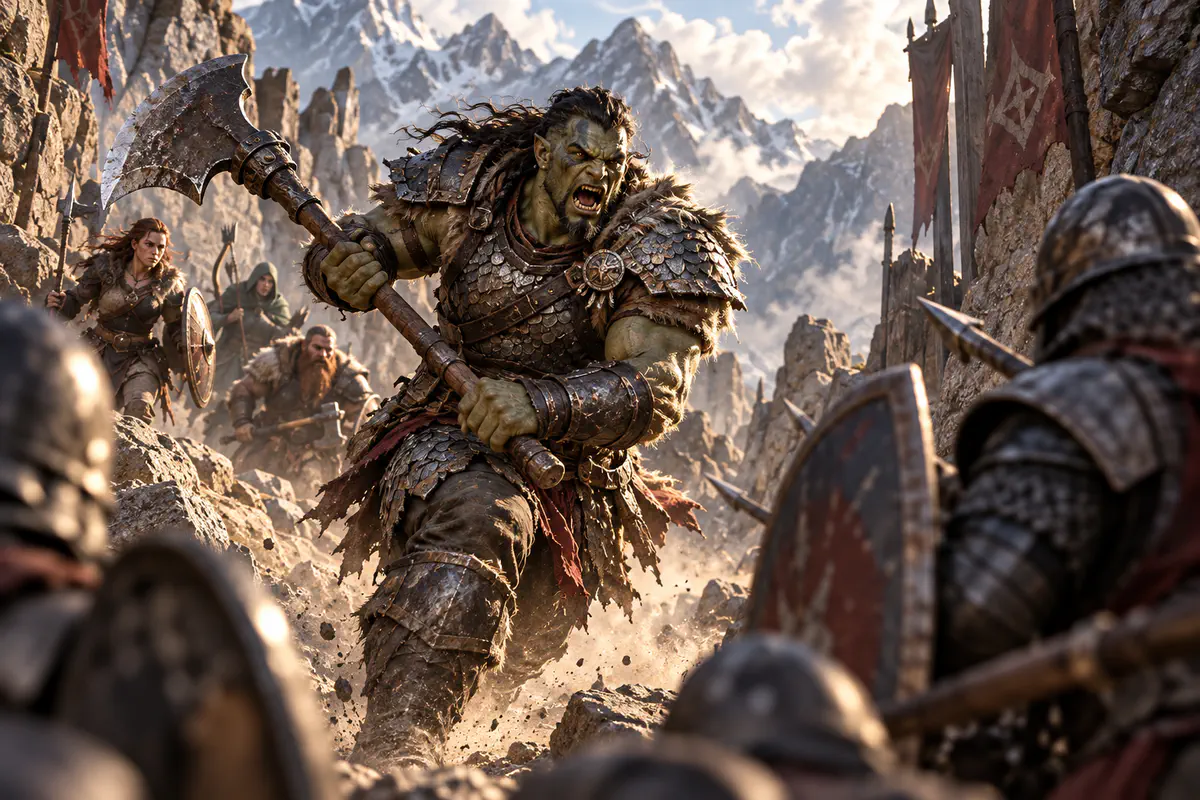
Three complete Barbarian builds
All three use 2014 class rules, ordinary starting racial bonuses, and 27-point buy. Scores are listed in Strength, Dexterity, Constitution, Intelligence, Wisdom, Charisma order. Begin at level 1 and take the listed subclass at level 3. Purchased upgrades are separate from starting equipment.
Beginner bruiser: Bear Totem half-orc
Goal: a durable character with straightforward turns. Requires the 2014 Player’s Handbook for Totem Warrior; no feats or optional class features required.
| Choice | Selection |
|---|---|
| Before racial bonuses | 14, 14, 15, 8, 12, 8 — costs 7 + 7 + 9 + 0 + 4 + 0 = 27 |
| After half-orc bonuses | 16, 14, 16, 8, 12, 8 |
| Background | Outlander: Athletics, Survival; replace duplicated Athletics with Insight |
| Class skills / racial skill | Athletics, Perception / Intimidation |
| Level 1 equipment | Greatsword instead of greataxe, two handaxes, explorer’s pack, four javelins; background equipment separately |
| First purchases | Scale mail (50 gp); shield (10 gp) and one-handed weapon if you want a defensive alternative |
| Level 3 | Totem Warrior, Bear option |
| Level 4 / 8 | +2 Strength / +2 Strength: Strength 18, then 20 |
| Level 12 direction | +2 Constitution, or Resilient (Wisdom) if feats are allowed and control is troublesome |
At level 5: scale mail gives AC 16, speed is 40 feet, and a raging greatsword hit deals 2d6 + 6. Move into contact, use your bonus action to Rage, and take two attacks. Reckless is a decision at your first attack, not something you declare separately for every swing.
Weakness: Bear resistance keeps you alive but does not compel enemies to engage. Use narrow approaches and threatening positions. A shield helps your AC, but switching equipment is a planned change of style, not a free toggle between every attack.
SRD-only alternative: Berserker uses the same scores and equipment. Your resistance stays limited to the three base types, and Frenzy needs an exhaustion budget.
Ally protector: Ancestral Guardian half-orc
Goal: reduce the danger to fragile teammates. Requires Xanathar’s Guide to Everything. The main advancement path works without feats.
| Choice | Selection |
|---|---|
| Before racial bonuses | 14, 14, 15, 8, 12, 8 — 27 points |
| After half-orc bonuses | 16, 14, 16, 8, 12, 8 |
| Background | Soldier: Athletics, Intimidation; replace racial duplicate Intimidation with Insight |
| Class skills | Perception, Survival |
| Level 1 equipment | Battleaxe instead of greataxe, two handaxes, explorer’s pack, four javelins |
| First purchases | Shield (10 gp), scale mail (50 gp) |
| Level 3 | Ancestral Guardian |
| Level 4 / 8 | +2 Strength / +2 Strength: Strength 18, then 20 |
| Level 12 direction | Resilient (Wisdom) if allowed; otherwise +2 Constitution |
At level 5: scale mail and shield give AC 18. A raging one-handed battleaxe hit deals 1d8 + 6. Put your first successful attack into the enemy most likely to hurt an ally so Ancestral Protectors applies to that target. At level 6, preserve your reaction for Spirit Shield when reducing an ally’s damage matters more than an opportunity attack.
Grapple mode: hold the shield and keep your other hand empty, or fight with the battleaxe and an empty hand instead of the shield. You cannot hold both weapon and shield and also grapple with an ordinary third hand. Donning or doffing the shield takes an action. With shield plus empty hand, grapple and shove can be your contribution, but you lack a held weapon for an ordinary armed strike.
Weakness: you are particularly good at limiting one threat, not controlling every enemy. Sentinel is an alternative feat investment, but its reaction demand overlaps with Spirit Shield.
Damage specialist: Polearm Zealot variant human
Goal: sustained melee damage from level 5 onward against targets you can reach. This is a focused damage recommendation, not a claim to be the best build in every encounter. Requires variant human, feats, the 2014 PHB, and Xanathar’s Guide to Everything.
| Choice | Selection |
|---|---|
| Before racial bonuses | 15, 14, 15, 8, 10, 8 — costs 9 + 7 + 9 + 0 + 2 + 0 = 27 |
| After +1 Strength / +1 Constitution | 16, 14, 16, 8, 10, 8 |
| Background | Soldier: Athletics, Intimidation |
| Class skills / human skill | Perception, Survival / Insight |
| Level 1 feat | Polearm Master |
| Level 1 equipment | Glaive instead of greataxe, two handaxes, explorer’s pack, four javelins |
| First purchase | Scale mail (50 gp); later half plate if affordable |
| Level 3 | Zealot |
| Level 4 / 8 | Great Weapon Master / +2 Strength: Strength remains 16 at 4, reaches 18 at 8 |
| Level 12 direction | Strength 20, or a defensive choice if staying active is the larger problem |
At level 5: a normal raging glaive hit deals 1d10 + 5; the Polearm Master bonus attack deals 1d4 + 5. Divine Fury adds its separate damage once on your turn when its conditions are met. The opening bonus action is Rage, so there is no polearm bonus attack that turn. On later turns, use that attack after your Attack action; a Great Weapon Master bonus attack, when available, competes for the same bonus action.
Reckless makes the feat’s accuracy trade more attractive, but apply the AC comparison above rather than using the penalty automatically. Its advantage lasts only during your turn in 2014, including when you make a polearm bonus attack; it does not carry into your reaction attack.
Weakness: this plan delays Strength increases, relies on melee access, and exposes you to extra hits. Its Wisdom 10 and limited protection from mental effects are real costs. When you need reliable hits or extra safety, turn off the damage penalty or attack without Reckless.
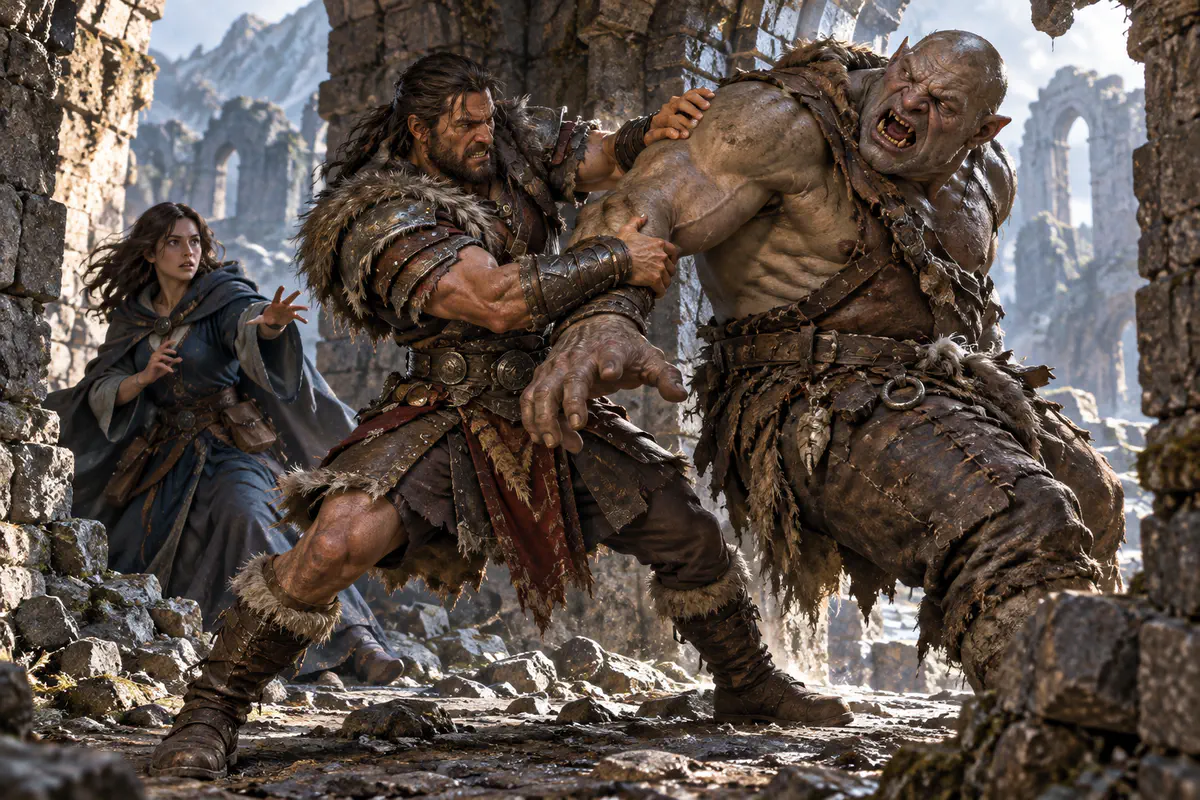
Combat decisions with examples
Deal damage or grapple?
In 2014, grappling replaces one attack in the Attack action. Use a free hand and contest your Strength (Athletics) against the target’s Athletics or Acrobatics. The target must be within reach and no more than one size larger. Rage helps your check. A grapple reduces speed to 0; it does not stop attacks, impose disadvantage, or end concentration by itself.
Level 5 example: an ogre is trying to reach your wizard. With an empty hand, replace your first attack with a grapple, then replace your second with a shove prone. If both succeed, its speed is 0 and it cannot spend movement to stand. Nearby melee allies gain advantage from prone, but attacks from farther than 5 feet have disadvantage. You traded your weapon damage for positioning and party accuracy; with several melee allies still to act, that can be worthwhile.
Against an enemy you can finish with one hit, damage is usually the better control. Against a Huge creature while you are Medium, this grapple plan is not legal without a feature that changes the size limit. Shoving also has a size limit, and it does not require a free hand.
Protect an ally without promising a taunt
A shield improves your defenses; it does not transfer attacks from the wizard to you. Guard a narrow approach, grapple a pursuer, or apply a subclass feature that penalizes attacking someone else. Even then, explain protection in terms of its actual rules rather than assuming enemies must choose you.
Know what your opportunity attack can do. Normally it costs your reaction and deals one melee attack; without an additional effect, it does not stop movement. Forced movement from a shove normally does not provoke. An enemy can also Disengage to avoid the ordinary trigger.
What if you cannot reach the enemy?
Before spending Rage, measure the distance and consider whether you will be exposed for a round. A javelin attack can maintain an existing Rage; Dash closes distance but may leave you without the attack or incoming damage needed to maintain 2014 Rage. You do not get a generic bonus-action Dash from Barbarian.
If enemies are firing from a defended ledge, use cover or find a different approach. You can Dodge when defense is more valuable than an unlikely hit, but Dodge alone does not maintain 2014 Rage. Against persistent flight, coordinate ranged damage, control spells, terrain, or a mobility item with your party.
When is Reckless safer than it looks?
If the only enemy still able to attack you already has advantage, Reckless adds no further accuracy benefit to that enemy. If it is attacking with a saving-throw effect instead, Reckless does not improve that effect. Conversely, several enemies making attack rolls can multiply the defensive cost. Evaluate the enemies that will actually act before your next turn.

Exploration and roleplaying
Athletics can make you the person who climbs first, secures a rope, swims a dangerous crossing, or moves a heavy obstruction. Not every physical task needs a roll: ask what preparation makes it reliable. Rage can help a short sequence of Strength checks, but outside combat the 2014 maintenance condition makes it unsuitable for a long climb. Ordinary carrying capacity also is not an ability check that advantage doubles.
Survival and an appropriate background give you a wilderness role. Perception helps you contribute on watch; vision and light explain why darkvision does not remove every visibility problem. For a stealthy approach, choose armor deliberately and work with the party’s hiding rules rather than assuming the Barbarian must always announce the group.
Give your character a reason to cooperate and a life beyond combat. A veteran might Rage through disciplined breathing; a guardian might invoke ancestral names; an athlete might enter a state of intense focus. Those descriptions use the same mechanics. Low Intelligence does not require foolish decisions, and low Charisma does not prevent you from speaking in a scene.
Two useful questions are: who can persuade you to stand down, and what will you protect even when victory is unlikely? Answering them gives the DM and your companions something to play with.
Should you multiclass?
For a first Barbarian, stay single-classed through at least level 5. Every detour delays subclass features, Rage progression, and eventually the level 20 Strength/Constitution increase. Multiclassing is optional and has ability prerequisites: Barbarian needs Strength 13, and you must also meet the other class’s requirements.
| 2014 option | What you gain | What you pay or must check |
|---|---|---|
| Fighter 1–3 | Fighting Style, then Action Surge, then a subclass such as Battle Master | One to three levels of delayed Barbarian advancement; avoid a concentration-dependent plan |
| Rogue 1–2 | Expertise, then Cunning Action | Dexterity 13 required; Sneak Attack needs a finesse or ranged weapon, although a finesse melee weapon can use Strength to retain Rage/Reckless synergy |
| Paladin 2 | Divine Smite can spend slots without casting a spell in the 2014 rules | Charisma 13 plus Strength 13, limited slots, and two delayed Barbarian levels |
The 2014 Paladin interaction is edition-specific. The 2024 Divine Smite is a spell, so you cannot cast it while raging. Do not carry a 2014 multiclass recommendation into the revised rules unchanged. The 2014 multiclass rules and 2024 Divine Smite provide the relevant references.
2024 Barbarian changes
This section compares the revised class in SRD 5.2.1 with the 2014 class above. It is not an instruction to mix their features. If you use older subclasses or backgrounds with the revised class, agree on the permitted versions and conversion rules before building.
| Topic | 2014 | 2024 |
|---|---|---|
| Rage duration | Up to 1 minute; attack a hostile creature or take damage to maintain it before level 15 | Initially lasts through your next turn; extend on subsequent turns by making an attack roll against an enemy, forcing an enemy save, or spending a bonus action; maximum 10 minutes |
| Rage recovery | All uses on a long rest | One expended use on a short rest; all on a long rest |
| Rage damage | Strength-based melee weapon attacks | Strength attacks with a weapon or Unarmed Strike, including qualifying thrown attacks |
| Rage advantage | Strength checks and saves | Still Strength checks and saves; not all Strength d20 tests |
| Reckless Attack | Strength melee weapon attacks during your turn | Strength attack rolls until the start of your next turn, including qualifying reaction or thrown attacks |
| Danger Sense | Visible effects; unavailable while blinded, deafened, or incapacitated | Dexterity-save advantage unless incapacitated |
| Weapon Mastery | No base-class mastery feature | Two melee-weapon masteries at level 1; more as you advance |
| Primal Knowledge | No equivalent in the base class | At level 3, another class skill and Strength substitution for selected skills during Rage |
| Instinctive Pounce | Not in the base class; an optional level 7 feature in Tasha’s | Base-class feature at level 7: move up to half your speed as part of entering Rage |
| Level 9 offense | Brutal Critical | Brutal Strike trades advantage on one eligible attack for extra damage and control on a hit |
| Grapple initiation | Athletics contest | Unarmed Strike option; target chooses a Strength or Dexterity save against 8 + your Strength modifier + proficiency bonus |
| Grappled enemy’s attacks | Grapple alone does not penalize them | Disadvantage against targets other than the grappler |
Revised weapons and feats
For a first 2024 two-handed character, greatsword Graze provides some damage on misses, while maul Topple can knock a target prone after a failed save. Greataxe Cleave is useful against adjacent enemies; pike Push helps reposition a target. Longsword Sap can reduce an enemy’s next attack accuracy, but it is not a taunt. Topple’s prone result helps nearby attackers and can hinder distant allies’ attacks, so coordinate with your party. Consult the SRD weapon and mastery entries for each property’s limits.
2024 backgrounds supply ability-score increases and an Origin feat. Soldier is a simple SRD choice with Strength/Dexterity/Constitution options and Savage Attacker. Orc is useful for mobility, but its bonus-action Dash competes with entering Rage. Goliath offers other mobility and ancestry choices. Do not assume a 2014 race’s bonuses apply on top of 2024 background increases.
The 2014 feat progression above also needs rebuilding: 2024 Great Weapon Master no longer uses the −5/+10 option; Polearm Master’s Reactive Strike is not an opportunity attack, so do not assume its old Sentinel combination works. General feats have prerequisites, and many include an ability increase. The revised Grappler rewards a dedicated free-hand plan; it does not solve the weapon-plus-shield hand conflict. Use the official feat listings with the correct book version selected.
Revised subclasses
| 2024 PHB subclass | Choose it for | Practical caution |
|---|---|---|
| Berserker | Simple damage: Frenzy adds d6s equal to your Rage Damage bonus on your first Strength hit on your turn when using Reckless during Rage | Reckless still exposes you; the old exhaustion cost is gone |
| Wild Heart | Animal-themed flexibility and situational defenses | Read the revised choices; do not assume 2014 Bear resistance carries over |
| World Tree | Ally support, battlefield repositioning, and later teleportation | Check feature levels before planning around movement tricks |
| Zealot | Divine offense with more emphasis on self-sustain | Its healing and high-level survival features differ from the 2014 subclass |
Berserker is the SRD subclass. The other three are summarized from the official 2024 Barbarian overview; use the 2024 PHB for their full rules.
Utility and higher-level changes
At level 3, Primal Knowledge lets a raging Barbarian use Strength for Acrobatics, Intimidation, Perception, Stealth, and Survival checks. That makes a short burst of scouting or tracking a real Rage decision. It does not replace every skill’s ability, and a noncombat Rage still needs extending. Medium armor’s Stealth disadvantage still applies when relevant.
At level 11, revised Relentless Rage restores hit points equal to twice your Barbarian level on a successful save instead of leaving you at 1. At level 15, revised Persistent Rage removes round-by-round maintenance and offers a once-per-long-rest Rage refill when rolling initiative; its early-ending rules also change. Level 19 grants an Epic Boon feat or another qualifying feat. These are reasons to compare higher-level class progression before assuming an old multiclass plan remains worthwhile.
Barbarian FAQ
Do I have to fight without armor?
No. Medium armor is often better than Unarmored Defense early on. You can use a shield with either, but heavy armor interferes with Rage’s benefits.
Can I Rage and use Reckless Attack on the same turn?
Yes, once you have Reckless Attack at level 2. Rage uses your bonus action; Reckless is a choice when you make your first attack on your turn. Neither requires spending your action to activate it.
Can I maintain 2014 Rage if I miss?
Yes. Attacking a hostile creature qualifies even on a miss. Taking damage also qualifies; merely being targeted by an attack that misses does not.
Is a Barbarian automatically a tank?
It is durable, but enemies can often move around it. Protection comes from positioning, grapples, subclass features, or particular feats. High AC alone does not make an enemy choose you.
Does Rage help me resist every damage type?
Base Rage resists bludgeoning, piercing, and slashing. A separate feature must supply other resistances. For example, base Rage does not halve psychic damage, a particular concern even for a 2014 Bear Totem character.
Rules sources
The main guide and examples use the 2014 class and combat framework in SRD 5.1. The revision comparison uses SRD 5.2.1. Calculations, recommendations, and example builds are original analysis using the assumptions stated beside them.
Non-SRD choices are identified by book: the 2014 Player’s Handbook for the variant human, Totem Warrior, and named PHB feats; Xanathar’s Guide to Everything for Ancestral Guardian, Storm Herald, and Zealot; Tasha’s Cauldron of Everything for Beast, Wild Magic, and optional class features; Sword Coast Adventurer’s Guide for Battlerager; and Bigby Presents: Glory of the Giants for Giant. Their short summaries are commentary, not complete feature text. Consult those books and the official 2014 Sage Advice Compendium for detailed interactions.