Sword Burst 5e: Area, Allies, and Cantrip Scaling
Sword Burst is the cantrip I look at when a spellcaster expects enemies to crowd them. It trades the safety and focus of a ranged cantrip for the chance to damage several adjacent creatures at once, but its inability to spare allies makes positioning every bit as important as the damage roll.

Sword Burst 5e — Quick Spell Reference
| Casting Time | 1 action |
|---|---|
| Range | Self (5-foot radius) |
| Components | V |
| Duration | Instantaneous |
| Concentration | No |
| Ritual | No |
| Classes | Artificer, Sorcerer, Warlock, Wizard |
| Source | Tasha's Cauldron of Everything, pg. 115 |
How Sword Burst Works
When the caster uses Sword Burst, every other creature within 5 feet must make a Dexterity saving throw. A creature takes 1d6 force damage on a failed save and no damage on a successful one.
There is no spell attack roll and no half damage on a successful save. Each creature rolls its own save, so one enemy can evade the blades while another fails. The spell is instantaneous and requires no concentration.
The range of Self means the effect is centered on the caster. It is not a point the caster places somewhere else, and effects that merely increase a spell’s range do not necessarily enlarge its 5-foot radius.
Does Sword Burst Hit Allies?
Yes. Sword Burst affects every creature other than the caster within the radius. The spell does not say the caster can choose targets, so nearby allies, friendly NPCs, mounts, and other creatures must save too.
That makes the cantrip best when the caster is surrounded primarily by enemies. Before casting it, I count every occupied space adjacent to the caster rather than assuming an area spell distinguishes friend from foe.
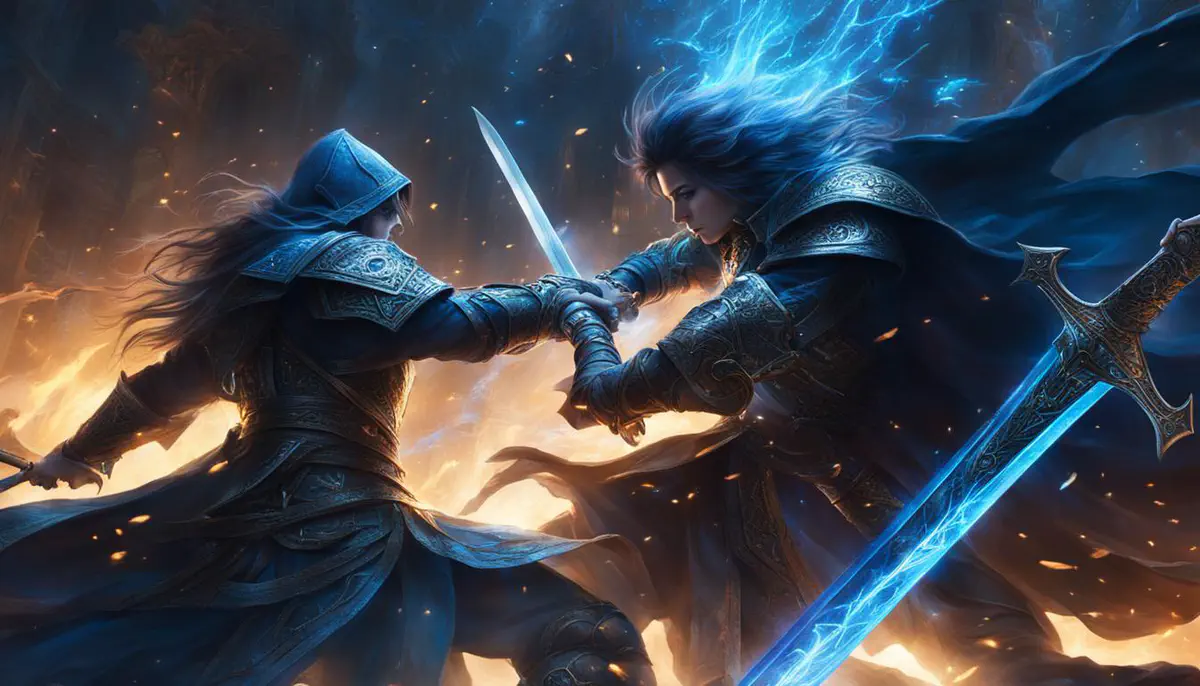
Area, Cover, and Targets
On a square grid, the 5-foot radius normally reaches the eight spaces surrounding a Medium or Small caster. Theater-of-the-mind positioning can be less exact, but the same principle applies: a creature must be within 5 feet when the spell resolves.
Sword Burst targets creatures, not unattended objects. It does not automatically cut ropes, damage doors, clear webs, or reveal an unseen creature by attacking an empty space. A hidden or invisible creature that is actually within the area can still be affected because the spell does not require the caster to see its targets.
Cover can matter to Dexterity saves when a creature has cover from the spell’s point of origin. The DM determines whether a barrier between the caster and a nearby creature provides cover.
Damage and Cantrip Scaling
Sword Burst deals force damage, a damage type resisted by relatively few creatures. Its damage increases with total character level, not spellcasting-class level and not the level of a spell slot:
| Character level | Damage on a failed save |
|---|---|
| 1–4 | 1d6 force |
| 5–10 | 2d6 force |
| 11–16 | 3d6 force |
| 17+ | 4d6 force |
The spell never uses a spell slot, and it cannot be upcast. Damage from Sword Burst can force a creature that is concentrating to make a normal concentration saving throw.
When Is Sword Burst Worth Casting?
Against one target, a higher-damage or ranged cantrip is often easier to use. Sword Burst becomes efficient when it can catch two or more enemies without catching allies. It is also useful when making a spell attack would be awkward, because every target makes a save instead.
The risk is proximity. Enemies close enough to be hit are usually close enough to attack the caster, and leaving their reach can provoke opportunity attacks. Sword Burst damages nearby enemies but does not push them away or protect the caster afterward.

Frequently Asked Questions
Can Sword Burst spare an ally?
No. Every creature other than the caster within 5 feet makes the save.
Does Sword Burst require a spell attack?
No. Each affected creature makes a Dexterity saving throw against the caster’s spell save DC.
Can Sword Burst hit an invisible creature?
Yes, if the creature is within the area. The spell does not require the caster to see affected creatures.
Does Sword Burst require a weapon or free hand?
No. It has only a verbal component, although the caster must still be able to speak that component.