Ogre 5e Guide: Heavy Hits, Readable Danger, and a Mill
Rules baseline: 2014 D&D 5e, SRD 5.1. Use the ogres entry in the complete SRD for statistics and exact trait wording. The motives, layouts, bargains, and morale choices below are original DM suggestions.

An ogre should change how a party approaches a place. Show its size, reach to nearby objects, and immediate desire before asking anyone to commit to a fight. A clearly dangerous obstacle gives players room to negotiate, scout, or prepare.
What to emphasize
The ordinary 2014 ogre hits hard but has no printed Multiattack. Use its listed weapon actions rather than granting a flurry of blows because it looks formidable. A low challenge rating does not make one strong hit safe for a fragile character.
Describe scale through the environment: a doorframe scraped by shoulders, a trough used as a bowl, or grain sacks stacked like cushions. Those clues communicate danger without having the ogre demonstrate it on a party member.
Terrain that offers decisions
Give the party somewhere to stand safely while they talk. A riverbank, sturdy balcony, or wide open exit makes conversation a real option. Explain where a large creature can move and which obstacles block a direct approach.
If the ogre damages an object, resolve that as a separate action using your established object rules. Do not turn one club attack into an automatic room collapse. Likewise, a barricade built by the party should have the benefit you agreed it would provide.
Make the ogre’s objective simple enough to act on, while allowing a distinct personality. It might want steady meals, payment, help with an uncomfortable shelter, or recognition of a promise. A simple demand can support several solutions.
Ready to run: grain for the mill keeper
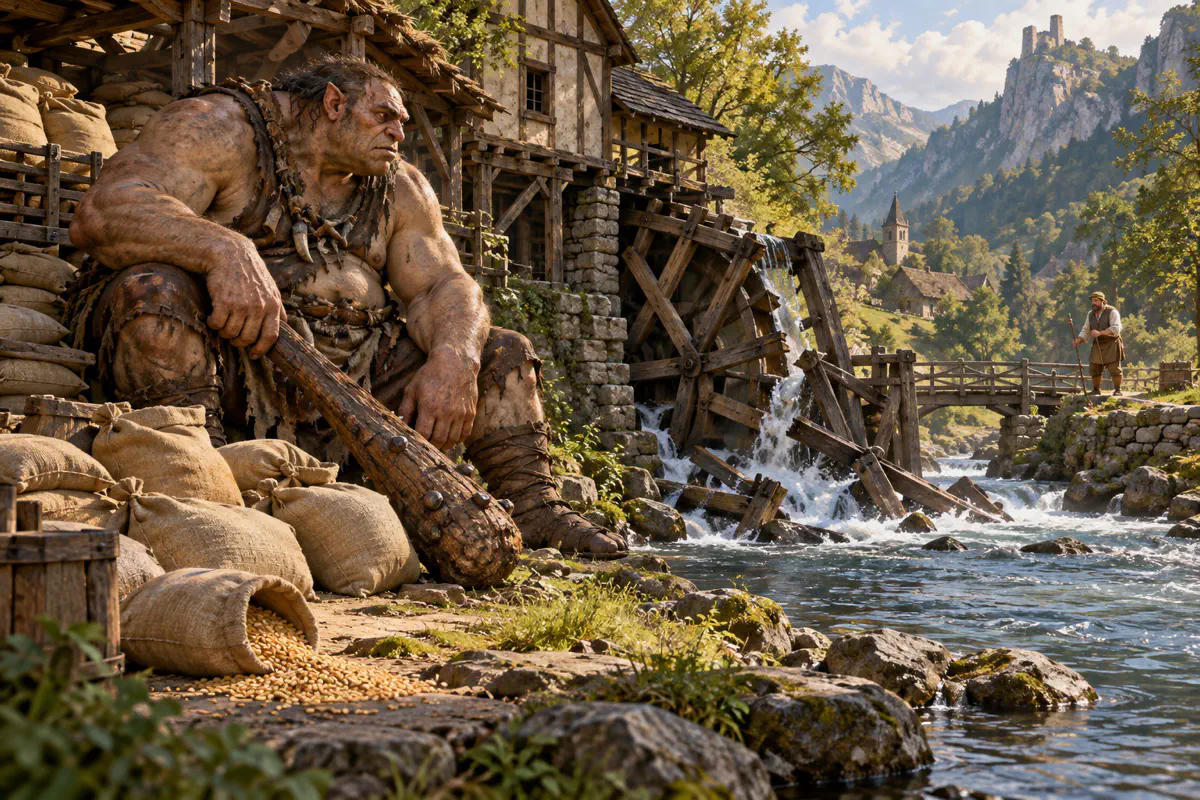
Situation: one ogre has moved into a mill and taken its stored grain. It wants regular food and believes the abandoned-looking building was free to occupy. The miller wants the grain returned before the next delivery.
Layout: the mill stands on the east bank of a shallow river. The party and miller can talk from the west bank. A sound footbridge crosses upstream. A broken waterwheel is visible beside the mill; the ogre has dragged grain sacks outside into a dry pile.
Opening: the ogre calls across the water, asking whether the visitors have brought something that tastes better than dry grain.
Choices: arranging a fair food delivery and another shelter persuades it to leave. Helping repair the wheel gives the miller a reason to negotiate employment moving heavy loads. A food-for-grain exchange can recover the immediate shipment while leaving the larger dispute for later.
If combat begins: roll initiative. The ogre uses its printed weapons, defending the grain rather than chasing retreating travelers indefinitely. It accepts a ceasefire when offered a credible way to keep eating.
Finish: a bargain restores the mill and creates a recurring local character. Taking the grain by force solves possession but leaves the damaged wheel. Easier: let the miller supply a convincing alternative meal. Harder: introduce an approaching delivery deadline; explain that clock openly instead of adding hidden attackers.
Prepare for your party
Use the encounter balancing guide before choosing numbers and positions. A creature’s challenge rating alone does not account for terrain, allies, or depleted resources. For more locations, browse environment encounters. Keep initiative and hit points visible during play, and return to Monster Guides for another creature.
This work includes material taken from the System Reference Document 5.1 (“SRD 5.1”) by Wizards of the Coast LLC and available at https://dnd.wizards.com/resources/systems-reference-document. The SRD 5.1 is licensed under the Creative Commons Attribution 4.0 International License available at https://creativecommons.org/licenses/by/4.0/legalcode.