Wraith 5e Guide: Creature Overview, Life Drain, and Haunted Places
Rules baseline: 2014 D&D 5e, SRD 5.1. Use the for complete statistics. The haunting, recognition condition, layout, and pursuit boundary below are original DM suggestions.
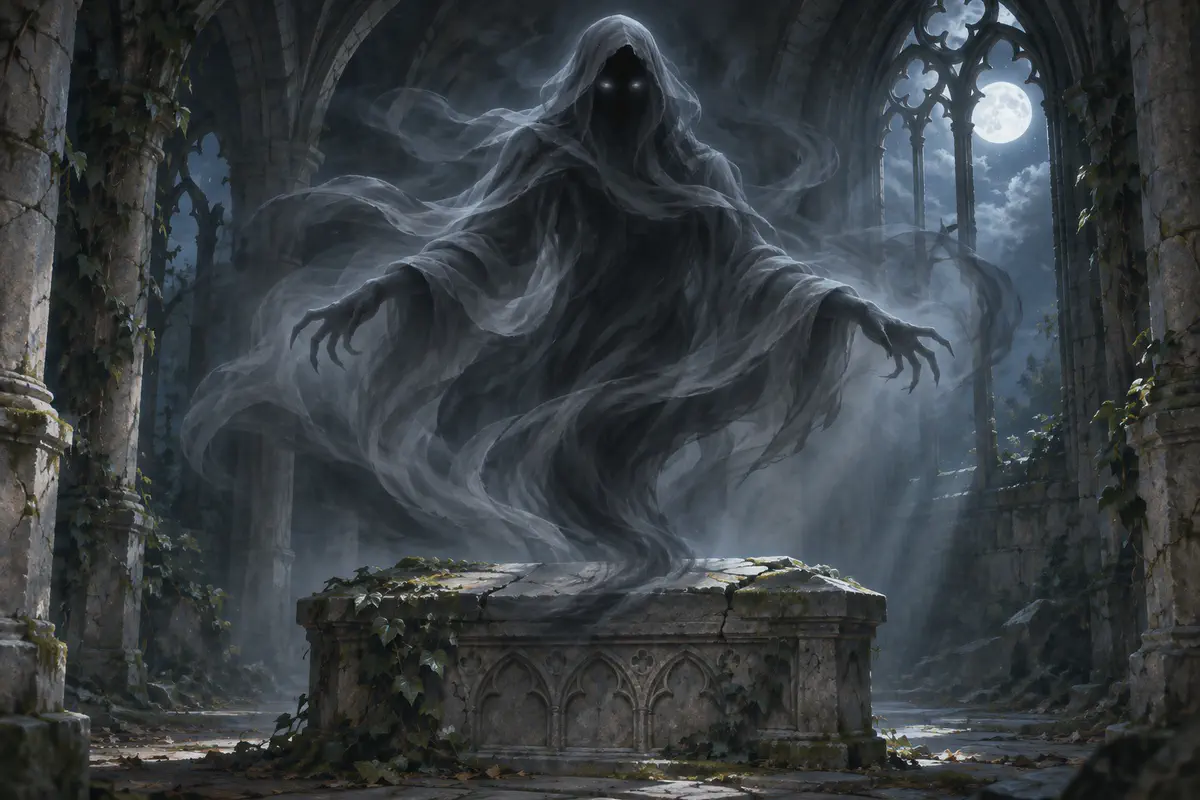
Monster overview
A wraith is an incorporeal undead creature: a hostile presence given a shadowy, almost humanoid form. Unlike a skeleton or zombie, it has no solid body to bar with a locked door. Its hovering movement, spectral appearance, and life-draining touch make it a threat to both the living characters and their sense of safety within ordinary walls.
Ruined shrines, battlefields, burial places, and abandoned estates suit a wraith’s atmosphere. Its ability to understand languages from life also gives a DM room for threats, recognition, or demands. A specific unfinished grievance is a useful adventure premise, but neither a universal wraith weakness nor a rule requiring every haunting to end when someone repairs a memorial.
What to emphasize
The standard wraith is CR 5, flies 60 feet with hover, and has several damage resistances and immunities. Check the actual entries: it is not immune to all weapon damage. Its resistance to nonmagical bludgeoning, piercing, and slashing specifically excludes silvered attacks. Radiant damage is not listed as a vulnerability that automatically doubles damage. See damage resistance when applying the party’s attacks.
Life Drain damages a target and calls for a DC 14 Constitution save. Failure reduces the target’s hit point maximum by the damage taken until it finishes a long rest. Track current hit points and the reduced maximum separately. Ordinary healing cannot exceed that maximum. The target dies if this effect reduces its maximum to zero; reaching zero current hit points is a different event.
Create Specter is a separate action, not an automatic consequence of every Life Drain hit. Its target must be a humanoid within 10 feet that died violently no more than one minute ago. The wraith can control at most seven specters at once. Adding eligible bodies to a fight can therefore change its difficulty substantially.
Use walls without losing the scene
Incorporeal Movement treats other creatures and objects as difficult terrain and deals force damage if the wraith ends its turn inside an object. It does not let the creature ignore line of sight when attacking. Describe where it emerges, resolve the attack from that position, and account for movement through the wall.
Ordinary doors are poor barriers, but visible retreat routes still help players choose a response. A haunting’s boundary can be a prepared behavior: this wraith refuses to abandon its memorial. State that through clues instead of pretending the chapel’s masonry physically imprisons it.
Sunlight Sensitivity applies its specified disadvantages in sunlight. Lantern light is not sunlight. Decide whether any magical light effect actually meets the relevant requirement before treating it as a countermeasure.
Ready to run: a name returned
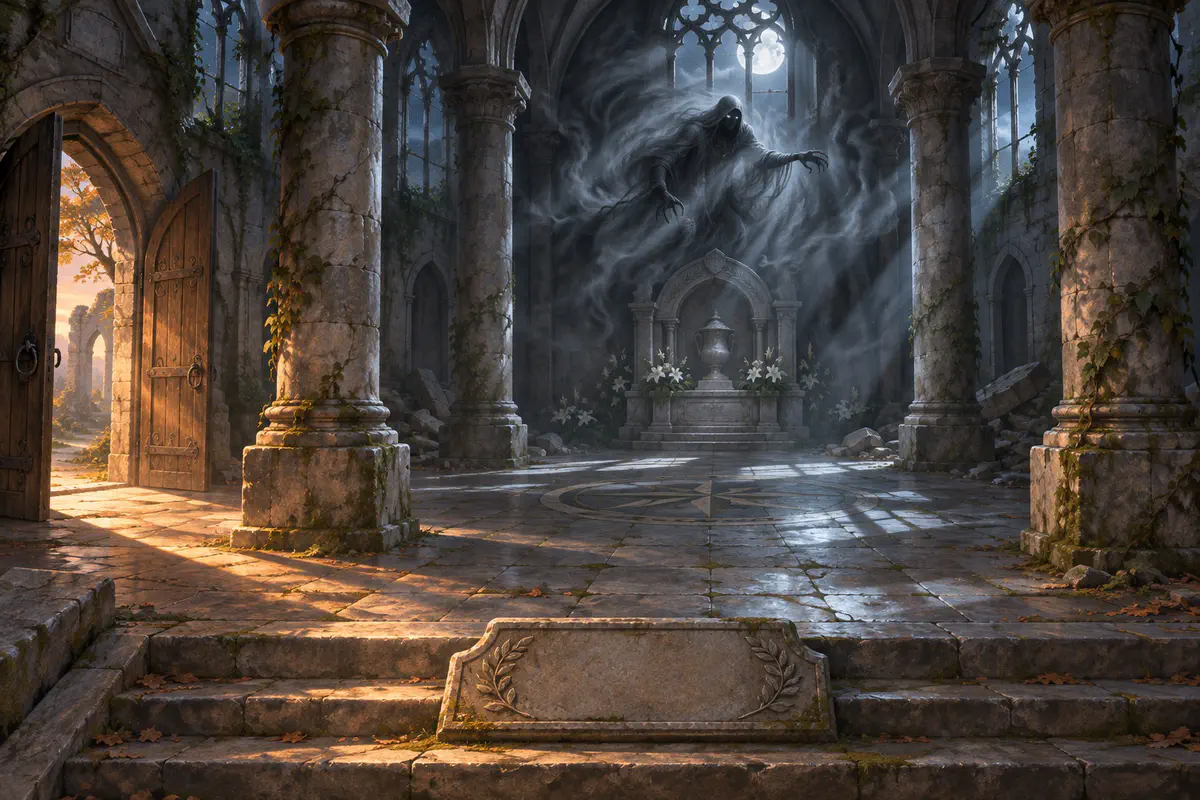
Situation: one wraith haunts a chapel after thieves tore a nameplate from its memorial. In this original scenario, restoring the plate and speaking the recorded name ends its hostility. The wraith has no existing specter allies, and no recently killed humanoids are in the chapel.
Layout: a 60-by-40-foot chapel has a broad southern doorway, four thick pillars, and a northern memorial niche. The plate lies on the southern steps. Its broken brackets match the empty space in the niche. A side aisle permits movement around the pillars, but no wall blocks the wraith’s passage.
Opening: from the niche it demands, in Common, that the living return what was stolen. The chapel ledger outside the doorway names the deceased and records the missing plate. Reading it and inspecting the matching brackets require no check once the party looks there.
Choices: carrying the plate openly and stating the intention to restore it makes this wraith wait while one character approaches. Fitting it into place and speaking the recorded name ends the encounter without a roll. The party can also withdraw before attacking and seek help. The peaceful resolution is specific to this haunting; it does not alter the standard monster’s statistics.
If combat begins: roll initiative. The wraith uses Life Drain, moves through pillars as allowed, and stays within the chapel grounds. Record maximum-hit-point reductions immediately. If a humanoid dies violently, check Create Specter’s actual requirements before the wraith spends an action on it. Restoring the memorial still offers a ceasefire if the party stops attacking.
Finish: the wraith ceases its attacks and fades from this site when the memorial is restored, as the resolution of this particular haunting. That does not automatically heal damage or remove an existing maximum-hit-point reduction. An old maintenance box contains the caretaker’s promised 60 gp reward.
Prepare for your party
Use the encounter balancing guide and account for depleted hit points, damage resistances, and possible specters. Easier: place the plate beside the niche so restoration takes little travel. Harder: recovering the plate first requires a separate investigation, with the wraith’s demand still clear. For a simpler undead encounter, use the ghoul guide or browse swamp encounters.