Hydra 5e Guide: Head Regrowth, Fire, and a Floodgate Encounter
Rules baseline: 2014 D&D 5e, SRD 5.1. Open the for complete statistics. The floodgate, terrain, and pursuit limits below are original suggestions.
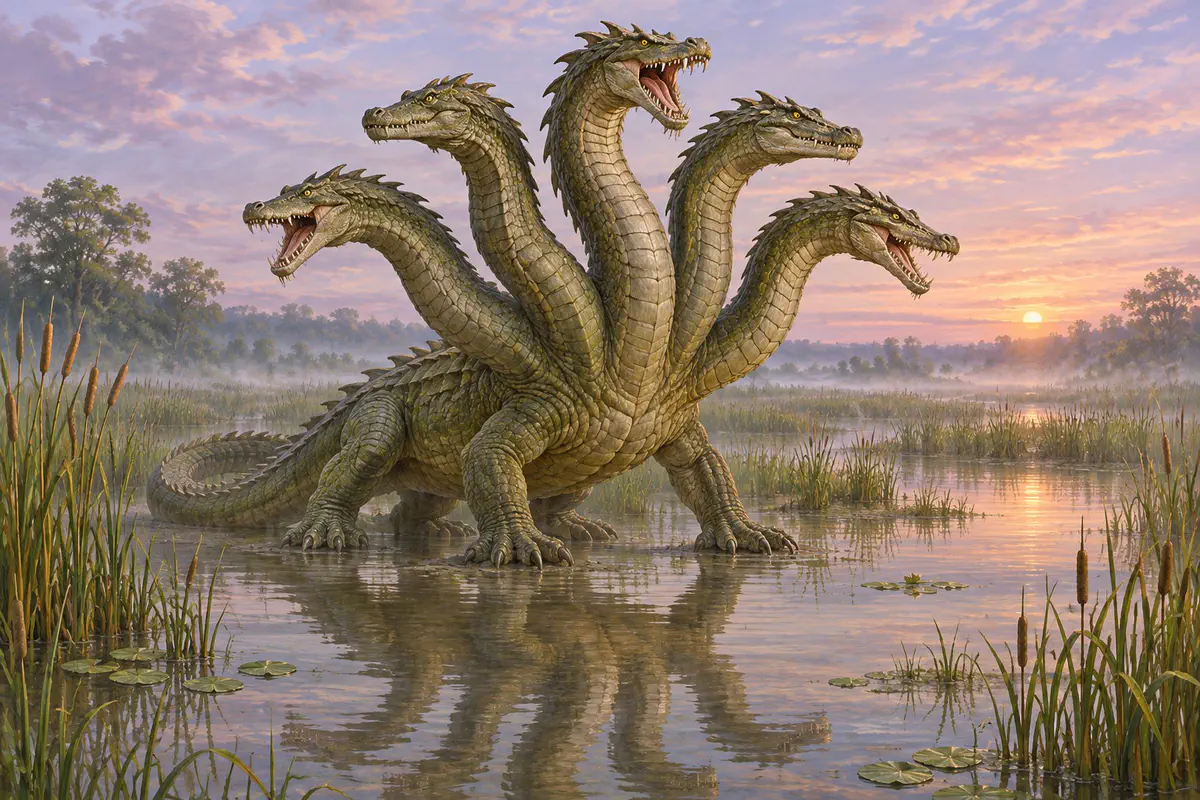
Monster overview
A hydra is a Huge monstrosity with a crocodilian body and several heads on long necks. The standard hydra starts with five heads. It swims as quickly as it walks and can stay submerged for up to an hour on one breath. A reed channel, drowned ruin, or flooded millrace lets it approach with most of its body hidden.
A CR 8 hydra makes a good set-piece monster because what the party does this turn changes the attacks it faces on the next. Let players see a head go down, and show what happens to the wound at the end of the hydra’s turn. They can use that information to decide whether to press the fight or finish their objective and get clear.
How to track heads and fire damage
Start with five living heads. When damage dealt to the hydra reaches 25 in a single turn, one head dies. Add damage from separate hits on the same turn. For example, hits for 14 and 12 on a fighter’s turn cost a head. If those amounts come on separate turns, neither reaches the threshold. Track the hydra’s hit points normally. It also dies if all its heads die.
At the end of the hydra’s turn, count heads lost since its last turn. It grows two heads and regains 20 hit points for each one lost during that interval, provided it took no fire damage in the interval. Fire can come from a different creature and a different hit than the one that killed a head. If fire suppresses regrowth at this check, those losses do not carry forward to a later turn.
For a quick record, write Heads 5 | Lost 0 | Fire no. Adjust Heads and Lost when a head dies. Mark Fire yes the first time it takes fire damage. Resolve the growth check at the end of the hydra’s turn, then clear Lost and Fire for the next interval. This keeps the head-loss threshold per turn and the regrowth check at the end of the hydra’s turn.
How heads change the fight
Multiattack makes one bite per living head, each with 10-foot reach. For every head beyond the first, the hydra also has an extra reaction it can use only for opportunity attacks. Several characters retreating from the same bank can each give it an opening. A character can move within the hydra’s reach without provoking for that movement, then use Disengage to leave it safely.
While more than one head survives, it has advantage on saves against several conditions, including being frightened or stunned. Check the stat block for the list. At least one head stays awake even while the hydra sleeps, so a quiet marsh at night does not guarantee an unguarded approach.
Ready to run: The Blackreed floodgate
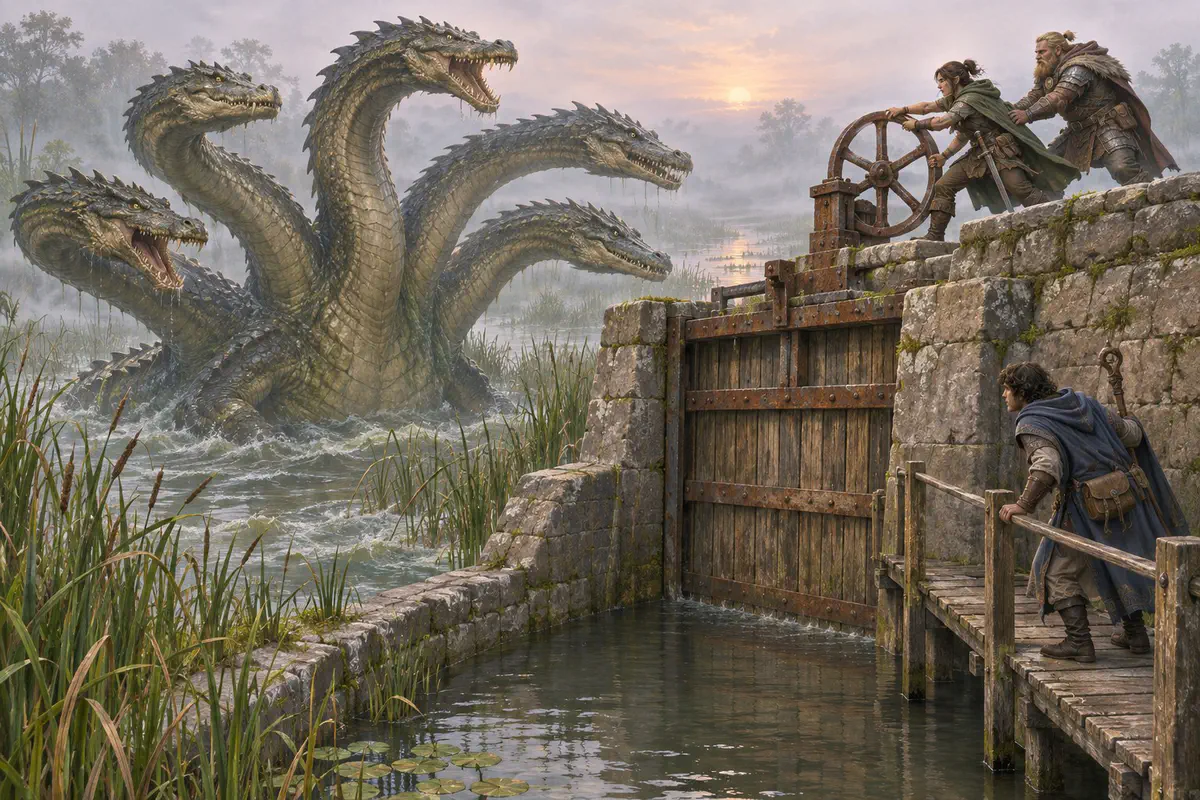
Situation. One hydra has moved into the feeder channel above a village. The open floodgate gives it a route to the lower millpond. The lockkeeper needs the party to close the gate and keep the creature upstream while the village shores up its banks.
Layout. The gate spans a 20-foot-wide channel. The hydra begins in a reed pool 35 feet upstream. The direct maintenance walk follows the near bank to a set of steps below the handwheel. A dry service path takes 80 feet from the entrance, runs behind a stone parapet, and comes out 20 feet back from the water at the wheel. A ramp upstream gives the hydra a way onto the dry bank.
Opening. The lockkeeper points out both approaches and shows the party a torn iron rail at the water’s edge. Five trails in the reeds converge just above the gate. The keeper hands over a flask of alchemist’s fire and reports that a wounded neck grew back on a previous attempt to drive the monster off.
Choices. The service path gives the party cover while they approach the wheel. At the wheel, an adjacent creature uses an action to release the lock pin, then an adjacent creature uses an action to wind the gate down. The two actions can come from different characters in the same round. No check is needed if they can reach the wheel and act. Characters on the maintenance walk can engage the hydra to draw its attention while others take the longer path.
If combat begins. Roll initiative as soon as the hydra notices prey on the exposed walk or a character attacks. It swims toward the nearest exposed creature it can reach, or uses the ramp if prey backs away onto the bank. Resolve its bites from its current head count and announce regrowth when it occurs. Closing the gate blocks the channel. In this scene, the hydra breaks off once prey leaves the embankment and retreats into the upstream reeds.
Finish. Closing the gate earns 200 gp and keeps the hydra out of the millpond. A retreat leaves the gate open. The lockkeeper evacuates the mill while the party regroups. If the party kills the hydra first, the floodgate still needs closing to protect the lower fields.
Prepare for your party
Use the encounter balancing guide before offering a straight fight. Five bites can overwhelm a character caught alone. For an easier objective, put the lock pin in the open position before the scene begins. For a harder objective, a snapped crank puts the manual release at the top of the exposed steps, so the party must secure the waterline to close the gate. The swamp encounter collection has follow-up scenes for the flooded road or the upstream search.