Blindness/Deafness 5e: Saves, Conditions, and Range
I’ve always liked Blindness/Deafness because it offers real control without occupying concentration. Blindness can swing a fight immediately, while deafness is a narrower tool with excellent situational uses. The target gets repeated saves, so the spell rewards careful timing rather than blind optimism.
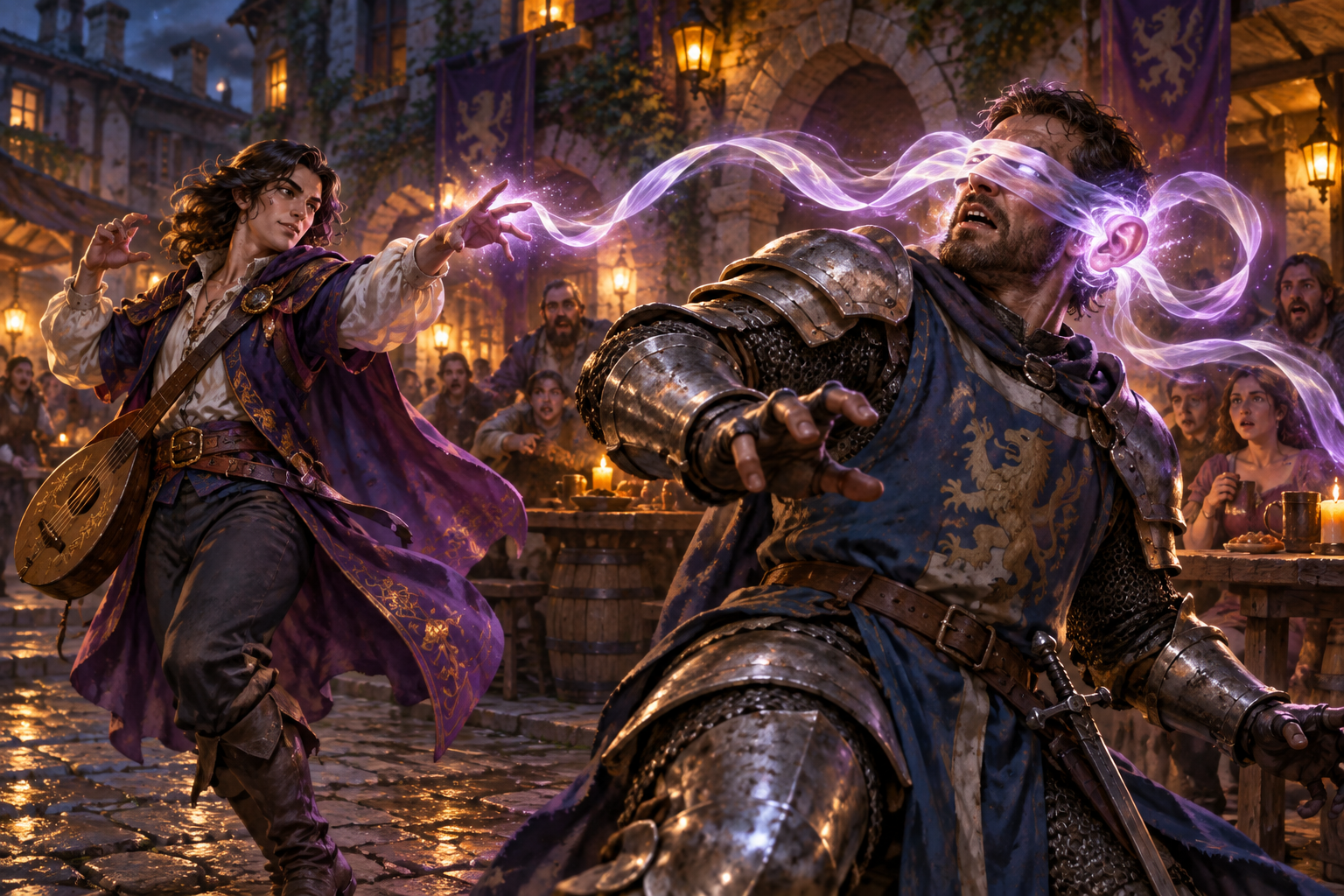
Blindness/Deafness 5e — Quick Spell Reference
| Casting Time | 1 action |
|---|---|
| Range | 30 feet |
| Components | V |
| Duration | 1 minute |
| Concentration | No |
| Ritual | No |
| Classes | Bard, Cleric, Sorcerer, Wizard |
| Source | Player's Handbook (2014), pg. 219 |
How Blindness/Deafness Works
Choose one creature you can see within 30 feet. It makes a Constitution saving throw. On a failure, choose whether it is blinded or deafened for up to 1 minute.
At the end of each of its turns, the target repeats the Constitution save. A success ends the spell on that creature. A successful initial save means the spell has no effect.
The spell requires only a verbal component and does not require concentration. You can maintain another concentration spell while Blindness/Deafness remains active.
What Does the Blinded Condition Do?
A blinded creature suffers three direct rules effects:
- It cannot see.
- It automatically fails ability checks that require sight.
- Its attack rolls have disadvantage, while attack rolls against it have advantage.
Blindness is usually the stronger combat option. It weakens the target’s attacks and makes it easier for the entire party to hit. It can also prevent spells and abilities that require the user to see a target or destination.
Blindness does not automatically stop every spell. A spellcaster can still cast a spell that does not require sight, provided it can satisfy the spell’s other requirements. Blindness also does not impose disadvantage on all saving throws.
What Does the Deafened Condition Do?
A deafened creature cannot hear and automatically fails ability checks that require hearing. The condition does not impose disadvantage on attack rolls, grant advantage to attackers, or prevent movement.
Deafness can still matter when hearing is central to a scene: stopping a guard from hearing an alarm, defeating a listening-based check, or interfering with communication. It does not create magical silence. A deafened creature can still speak and provide verbal spell components, even though it cannot hear its own voice.

Repeated Saving Throws and Duration
The target repeats its save at the end of each of its turns. If you cast the spell before the target acts, it still suffers the condition during that turn before receiving another chance to end it.
That makes initiative important. Casting immediately after the target’s turn gives your allies more time to exploit the condition before the first repeat save. Casting just before the target acts guarantees less time, but blindness can still hamper that upcoming turn.
The spell does not say that damage grants another save. Striking the target, moving it, or casting another spell on it does not end Blindness/Deafness unless that effect specifically removes the condition or ends the spell.
Upcasting Blindness/Deafness
For each slot level above 2nd, you can target one additional creature:
| Slot | Targets |
|---|---|
| 2nd | 1 |
| 3rd | 2 |
| 4th | 3 |
| 5th | 4 |
| 6th | 5 |
| 7th | 6 |
| 8th | 7 |
| 9th | 8 |
Each target makes its own initial save and its own repeat saves. You may choose blindness or deafness separately for each target because the choice is made for the creature affected.
Upcasting can be valuable because the spell still does not require concentration. However, Constitution is often a strong monster save, so targeting several resilient enemies can produce inconsistent results.
Tactical Uses
Blind a dangerous weapon user to protect the party and grant advantage on attacks against it. Blind a spellcaster when many of its best options require sight. Use deafness outside a straightforward damage race when secrecy, alarms, spoken orders, or sound-based perception matter.
The spell’s 30-foot range is a real risk in 2014 play. Position behind sturdier allies, and remember that you need to see the target only when casting; the text does not require continuous sight afterward.
Blindness/Deafness: 2014 vs. 2024 Rules
The 2024 version keeps the level, action, verbal-only component, 1-minute duration, no-concentration design, Constitution saves, condition choices, end-of-turn repeat saves, classes, and additional-target upcasting.
It changes two spell-table details:
- The school changes from Necromancy to Transmutation.
- The range increases from 30 feet to 120 feet.
The longer range makes the 2024 spell considerably safer to deploy. The main guidance and quick reference here use the 2014 rules.
Blindness/Deafness FAQ
Does Blindness/Deafness require concentration?
No. This is one of its main advantages, and being blinded or deafened does not itself break a creature’s concentration.
Can a blinded spellcaster still cast spells?
Yes, unless the spell requires the caster to see its target or otherwise depends on sight. Blindness does not generally remove spellcasting.
Does deafness stop verbal components?
No. Deafness prevents hearing; it does not prevent speech. Silence is a different effect.
When does the target repeat its save?
At the end of each of its turns. It remains affected through that turn, then ends the spell on itself if the save succeeds.
Can I choose different effects when upcasting?
Yes. Choose blindness or deafness for each affected creature rather than making one choice for the entire casting.
Which option is usually better?
Blindness is normally stronger in combat. Deafness is more specialized and shines when hearing, warnings, or detection are the real problem.