Death Saving Throws 5e: What Happens at 0 HP?
When an ally drops to 0 hit points, I check the turn order first. It tells the party who can reach them and whether there’s time to heal them before their next death save. This guide uses the 2014 D&D 5e rules.
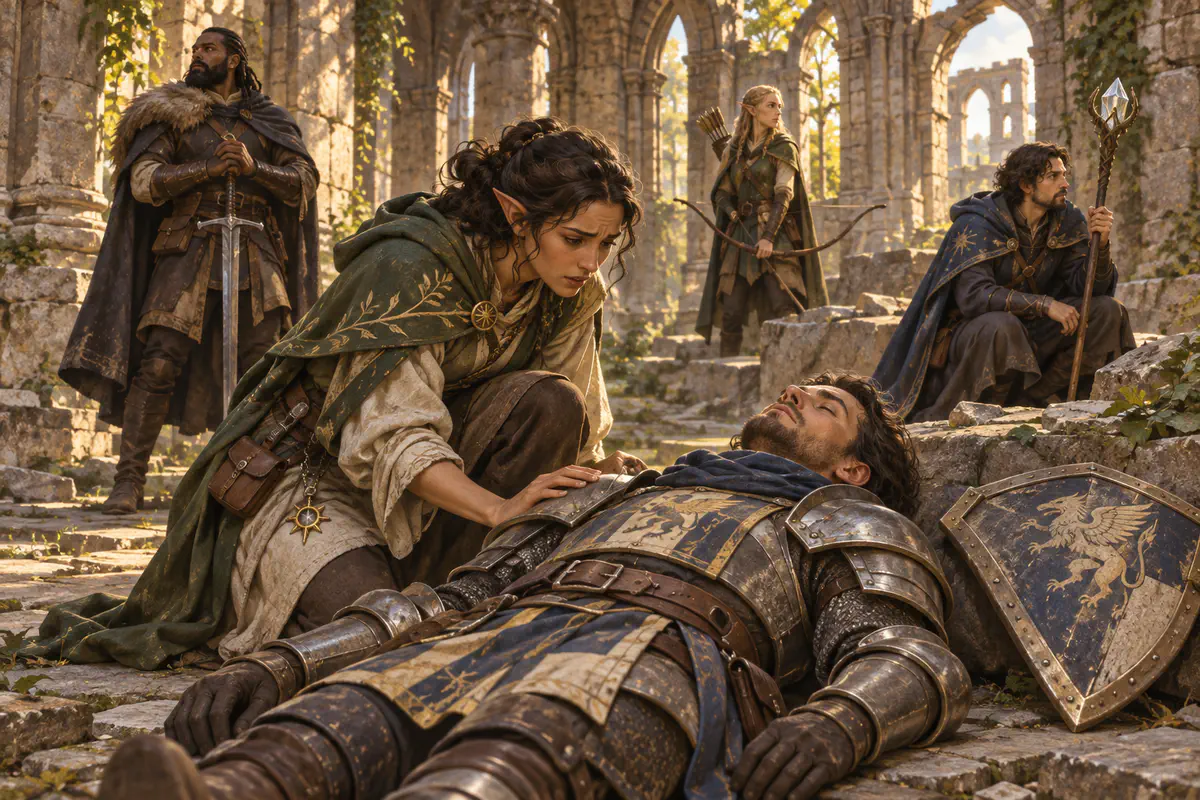
Death Saving Throws 5e Quick Answer
If you’re alive, at 0 hit points, and unstable when your turn starts, roll a d20. A result of 10 or higher succeeds. Three successes stabilize you, and three failures kill you. A natural 1 counts as two failures, and a natural 20 restores 1 hit point immediately.
Track successes and failures separately. Becoming stable or regaining any hit points clears both counts. 2014 Basic Rules on dropping to 0 hit points
What Happens When You Drop to 0 HP?
First check for instant death. When a hit drops you to 0, subtract the hit points you had from the damage taken. If the leftover damage equals or exceeds your hit point maximum, you die immediately. For example, a character with 7 current HP and a maximum of 24 dies outright from 31 damage because 31 − 7 = 24. A hit for 30 leaves 23 damage after reaching 0, which is below that threshold.
If the hit leaves you alive, you fall unconscious and drop anything you’re holding. You also fall prone and become incapacitated, so you lose actions and reactions. If you were concentrating on a spell, that concentration ends. Hit points · Concentration · 2014 unconscious condition
When Do You Roll and What Counts as a Success?
Roll at the start of your turn if you’re still at 0 HP and unstable. A hit that drops you during someone else’s turn leaves time for other creatures to act before your next roll. Damage that hits you once you’re already down has its own rule.
| Result | Effect |
|---|---|
| Natural 1 | Mark two failures. |
| Natural 20 | Regain 1 HP and clear both counts. |
| Other d20 result, total below 10 | Mark one failure. |
| Other d20 result, total of 10 or higher | Mark one success. |
The natural 1 and 20 entries use the number showing on the d20 you keep. A death save has no associated ability modifier, but an applicable saving throw bonus can change an ordinary result. For instance, an ally who is still concentrating on bless can help turn an 8 into a success if the spell adds 2 or more. A total of 20 from a lower die roll gives an ordinary success. Bless · Advantage and disadvantage
How Does Damage at 0 HP Affect Death Saves?
Damage at 0 HP causes one failure immediately. Damage from a critical hit causes two. A single instance of damage at least equal to your hit point maximum kills you outright. If you were stable, taking damage also ends that stability.
An attack that hits an unconscious creature from within 5 feet is a critical hit. The attacker still rolls to hit. For example, a sword hit from 5 feet away can take a downed character from one failure to three. A reach weapon used from 10 feet away can still crit on a natural 20, but distance puts it outside the unconscious condition’s automatic critical hit rule. 2014 damage at 0 HP · 2014 unconscious condition
How Can an Ally Stabilize or Heal You?
Healing restores actual hit points, ends the unconsciousness caused by dropping to 0, and clears the death save counts. You’ll still need to stand up if you’re prone. Stabilization clears both counts and stops death saves while you stay stable. You remain unconscious at 0 HP and recover 1 HP after 1d4 hours if you stay stable and receive no healing. Prone · 2014 stabilization rules
| Rescue option | What the ally does | Result |
|---|---|---|
| First aid | Uses an action and succeeds on a DC 10 Wisdom (Medicine) check. | You stabilize. |
| Healer’s kit | Uses an action and expends one use of the kit. | You stabilize without a Medicine check. |
| Healing word | Casts the spell as a bonus action on an eligible ally in sight within 60 feet. | You regain HP and wake up. |
The kit’s standard use stabilizes a creature. A feature such as the 2014 Healer feat can change what happens when you use it. 2014 adventuring gear · Healing Word
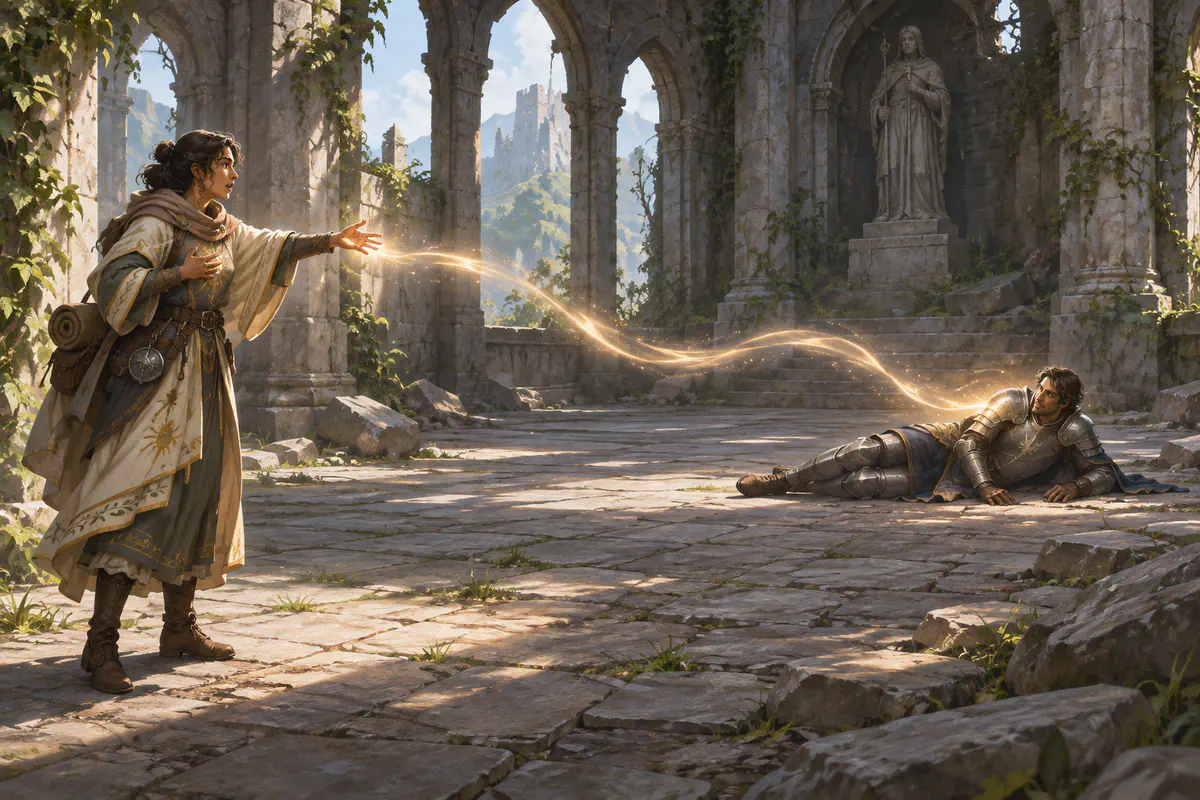
Worked Example of a Rescue in Initiative Order
- An enemy drops Mara to 0 HP without enough damage to kill her outright.
- At the start of Mara’s turn, she rolls a 7 and marks one failure. She remains unconscious.
- The cleric acts next and sees Mara 35 feet away. Healing word restores 5 HP, clearing the failure and waking Mara while she’s still prone.
- On Mara’s next turn, assuming she still has positive HP, she skips the death save and can act. With a speed of 30 feet and enough movement available, she can spend 15 feet to stand.
If the cleric had stabilized Mara with a healer’s kit instead, the failure would still clear. Mara would start her next turn unconscious and stable at 0 HP, assuming she took no further damage.
2014 vs. 2024 Rules
The 2024 rules keep the death save threshold, the three-success and three-failure outcomes, and the natural 1 and 20 results. They name the Help action as the way to attempt Medicine stabilization, still at DC 10. The rules for deliberately knocking a foe out in melee produce a different starting state. 2024 damage and healing
| Rules | When you choose a melee knockout |
|---|---|
| 2014 | The target falls unconscious and stable at 0 HP. |
| 2024 | The target is left at 1 HP, gains the Unconscious condition, and starts a Short Rest. First aid or regained HP can end this unconsciousness early. |
Death Saving Throws FAQ
Can temporary hit points wake you up?
Temporary hit points provide a damage buffer. You stay at 0 actual HP and keep your current stable or unstable state when you receive them. Temporary hit points
Can you act on the turn you roll a natural 20?
Yes. You regain 1 HP at the start of that turn, so the unconsciousness from being at 0 ends in time to act. Any other effects still apply, including being prone.
Do monsters make death saving throws?
The 2014 rules describe most monsters dying when they reach 0 HP. The DM can use the character procedure for an important villain or another creature whose survival matters to the scene.