Monk Guide 5e: Ki, Open Hand, and Complete Builds
A Monk turns movement into choices: reach a vulnerable enemy, threaten a dangerous caster, or escape before the next round of attacks. Your bonus action and ki pool decide how much offense or safety you can buy on a particular turn. An unarmored character still needs cover, allies, and a retreat route.
This guide uses 2014 D&D 5e, with Open Hand as the SRD subclass. The three original builds use 27-point buy and ordinary racial bonuses. Revised Focus and Deflect Attacks belong to the separate 2024 comparison.

Monk quick build
Choose a standard human with Dexterity 16, Constitution 14, and Wisdom 16. Use a quarterstaff, no armor or shield, an explorer’s pack, and ten darts. Take Acrobatics and Stealth, Acolyte for Insight and Religion, and flute as the class instrument proficiency. At level 3 choose Way of the Open Hand. Increase Dexterity at 4, then Wisdom at 8.
Monks use a d8 Hit Die and are proficient in Strength and Dexterity saving throws. Dexterity drives the usual attack plan; Wisdom improves unarmored AC and ki save DC; Constitution buys the HP needed to survive an exposed position. A low-Wisdom bruiser is possible, but its stun DC and defenses will suffer.
Martial Arts and ki: where the actions go
While unarmored, without a shield, and using only unarmed strikes or Monk weapons, Martial Arts lets you use Dexterity for qualifying attacks and its die in place of their usual damage. The 2014 die is d4 at levels 1–4, d6 at 5–10, d8 at 11–16, and d10 at 17–20. Monk weapons are shortswords and qualifying simple melee weapons; a versatile quarterstaff qualifies even when held in two hands. A longbow does not become a Monk weapon merely because your race grants proficiency.
After taking the Attack action with an unarmed strike or Monk weapon, you can make one unarmed strike as a bonus action. That costs no ki. At 2, Flurry of Blows instead spends one ki for two bonus-action unarmed strikes immediately after the Attack action. It replaces that ordinary bonus strike; it does not add a second bonus action.
Patient Defense spends one ki and a bonus action to Dodge. Step of the Wind spends one ki and a bonus action to Dash or Disengage, also doubling jump distance for the turn. Sometimes avoiding three incoming attacks is a better use of that bonus action than making another strike. You have ki equal to Monk level, recovered after a short or long rest that includes at least 30 minutes of meditation. Ki save DC is 8 + proficiency + Wisdom modifier.
Weapons, armor, and equipment
Unarmored Defense is 10 + Dexterity modifier + Wisdom modifier. Armor or a shield disables key Monk features, even if another source gives proficiency. Unarmored Movement also requires neither armor nor shield. The class does not begin with a component pouch or spellcasting.
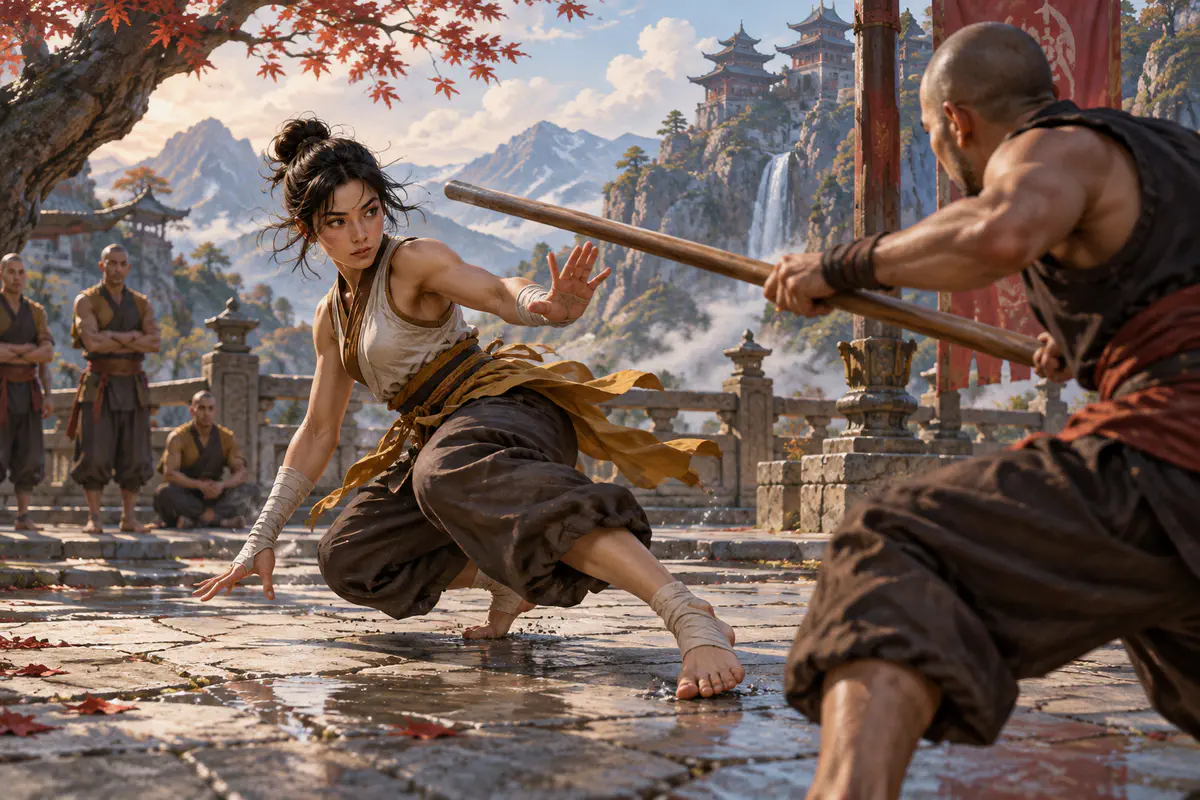
A quarterstaff can deal 1d8 when used with two hands, while your bonus strike can be a kick; an unarmed strike does not require an empty fist. Darts are a useful ranged fallback, but their ranged attacks do not by themselves satisfy the Martial Arts bonus-strike trigger. Pack a light source if your race lacks darkvision, and remember that running ahead of the light can separate you from help.

Monk progression: levels 1–20
| Class level | Milestone |
|---|---|
| 1 | Martial Arts d4; Unarmored Defense |
| 2 | Ki 2; Unarmored Movement +10 feet |
| 3 | Open Hand; Deflect Missiles |
| 4 | ASI or optional feat; Slow Fall |
| 5 | Extra Attack; Stunning Strike; Martial Arts d6 |
| 6 | Ki-Empowered Strikes; Open Hand: Wholeness of Body; movement +15 feet |
| 7 | Evasion; Stillness of Mind |
| 8 | ASI or optional feat |
| 9 | Unarmored Movement can cross liquids and vertical surfaces during the move |
| 10 | Purity of Body; movement bonus +20 feet |
| 11 | Open Hand: Tranquility; Martial Arts d8 |
| 12 | ASI or optional feat |
| 13 | Tongue of the Sun and Moon |
| 14 | Diamond Soul: all save proficiencies and ki-funded rerolls; movement +25 feet |
| 15 | Timeless Body |
| 16 | ASI or optional feat |
| 17 | Open Hand: Quivering Palm; Martial Arts d10 |
| 18 | Empty Body; movement bonus +30 feet |
| 19 | ASI or optional feat |
| 20 | Perfect Self restores ki to 4 when initiative starts with none |
At 5, Stunning Strike spends one ki when a melee weapon attack hits, forcing a Constitution save. On failure, the target is stunned until the end of your next turn. An unarmed strike qualifies for this feature under the 2014 rules clarification. You may try on more than one hit if you have ki, but a high-Constitution opponent can drain the pool quickly. A stunned target cannot act or move, attacks against it have advantage, and it automatically fails Strength and Dexterity saves. Plan the party’s follow-up around those specific benefits.
Deflect Missiles is a reaction against a qualifying ranged weapon hit; it is not general damage reduction against every spell. Evasion helps with Dexterity-save effects of the specified kind, not every saving throw. Stillness of Mind costs an action and does not promise that every charm allows you to choose that action.
Choosing a monastic tradition
Way of the Open Hand (SRD/PHB 2014) makes Flurry of Blows hits a control decision at level 3: its distinct options can knock a target prone, push it, or prevent reactions under their printed conditions. Push and prone involve saves; the reaction-prevention option does not. Its drawback is that you must first spend ki on Flurry and hit, so control shares the same small pool as defense and stunning.
Way of Shadow (PHB 2014) suits infiltration and working around obscured spaces. Way of the Four Elements (PHB 2014) is the elemental-discipline route, with disciplines drawing on ki. Check their actual feature and discipline costs before choosing: neither adds a second resource pool. These are sourcebook alternatives, not extra SRD subclasses. The builds below use Open Hand so their key features can be checked in the freely licensed rules.
Three complete 2014 Monk builds
All scores use STR, DEX, CON, INT, WIS, CHA order. Each base array costs 27 points. All choose Open Hand at 3 and take the starting quarterstaff, explorer’s pack, and ten darts, plus the Acolyte package. No armor, shield, feat, magic item, or multiclass benefit is included. Level-5 HP uses fixed increases.
Human staff generalist
Role and sources: mobile skirmisher; standard human, Acolyte, Open Hand; SRD/PHB 2014. Base 8, 15, 13, 10, 15, 10; +1 each gives 9, 16, 14, 11, 16, 11. Class Acrobatics/Stealth; background Insight/Religion; flute proficiency. There are no duplicate skills.
At 4 increase Dexterity to 18; at 8 increase Wisdom to 18. At 5: AC 17, HP 38, staff/unarmed attack +7, ki DC 14, five ki. Staff damage is 1d8 + 4 when held in two hands; unarmed damage is 1d6 + 4. Speed is 40 feet. You have no spells or cantrips from this build.
Turn: approach, attack twice with the staff, then either make the free Martial Arts bonus strike or pay one ki for Patient Defense when you must remain exposed. A stun attempt costs additional ki on a hit. Weakness: a d8 Hit Die and limited ki do not support standing alone among several enemies.
Wood elf scout
Role and sources: perceptive approach-finder; wood elf from the PHB/2014 Basic Rules, Acolyte, Open Hand. Base 10, 15, 14, 8, 15, 8; +2 Dexterity/+1 Wisdom gives 10, 17, 14, 8, 16, 8. Class Acrobatics/Stealth; racial Perception; background Insight/Religion; flute proficiency.
At 4 add +1 Dexterity/+1 Wisdom, reaching 18/17; at 8 add +1 Wisdom/+1 Constitution, reaching 18/15. At 5: AC 17, HP 38, attacks +7, staff 1d8 + 4, unarmed 1d6 + 4, ki DC 14, five ki. Wood elf base speed plus the class bonus gives 45 feet. A purchased longbow is a racial-proficiency ranged option, but it is neither starting Monk gear nor a baseline Monk weapon.
Turn: get to the enemy threatening the rear line, use two staff attacks, then spend ki on Flurry. If an Open Hand hit prevents that target’s reactions, reposition without its opportunity attack; other enemies may still react. Weakness: relying on that hit to escape is a risk, and ordinary Stealth never guarantees invisibility.
Half-orc Strength grappler
Role and sources: Athletics and close control; half-orc, Acolyte, Open Hand; SRD/PHB 2014. Base 14, 14, 13, 8, 14, 9; +2 Strength/+1 Constitution gives 16, 14, 14, 8, 14, 9. Class Athletics/Stealth; racial Intimidation; background Insight/Religion; flute proficiency.
At 4 raise Strength to 18; at 8 raise Dexterity to 16. At 5: AC 14, HP 38, Strength attacks +7, staff 1d8 + 4 with two hands or 1d6 + 4 with one, unarmed 1d6 + 4, ki DC 13, five ki. Strength is allowed: Martial Arts permits Dexterity, it does not require it.
Turn: at level 5 replace one of the two Attack-action attacks with a grapple, keeping a free hand for it; use the other for a one-handed staff attack, then a bonus-action kick. Grappling uses Athletics rather than the ki save DC. Weakness: low AC and the weaker Wisdom DC make this a party-supported specialist. A grapple does not itself stop a target from attacking you. See grappling for the distinctions.

In the 2014 grapple contest, the attacker uses Strength (Athletics), while the defender chooses Strength (Athletics) or Dexterity (Acrobatics). The target must be within reach and no more than one size larger. A grapple sets its speed to zero; it does not impose restrained or disadvantage on its attacks. Moving it normally halves your speed unless it is at least two sizes smaller.
Feats and multiclass decisions
Dexterity and Wisdom improve several parts of the class at once. The examples therefore use ASIs. Optional PHB 2014 feats worth considering include Mobile for a hit-and-move plan, Alert for acting before a dangerous enemy, and Resilient (Wisdom) if that save is an immediate campaign concern. Diamond Soul at 14 eventually grants every save proficiency, which changes the long-term appeal of buying one early. Read the feat’s own conditions; these builds assume none of them.
Multiclass Monk requires Dexterity 13 and Wisdom 13, plus the other class’s prerequisite. Rogue can add skills, but Sneak Attack still needs a finesse or ranged weapon; an unarmed strike does not qualify just because it uses Dexterity. Fighter can add features but an armor-dependent plan conflicts with the Monk kit. Every non-Monk level delays ki, Martial Arts scaling, and the level-5 breakthrough.
Combat and exploration decisions
An original level-5 sequence: a caster stands behind a guard. First decide whether the route is safe. If you can reach the caster without spending the bonus action, attack and consider Stunning Strike after a hit. If reaching them requires Step of the Wind, you cannot also Flurry or Patient Defense that turn. If the attempt leaves you surrounded, delaying for an ally may be the stronger play.
On an expedition, use speed to carry a rope to the far side, scout a short distance, or reach a lever. It does not let you ignore jump distance, visibility, climbing checks, or encumbrance. Level 9’s surface-running ability works during the move; it does not let you stop indefinitely on water or a wall. Insight can contribute to a negotiation even when Charisma is modest.

2024 Monk changes
The revised Martial Arts die starts at d6 and reaches d12, and the bonus unarmed strike is no longer tied to first taking the Attack action. Ki becomes Focus Points. Basic bonus-action Dash and Disengage are free through the revised features, with Focus buying stronger versions; Patient Defense also has a free Disengage option and a paid Disengage-plus-Dodge option. Uncanny Metabolism changes recovery and healing at level 2.
Deflect Attacks at 3 covers qualifying melee as well as ranged attack damage, with later expansion. Stunning Strike is limited to once per turn, ends at a different point on a failed save, and gives a benefit even when the target saves. Heightened Focus at 10 improves several Focus options. Open Hand has revised features, and the capstone improves Dexterity and Wisdom rather than using the old Perfect Self recovery.
These changes affect both survival and the bonus-action budget. Rebuild the point-buy examples using revised background boosts and equipment; do not add the free revised Dash to a 2014 ki build. Level 19’s Epic Boon is also a revised progression choice.
Monk FAQ
Can a quarterstaff be used two-handed?
Yes: versatile is not the prohibited two-handed weapon property. You can still kick for an unarmed strike.
Does Flurry add two attacks on top of the normal bonus strike?
No. Both use your one bonus action.
Can I stun with a bow?
No. The 2014 feature needs a hit with a melee weapon attack. The racial longbow proficiency does not change that.
Do I need to spend all my ki on damage?
No. Defense, movement, and a well-chosen stun may preserve more party actions than another pair of attacks.
Rules sources: SRD 5.1 for the 2014 class, SRD subclass, equipment, and spells; the Player’s Handbook (2014) and 2014 Basic Rules races for named racial options and optional PHB choices; Sage Advice Compendium for relevant 2014 clarifications. The separate comparison uses SRD 5.2.1. Recommendations, builds, and example decisions are original advice.
This work includes material taken from the System Reference Document 5.1 (“SRD 5.1”) by Wizards of the Coast LLC and available at https://dnd.wizards.com/resources/systems-reference-document. The SRD 5.1 is licensed under the Creative Commons Attribution 4.0 International License available at https://creativecommons.org/licenses/by/4.0/legalcode. This work includes material from the System Reference Document 5.2.1 (“SRD 5.2.1”) by Wizards of the Coast LLC, available at https://www.dndbeyond.com/srd. The SRD 5.2.1 is licensed under the Creative Commons Attribution 4.0 International License, available at https://creativecommons.org/licenses/by/4.0/legalcode.