Knock 5e: Unlocking Doors, Arcane Lock, and Noise
I like Knock because it makes a locked door a decision about resources and consequences instead of just a stalled expedition. It can free an ordinary lock without a picking check, but the noise makes it an awkward solution when the party hopes nobody will notice. That tradeoff is what gives the spell its character.
This guide uses the 2014 version. Knock unlocks or frees the target; it does not automatically swing every door open or make the object safe to handle.
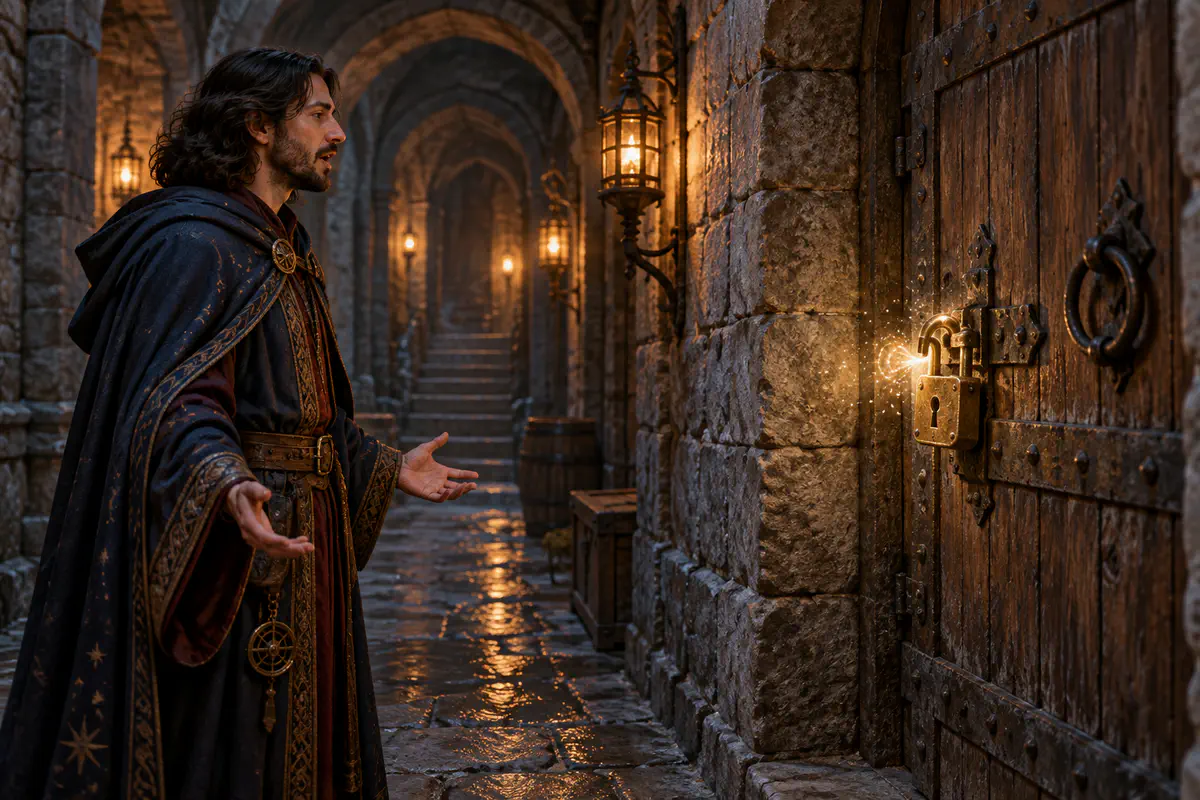
Knock 5e — Quick Spell Reference
| Casting Time | 1 action |
|---|---|
| Range | 60 feet |
| Components | V |
| Duration | Instantaneous |
| Concentration | No |
| Ritual | No |
| Classes | Bard, Sorcerer, Wizard |
| Source | Player's Handbook (2014), pg. 254 |
What Knock Opens Without a Check
Choose one object you can see within 60 feet that has a mundane or magical means of preventing access. Doors, chests, boxes, padlocks, and manacles are examples. If an ordinary lock, a bar, or a stuck mechanism holds the target shut, the spell unlocks, unbars, or unsticks it as applicable.
No spell attack, saving throw, lockpicking check, or Arcana check is required for that specified result. There is no ordinary-lock DC ceiling in the spell. A difficult mundane lock does not become immune simply because a rogue would find it hard to pick.
Visibility applies to the target object. You can target a visible door barred on the other side without separately seeing the bar. Conversely, knowing a chest is somewhere in a dark room does not meet the requirement to see it. Use the vision rules when that distinction matters.
Afterward, somebody still needs to open or move the object through an appropriate interaction. Unlocking a door does not carry the party through it, remove a barricade beyond it, or guarantee there is room to swing it open.
Multiple Locks and Arcane Lock
One casting unlocks only one lock on a multiply locked object. A chest secured by three ordinary locks can require three castings to release all three. Using a larger slot does not change that limit.
On a target held shut by Arcane Lock, Knock suppresses that spell for 10 minutes. During that window, the target can be opened and shut normally. Suppression does not permanently dispel Arcane Lock: the magical protection resumes when the period ends.
If a door combines several independent mundane locks and a magical ward, identify those layers before claiming one casting removes all of them. The text separately describes releasing a mundane lock and suppressing Arcane Lock; unusually combined mechanisms can require adjudication. The multiple-lock limitation is not permission to erase every other barrier on the same door.
For a different magical seal or a specific magic item’s immunity, read that effect’s rules. Knock is not a universal method of ending every ward. Dispel Magic addresses spells in a different way and can be preferable when removing the actual magical effect is the goal.

How Loud Is Knock, and Where Does the Sound Come From?
Every casting produces a loud knock at the target object, audible from as far as 300 feet away. Standing 60 feet from the door does not move the noise to the caster or reduce its stated reach.
That warning sound is separate from the verbal component. A feature that removes your need to speak does not, by itself, erase the knock generated at the object. The spell gives no option to trade its sound for a longer casting time, and it is not a ritual.
The 300-foot rule does not supply a decibel level or a complete model of sound through dungeon walls. Hearing conditions, background noise, and what listeners do afterward remain questions for the DM. Do not assume everybody within that distance learns your precise identity, but do plan for nearby guards to investigate.
Can Silence Hide the Knock?
Silence prevents sound from being created within or passing through its area. If the target object is inside Silence while the Knock caster stands outside it, the generated noise can be contained. The caster must still see the target, be within 60 feet, and have a clear path for the spell under the ordinary targeting rules.
A caster inside Silence cannot supply Knock’s verbal component. Both spells also need legal timing and resources: one character might maintain Silence while another casts Knock, or the same caster might establish Silence and cast Knock on a later turn from outside its area. Knock does not require concentration, so that later casting need not end Silence.
Silence does not disarm a trap on the door or hide the sight of the door opening. It addresses sound, not every way an intrusion might be detected. Our stealth-mission guide discusses combining several kinds of preparation.
Does Knock Disable Traps or Break Objects?
No general trap-disarming or object-destruction effect is included. A trap that triggers when someone picks a lock may behave differently from one triggered by opening the lid, crossing the doorway, or moving the object. Resolve the trap’s actual trigger rather than automatically declaring that Knock either triggers or defeats every trap.
For example, Knock can release a chest’s padlock while leaving a lid-triggered alarm intact. Inspecting the lid before lifting it still matters. The interactive-trap guide provides examples of mechanisms and separate triggers.
The spell also does not necessarily free an object buried under rubble, destroy hinges, cut chains, or release every possible form of restraint. Manacles are an explicit target, but a device with no applicable lock, bar, or stuck closure needs a ruling based on its actual construction.
Choosing Between Knock and Thieves’ Tools
Use Knock when speed or a difficult closure matters more than the slot and noise. Use a quiet mundane solution when the party has the proficiency, time, and a plausible way to work on the mechanism safely.
Example: a patrol is approaching a locked archive. Picking the lock may preserve secrecy but take uncertain time. Knock spends a slot and releases one ordinary lock immediately, but announces activity at that door. Neither choice is universally correct: the patrol’s distance, the number of locks, and the party’s escape route decide which cost is acceptable.
In a heist, that can make Knock a backup plan rather than the first step. It preserves a way forward when a quiet approach fails, without promising a silent or consequence-free entrance.
Knock FAQ
Can Knock open manacles while my hands are bound?
Potentially yes. It has only a verbal component, so bound hands alone do not prevent casting it. You must be able to provide that component and see the relevant target within range; other conditions or restraints may prevent those requirements.
Does the ordinary lock relock after ten minutes?
No. The ten-minute limit concerns suppressing Arcane Lock. An ordinary unlocked lock remains in that state until something locks it again.
Can Knock be upcast to affect more locks?
No. It lists no higher-slot benefit, so spending a larger slot does not add targets, remove more locks, or make it quieter.
Does Knock require a material component or an attack roll?
Neither. It uses a verbal component and resolves the stated unlocking effect without an attack roll.
Rules sources: 2014 Knock, SRD 5.1, and the spellcasting and Silence rules in that SRD. The revised Knock text was checked in SRD 5.2.1; its core unlocking, noise, and Arcane Lock suppression mechanics do not warrant a separate comparison section. Custom wards and trap mechanisms remain effect-specific.
This work includes material taken from the System Reference Document 5.1 (“SRD 5.1”) by Wizards of the Coast LLC and available at https://dnd.wizards.com/resources/systems-reference-document. The SRD 5.1 is licensed under the Creative Commons Attribution 4.0 International License available at https://creativecommons.org/licenses/by/4.0/legalcode.