Blade Barrier 5e: Damage, Wall Shapes, and Timing
I’ve always liked Blade Barrier because it can change an entire battlefield with one action. It is not merely a damage spell: the wall divides enemies, protects creatures behind it, slows anyone who crosses, and makes forced movement genuinely frightening. Its timing is easy to misread, though, especially when the wall first appears.
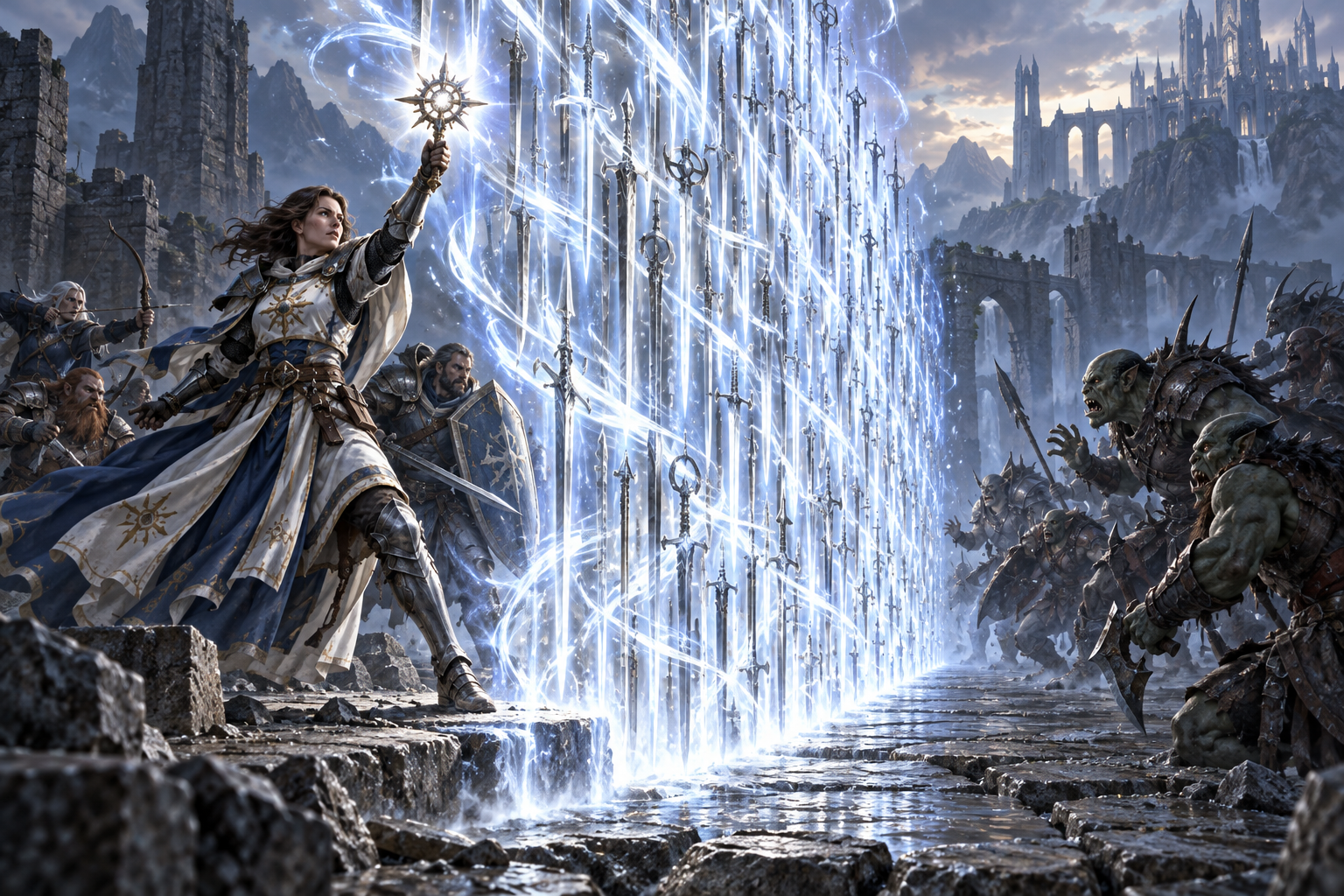
Blade Barrier 5e — Quick Spell Reference
| Casting Time | 1 action |
|---|---|
| Range | 90 feet |
| Components | V, S |
| Duration | Up to 10 minutes |
| Concentration | Yes |
| Ritual | No |
| Classes | Cleric |
| Source | Player's Handbook (2014), pg. 218 |
How Blade Barrier Works
You create a vertical wall of magical blades at a point within 90 feet. Choose one of two shapes:
- A straight wall up to 100 feet long, 20 feet high, and 5 feet thick
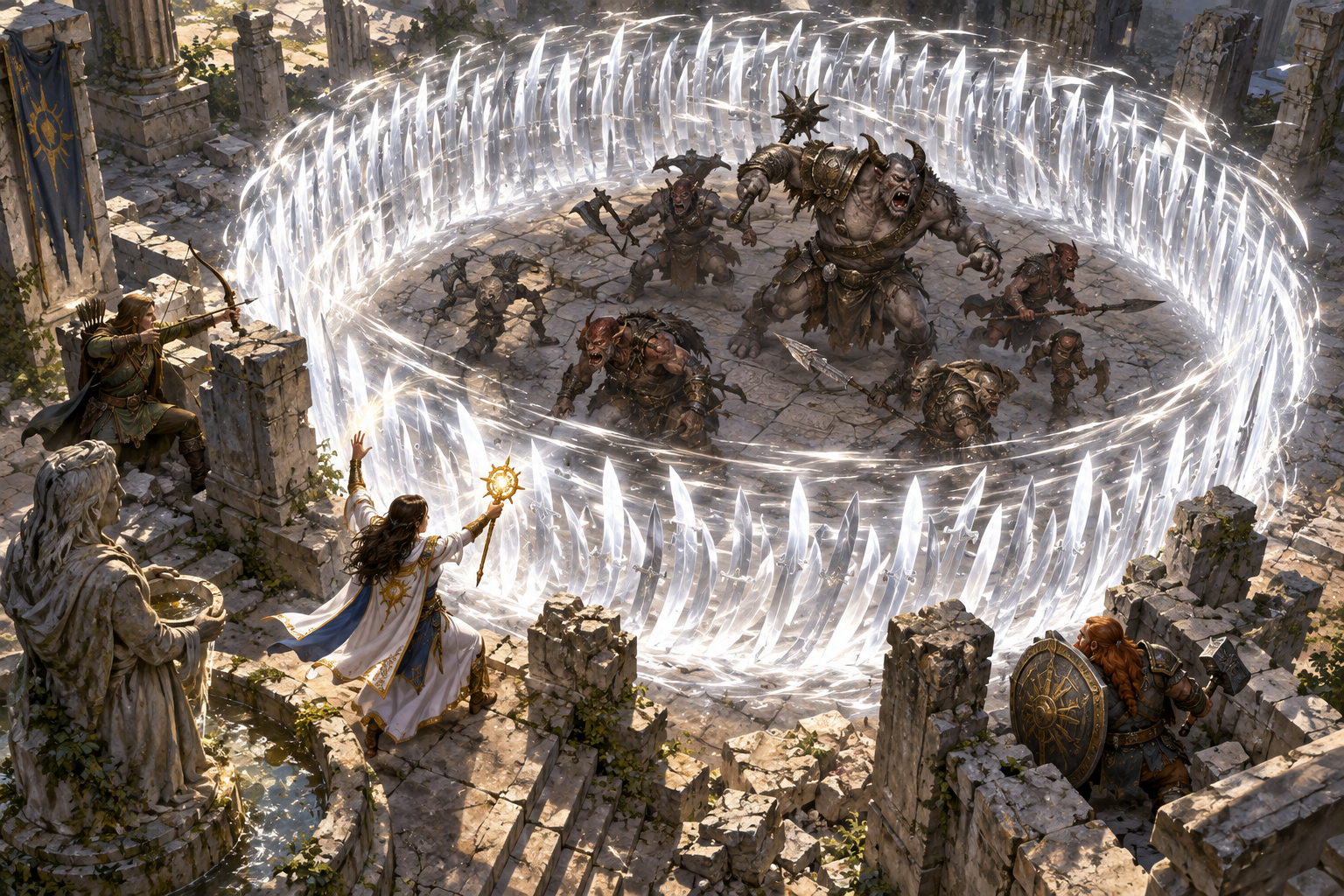
- A ringed wall up to 60 feet in diameter, 20 feet high, and 5 feet thick
The wall provides three-quarters cover to creatures behind it, and every space occupied by the wall is difficult terrain. It remains in place for up to 10 minutes while you maintain concentration.
A creature makes a Dexterity saving throw when it enters the wall for the first time on a turn or starts its turn there. It takes 6d10 slashing damage on a failed save, or half as much on a success.
When Does Blade Barrier Deal Damage?
The 2014 version has two specific triggers:
- A creature enters the wall for the first time on a turn.
- A creature starts its turn inside the wall.
Creating the wall in an occupied space does not cause immediate damage under the 2014 wording. A creature already there saves when its turn starts, unless it leaves before then. This differs from many area spells and from the 2024 version.
Entering means moving from outside the wall into its space. Walking, falling, teleporting directly into it, or being pushed or pulled into it can all satisfy that trigger. Moving around within the wall is not repeatedly entering it, and the spell says “for the first time on a turn,” so a creature cannot take the entry damage more than once during the same turn.
Because turns are separate, coordinated forced movement can be powerful. If an ally pushes a creature into the wall on one turn, the creature can take damage then and again when it starts its own turn in the barrier.
Cover and Difficult Terrain
Three-quarters cover gives a creature behind the wall a +5 bonus to AC and Dexterity saving throws against effects originating on the opposite side. It is not total cover: attacks and effects can still pass through when their other targeting requirements are met.
Cover depends on the line between attacker and target. A creature beside the wall may receive no cover from an attacker on the same side, while a creature directly across it may receive the full three-quarters benefit.
The wall’s spaces cost twice as much movement to cross because they are difficult terrain. A typical creature therefore spends 10 feet of movement to cross the 5-foot thickness. The wall does not say it is solid, so it does not prevent passage; it makes passage slow and dangerous.
Straight Wall or Ring?
The straight wall excels at dividing a room, sealing a corridor, protecting a retreat, or separating melee enemies from their support. A ring is better for enclosing a group or creating a dangerous perimeter around an objective.
The ring can be up to 60 feet in diameter, so it may be smaller. Neither option allows arbitrary curves, branching shapes, or a dome. The wall must be vertical and cannot be laid flat as a floor or ceiling.
Tactical Uses
Blade Barrier is strongest when its damage supports a positional plan:
- Split a large encounter so the party fights fewer enemies at once.
- Place the wall where enemies must cross to reach an exit or objective.
- Use grapples, shoves, and forced-movement effects to trigger entry damage.
- Protect wounded allies with three-quarters cover while they reposition.
- Ring enemies that lack teleportation or strong ranged options.
Remember that the wall harms allies too. Its triggers refer to “a creature,” not an enemy, and the difficult terrain applies to everyone in its space.
Blade Barrier: 2014 vs. 2024 Rules
The 2024 spell keeps the level, class, range, duration, concentration, dimensions, difficult terrain, cover, and 6d10 damage. Its damage rules change in three important ways:
- The damage becomes force instead of slashing.
- Creatures already in the wall save immediately when it appears.
- Afterward, a creature saves when it enters the wall or ends its turn there, rather than when it starts its turn there.
The 2024 version also says a creature makes this save only once per turn. The main rules and quick reference on this page use the 2014 version.
Can Blade Barrier Be Upcast?
No. Casting it with a 7th-, 8th-, or 9th-level slot does not increase its damage, dimensions, duration, or save DC beyond the normal benefit your character may already have from a higher spellcasting ability or magic items.
Blade Barrier FAQ
Does Blade Barrier damage creatures when it is cast?
Not under the 2014 wording. A creature already in the wall saves when it starts its turn there. The 2024 version adds an immediate save when the wall appears.
Can a creature walk through Blade Barrier?
Yes. The wall is not solid, but its space is difficult terrain and entering it triggers a Dexterity save against 6d10 slashing damage.
Does forced movement trigger the damage?
Yes. The spell does not require willing movement. Pushing, pulling, or otherwise moving a creature from outside the wall into its space triggers the entry clause.
Does the wall block sight?
The spell does not say it blocks sight or provides total cover. It provides three-quarters cover, so do not treat it as an opaque solid wall unless another effect creates that result.
Is Blade Barrier worth preparing?
It is excellent when terrain, chokepoints, or forced movement matter. In open fights where enemies can simply go around it—or where concentration is likely to break—a more immediate 6th-level spell may be easier to use.