Blight 5e: Plant Targets, Damage, and Upcasting
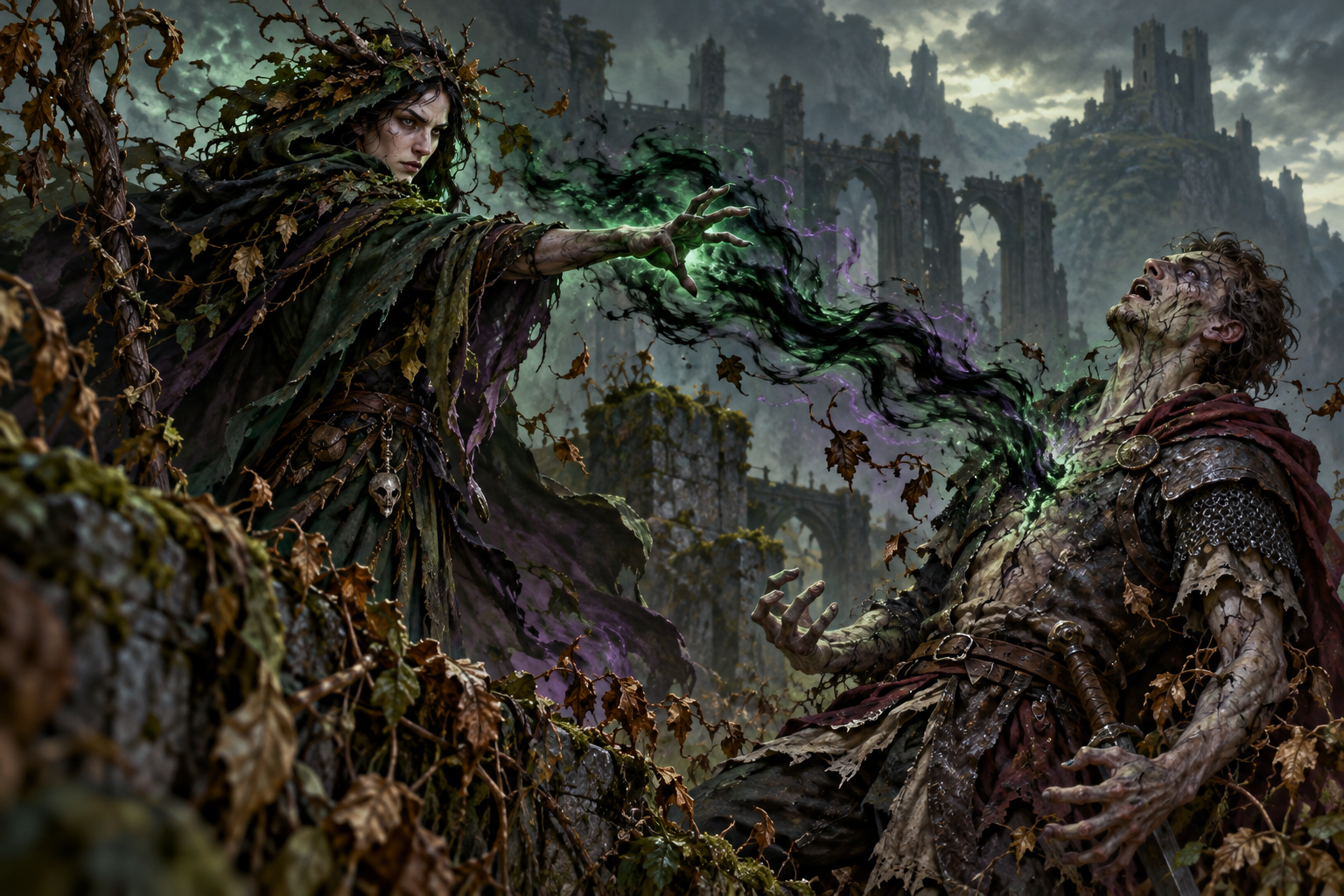
I’ve always enjoyed Blight as a spell with a wonderfully specific identity: it does not explode or spread across a battlefield; it drains the vitality from one target. Against an ordinary creature it is solid single-target damage. Against the right plant, it becomes terrifying.
Blight 5e — Quick Spell Reference
| Casting Time | 1 action |
|---|---|
| Range | 30 feet |
| Components | V, S |
| Duration | Instantaneous |
| Concentration | No |
| Ritual | No |
| Classes | Druid, Sorcerer, Warlock, Wizard |
| Source | Player's Handbook (2014), pg. 219 |
How Blight Works
Choose one creature you can see within 30 feet. It makes a Constitution saving throw, taking 8d8 necrotic damage on a failed save or half as much on a success. The average damage is 36 on a failed save and 18 on a successful one.
Blight is instantaneous and does not require concentration. It has only verbal and somatic components, so it needs no material component or costly focus.
The 2014 spell has three special target rules:
- It has no effect on undead or constructs.
- A Plant creature or magical plant saves with disadvantage and takes the maximum 64 damage if affected.
- A nonmagical plant that is not a creature receives no save; it simply withers and dies.
Blight Against Plant Creatures
The Plant creature type is a game statistic, not a visual judgment. A vine blight, awakened tree, or other stat block labeled “Plant” qualifies. A beast covered in moss or a humanoid created from wood does not qualify unless its creature type says Plant.
Under the 2014 rules, a qualifying Plant creature makes its Constitution save with disadvantage. Whether it succeeds or fails, do not roll the 8d8: the spell deals its maximum damage. That is 64 on a failed save or 32 after the successful-save reduction.
“Magical plant” can also cover a plant made magical by a specific effect even if it is not presented as a creature. When classification is uncertain, check the feature that created or transformed it rather than relying only on appearance.
What Happens to Ordinary Plants?
You may target a nonmagical plant that is not a creature, such as a normal tree or shrub. It makes no saving throw and withers and dies.
That clause does not automatically let Blight destroy every wooden object. A finished door, bow, ship, or table is an object made from processed plant material, not necessarily a plant. The spell gives no object damage, hit points, or structural effect. A DM can adjudicate unusual living-wood cases, but Blight is not a general-purpose demolition spell.

Undead and Constructs
In the 2014 rules, Blight has no effect on undead or constructs. They are not merely resistant or immune to its necrotic damage through a general creature rule; this specific spell says it does nothing to them.
That means an undead or construct does not take half damage on a successful save. The spell produces no effect on that target. Check creature type before committing a 4th-level slot when the enemy’s nature is uncertain.
Upcasting Blight
Blight gains 1d8 damage for each slot level above 4th:
| Slot | Damage | Average on Failed Save |
|---|---|---|
| 4th | 8d8 | 36 |
| 5th | 9d8 | 40.5 |
| 6th | 10d8 | 45 |
| 7th | 11d8 | 49.5 |
| 8th | 12d8 | 54 |
| 9th | 13d8 | 58.5 |
Against a 2014 Plant creature or magical plant, maximum damage also scales: 72 at 5th level, then 80, 88, 96, and 104 at 9th level.
Upcasting is dependable but modest. Each higher slot adds only 4.5 average damage against most creatures, so compare it with the stronger control or area options available at that slot.
Tactical Uses and Limits
Blight works best when you need immediate damage against one important target and cannot rely on an attack roll. It still deals half damage on a successful Constitution save, so the slot is rarely completely wasted against a valid target.
Its limitations are meaningful: 30 feet is short range, Constitution saves are often strong on large monsters, necrotic resistance can reduce the result, and the 2014 immunities make target knowledge important. Blight also offers no control, ongoing damage, or benefit to allies.
Blight: 2014 vs. 2024 Rules
The 2024 version keeps the level, school, classes, action, 30-foot range, components, 8d8 necrotic damage, half damage on a successful save, plant-withering option, and 1d8-per-level upcasting.
Two changes matter:
- Plant creatures automatically fail the saving throw instead of rolling with disadvantage and taking maximum damage.
- The sentence making undead and constructs unaffected was removed.
As a result, the 2024 spell can damage undead and constructs normally, while Plant creatures automatically take the rolled 8d8 rather than a guaranteed maximum 64. The main guidance on this page uses the 2014 version.
Blight FAQ
Does Blight work on undead or constructs?
Not in the 2014 rules. It has no effect on either creature type. The 2024 version removes that restriction.
Does a Plant creature take 64 damage even if it saves?
In 2014, the spell deals maximum damage to a Plant creature or magical plant, but a successful save still halves that damage to 32.
Can Blight destroy a wooden door or ship?
Not automatically. The spell targets a creature or a nonmagical plant, not any object made from wood.
Does Blight require concentration?
No. Its duration is instantaneous, so it can be cast while you concentrate on another spell.
Is Blight worth upcasting?
Sometimes, especially against a vulnerable 2014 Plant target. Against ordinary creatures, the extra 1d8 per slot is reliable but less dramatic than many higher-level alternatives.