Acid Damage 5e: Spells, Resistance, and Corrosion Rules
Acid damage makes me think of black dragon breath and dungeon floors sizzling beneath an adventurer’s boots. The important rules question is simpler: does the effect just deal damage, or does it also dissolve equipment?
This guide uses 2014 D&D 5e rules, with the revised Acid Splash explained separately below.
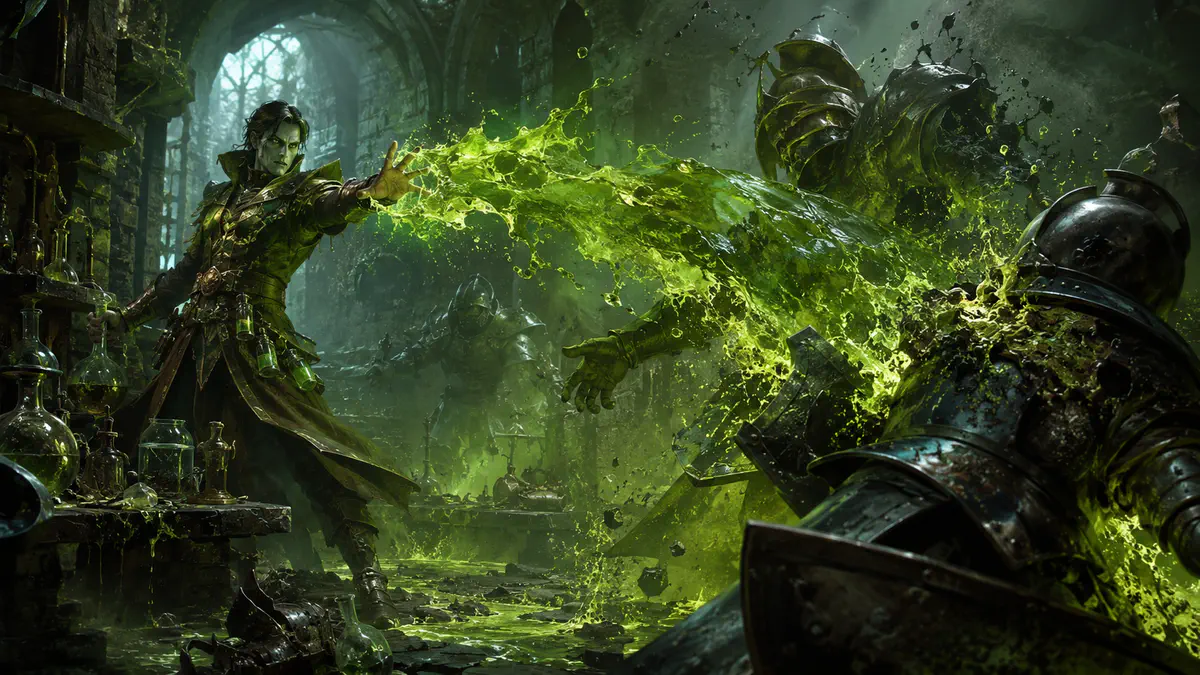
Acid Damage 5e: Quick Answer
Acid damage represents corrosive substances and digestive enzymes. It reduces hit points normally. Acid resistance halves it, immunity prevents it, and vulnerability doubles it.
The damage type alone does not destroy armor, reduce AC, continue burning on later turns, or impose a condition. Those consequences require wording in the spell, monster trait, item, or hazard.
What Deals Acid Damage?
Acid comes from both magical and nonmagical sources. Examples include:
| Source | What matters in play |
|---|---|
| Acid Splash | A cantrip resolved with a Dexterity saving throw |
| Acid Arrow | A spell attack with specific immediate and delayed damage |
| A vial of acid | An adventuring item with its own attack procedure |
| Black dragon breath | A monster action with its own area, save, and damage |
| A black pudding | An ooze whose individual traits explain its corrosive effects |
Do not transfer a monster’s special corrosion rules to every acid spell. The same damage type can appear in effects with very different targeting and durations.
How Do You Resolve Acid Damage?
First resolve the attack roll or saving throw required by the source. Then calculate its damage and apply relevant defenses before subtracting hit points. A successful save only halves damage if the effect says it does; some effects instead deal none.
For example, assume a dragon’s breath produces 27 acid damage, with a successful save allowing half damage. A successful save reduces that to 13 after rounding down. Acid resistance then reduces 13 to 6 damage. A failed save with resistance would instead produce 13 damage.
Two sources of acid resistance do not halve the same damage twice. See the damage resistance guide for the broader procedure.
How Does Acid Splash Work in the 2014 Rules?
The 2014 Acid Splash cantrip has a range of 60 feet. Choose one creature you can see within range, or two visible creatures within range that are within 5 feet of each other. Each target makes a Dexterity saving throw; a failed save deals 1d6 acid damage, while success deals none.
The damage increases to 2d6 at character level 5, 3d6 at level 11, and 4d6 at level 17. It does not leave an ongoing acid puddle or automatically damage a target’s possessions.
That makes positioning important: two adjacent enemies can give you more value from one casting, but two enemies farther apart cannot both be selected.
Does Acid Damage Melt Armor or Weapons?
Not automatically. Losing hit points to acid does not normally lower AC or destroy a weapon. Some monsters, including the 2014 black pudding, have explicit traits for damaging equipment. Those traits define what materials and items are affected and how the deterioration works.
Objects also have their own rules. Before trying to dissolve a lock, check whether your chosen effect can target an object at all. The 2014 Acid Splash targets creatures, so it is not a general-purpose lock-dissolving spell.
For a vial poured onto a hinge or a pool of acid eating through a floor, the DM must adjudicate the situation using the item or hazard and the object rules. Acid damage alone does not supply a universal dissolution rate.
Is Acid the Same as Poison or Fire?
No. Acid, poison, and fire are separate damage types. Resistance to one does not protect against either of the others unless a feature explicitly grants that protection too.
An effect described as burning might still deal acid damage. Use the listed damage type rather than a descriptive word. Likewise, a venomous bite may combine piercing and poison damage; it does not become acid because the venom sounds corrosive.
When Is Acid Damage Useful?
Acid gives a caster another option when an enemy resists a familiar element. Its usefulness depends on the actual enemy and effect, rather than a universal damage-type ranking.
Before choosing an acid option, compare the attack roll or save it requires, its range, its targets, and any delayed damage. A spell that can damage two nearby creatures may be a better choice than a single-target option, while the reverse can be true against a strong Dexterity save.
Acid Damage: 2014 vs. 2024 Rules
Acid Splash changes its targeting. The 2014 spell selects one creature or two close together. The 2024 version creates a 5-foot-radius sphere at a point within range and affects each creature in it. That can include allies.
Both versions use a Dexterity save and begin at 1d6 damage, but the revised area changes how you place the spell. Do not use the 2024 sphere with the 2014 spell’s selective targeting.
Acid Damage FAQ
Does acid keep dealing damage every round?
Only when the source specifies continuing damage. Acid Arrow has a delayed damage component; Acid Splash does not.
Does acid damage give the poisoned condition?
No. Neither acid damage nor poison damage automatically imposes that condition. An effect must explicitly apply it.
Can acid damage be nonmagical?
Yes. The damage type does not establish whether its source is magical. A mundane acid item and a spell can both deal acid damage.
Rules Sources
This guide uses the official 2014 combat rules, 2014 equipment rules, 2014 spell descriptions, and SRD 5.1. The comparison uses the official 2024 Acid Splash description.