Cleric Guide 5e: Spells, Domains, and Complete Builds
A Cleric can protect the party, control a dangerous approach, restore a fallen ally, or bring divine power to a fight. The challenge is choosing which job matters right now. Spending every turn repairing damage can be less effective than preventing the next attack or helping an ally finish the enemy.
This guide uses 2014 D&D 5e. The builds use 27-point buy and identify their optional books. The 2024 comparison explains the revised class separately. Life Domain is the SRD option; other domains discussed here require their named books.

Cleric quick build
For a forgiving start, choose a hill dwarf Life Cleric with Wisdom 16 and Constitution 16. Take Guidance, Sacred Flame, and Light as cantrips; prepare Healing Word and useful support spells. Life Domain always prepares Bless and Cure Wounds for you. Wear chain mail, carry a shield, and leave a hand free for casting when needed.
Choose Cleric if you like adapting your spell selection to tomorrow’s problems. You do not need to spend every turn healing, carry a weapon you rarely swing, or portray your faith as unquestioning obedience. Expect to manage concentration, spell slots, range, and your allies’ immediate needs.
Spellcasting and Channel Divinity
Clerics use a d8 Hit Die, begin with 8 + Constitution modifier hit points, and gain 1d8 (or 5) + Constitution modifier at each later Cleric level. Wisdom and Charisma are their saving throw proficiencies.
Prepared spells are not spell slots
Wisdom determines your Cleric spell attack modifier and save DC: proficiency bonus + Wisdom modifier for attacks, and 8 + proficiency bonus + Wisdom modifier for saves. At level 1 with Wisdom 16, those are +5 and DC 13. At level 5 with Wisdom 18, they become +7 and DC 15.
After a long rest, prepare a number of Cleric spells equal to Cleric level + Wisdom modifier, minimum one, choosing spell levels you can cast. Your domain spells are always prepared and do not count against that total. Cantrips are separate, and the 2014 base class does not let you replace them every morning.
All expended Cleric spell slots return after a long rest. A prepared spell is an available option; a slot pays for casting it. You can cast the same prepared spell repeatedly if you have suitable slots. A higher-level slot can cast a lower-level spell, but only the spell’s stated upcasting benefit applies. A Cleric ritual must be prepared and have the ritual tag; casting it as a ritual adds ten minutes and saves a slot.
Concentration is a major build choice
You can maintain only one concentration spell at a time. Bless, Shield of Faith, Hold Person, and Spirit Guardians compete for that resource. Healing Word does not require concentration, so healing an ally need not end Bless.
Taking damage requires a Constitution save to keep concentration: DC 10 or half the damage taken, whichever is higher. Clerics begin with Wisdom and Charisma saving throw proficiencies, not Constitution. Armor and concentration-protection feats help you stay useful after spending the slot.
Channel Divinity and Turn Undead
At level 2, you gain Turn Undead and a domain-specific Channel Divinity option. They share uses: one between rests initially, two at level 6, three at level 18. A short or long rest restores all expended uses in the 2014 class. These features are distinct from spell slots and do not automatically require concentration.
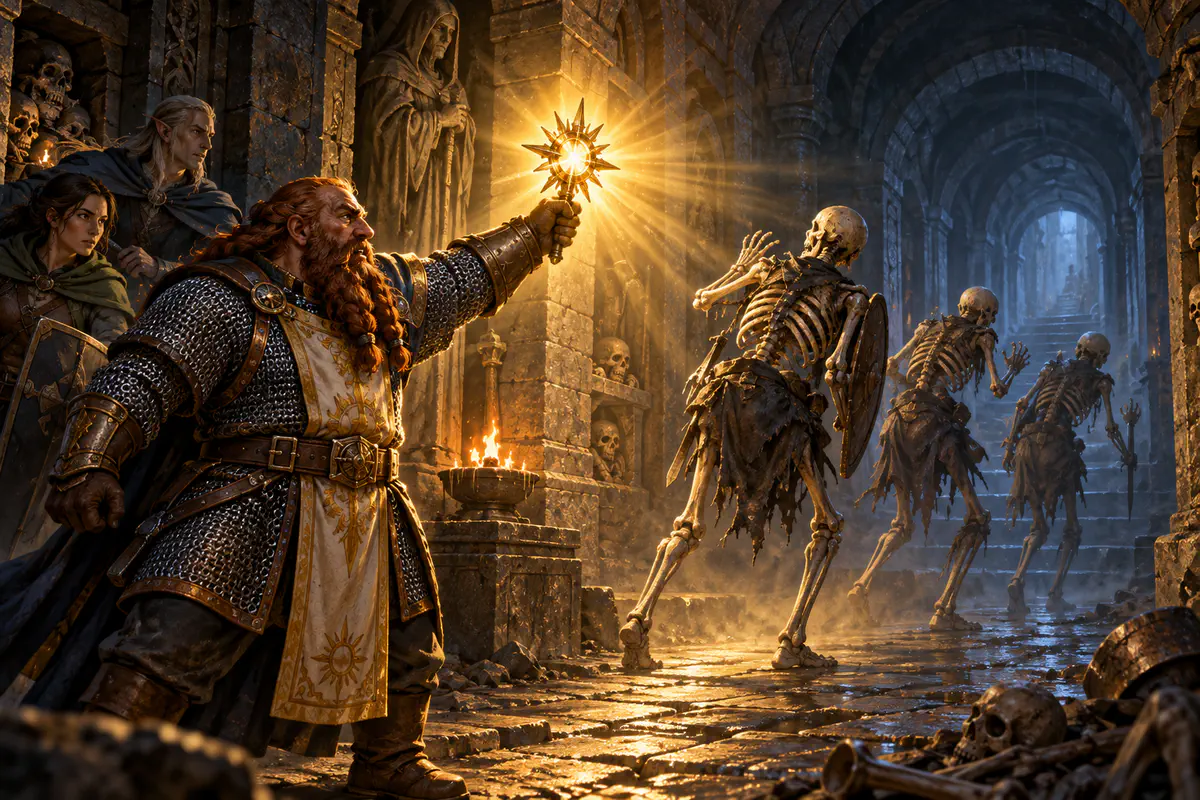
Turn Undead uses your action. Undead within 30 feet that can see or hear you make Wisdom saves. A failed save forces retreat under the feature’s rules for up to a minute; damage ends the effect on that creature. Coordinate with allies before they immediately attack a turned enemy. Destroy Undead begins at level 5 and destroys sufficiently low-CR undead that fail that save, rather than every undead in range.
What makes Life Domain useful?
Disciple of Life adds 2 + the spell’s level when you use a spell of level 1 or higher to restore hit points. It is a specific healing benefit, not a bonus to every source of healing.
At level 2, Preserve Life distributes a pool of five times your Cleric level among creatures within 30 feet. It cannot raise a target above half its hit-point maximum and does not affect undead or constructs. At level 5, that pool is 25 HP: a creature at 3/30 can receive at most 12, leaving 13 for other eligible targets. It cannot top that first creature up to 28/30. This is often useful when several allies need help at once.
Ability scores, skills, and equipment
| Ability | Aim for | Why it matters |
|---|---|---|
| Wisdom | 16 initially, usually increase toward 20 | Spell DCs, attacks, prepared spells, perception and insight |
| Constitution | 14–16 | Hit points and concentration saves |
| Dexterity | 14 for medium armor where affordable | AC, initiative, and Dexterity saves |
| Strength | Enough for your heavy armor plan, if any | Heavy armor speed requirements and occasional weapon attacks |
| Intelligence / Charisma | Support the character concept | Lore, religious knowledge, conversation |
The base 2014 class has light armor, medium armor, shields, and simple weapons. Heavy armor and martial weapons depend on additional features; Life adds heavy armor but does not itself add every martial weapon.
Armor examples
| Armor plan | AC | Limitation |
|---|---|---|
| Scale mail, Dexterity 14, shield | 18 | Stealth disadvantage |
| Breastplate, Dexterity 14, shield | 18 | Costs 400 gp, no Stealth disadvantage |
| Chain mail, shield | 18 | Heavy proficiency needed; Strength 13 avoids the normal speed reduction |
| Plate, shield | 20 | Costs 1,500 gp; normally wants Strength 15 |
Dwarven speed is not reduced by heavy armor under the original 2014 dwarf trait, but proficiency is still necessary. Do not confuse the armor’s Strength requirement with proficiency. Our Armor Class guide explains the calculations.
A holy symbol can serve as your spellcasting focus. A shield displaying it can supply appropriate material components, but that does not remove every somatic-component requirement. A spell with somatic but no material components still needs a free hand unless a feature allows otherwise. Costly or consumed components require the actual item. See spell components and focuses.
Take Insight and a knowledge skill if they suit your role; Medicine is useful but does not replace healing magic. Religion normally uses Intelligence, even for a Cleric. Let background skills provide breadth instead of assuming your high Wisdom makes you good at every religious question.
Cleric progression: levels 1–20
These are Cleric levels. Spell-level milestones do not mean unlimited spells of that level: your class table still determines slots.
| Level | Main milestone | Practical decision |
|---|---|---|
| 1 | Spellcasting, domain | Choose armor and three cantrips; prepare daily spells |
| 2 | Channel Divinity | Compare Turn Undead with the domain option |
| 3 | 2nd-level spells | Aid and restoration expand support |
| 4 | ASI or optional feat; fourth cantrip | Wisdom versus concentration protection |
| 5 | 3rd-level spells; Destroy Undead CR 1/2 | Spirit Guardians, Dispel Magic, and Revivify change your options |
| 6 | Domain feature; two Channel Divinity uses | Reassess short-rest resources |
| 7 | 4th-level spells | Plan protections such as Death Ward |
| 8 | ASI; domain feature; Destroy Undead CR 1 | Domain weapon/cantrip features do not grant Extra Attack |
| 9 | 5th-level spells | Greater Restoration and other costly spells need components |
| 10 | Divine Intervention; fifth cantrip | Intervention succeeds on a percentile roll at or below your Cleric level |
| 11 | 6th-level spells; Destroy Undead CR 2 | Access to Heal substantially changes emergency recovery |
| 12 | ASI or feat | Improve casting or defenses |
| 13 | 7th-level spells | Prepare major utility for the adventure |
| 14 | Destroy Undead CR 3; some domain damage improves | Read the chosen domain’s feature |
| 15 | 8th-level spells | High-level slots remain scarce |
| 16 | ASI or feat | Finish Wisdom or protect concentration |
| 17 | 9th-level spells; domain feature; Destroy Undead CR 4 | Compare a powerful domain capstone with your best spells |
| 18 | Three Channel Divinity uses | More domain effects between rests |
| 19 | ASI or feat | Complete remaining priorities |
| 20 | Improved Divine Intervention | The intervention succeeds automatically; successful use still has its recovery restriction |
2014 Divine Intervention is a request whose effect the DM chooses. After success, you cannot use it again for seven days; after failure, you can try again after a long rest. It is not a reliable extra daily spell at level 10.
Which Cleric domain should you choose?
Life is available in SRD 5.1. Other entries are short playstyle recommendations about official book options, not substitutes for their feature text. Subclass features start at level 1 in the 2014 class.
| Domain | Choose it for | Main limitation | Source |
|---|---|---|---|
| Life | Efficient healing and heavy armor | Healing bonuses do not prevent damage or guarantee concentration | SRD 5.1 / PHB 2014 |
| Light | Offensive spellcasting and radiant/fire themes | Positioning and ally safety matter for area spells | PHB 2014 |
| Tempest | Storm magic and a heavily armored caster | Its damage-maximizing Channel Divinity applies to specified damage types, not every spell | PHB 2014 |
| Knowledge | Lore and flexible noncombat utility | Less emphasis on weapon offense | PHB 2014 |
| Nature | Nature-themed divine casting and defensive support | Several benefits depend on the creatures and hazards you meet | PHB 2014 |
| Trickery | Infiltration and deception | Managing positioning and concentration demands care | PHB 2014 |
| War | Weapon support and martial identity | Limited bonus attacks do not equal a Fighter’s permanent Extra Attack | PHB 2014 |
| Arcana | An arcane/divine scholar | Understand which spells count as Cleric spells for features | Sword Coast Adventurer’s Guide |
| Forge | Armor, craftsmanship, and equipment support | Heavy equipment and melee positioning require planning | Xanathar’s Guide to Everything |
| Grave | Preventing deaths and setting up decisive attacks | Timing matters more than routine healing throughput | Xanathar’s Guide to Everything |
| Order | Directing allies through support magic | Needs allies who can exploit the granted opportunities | Tasha’s Cauldron of Everything |
| Peace | Strong cooperative support | Extra group effects require tracking and table agreement on allowed books | Tasha’s Cauldron of Everything |
| Twilight | Protective support and darkness-themed utility | Ongoing area effects add substantial bookkeeping | Tasha’s Cauldron of Everything |
| Death | Necrotic offense | A DMG option intended primarily for NPCs; ask before using it for a player | Dungeon Master’s Guide 2014 |
My beginner recommendation is Life. Choose Light for a more offensive caster or Tempest for a storm-themed armored caster. These are choices about playstyle, not a universal ranking of domain power. The builds below keep their required books explicit.

Preparing useful Cleric spells
Think in jobs rather than preparing five spells that all solve the same problem. Keep an emergency heal, one likely concentration plan, a way to contribute without spending a slot, and utility relevant to the next expedition.
| Spell level | Useful choices | Decision or caution |
|---|---|---|
| Cantrip | Guidance, Sacred Flame, Light | Guidance needs concentration and is not a bonus to every roll; Sacred Flame uses a save |
| 1 | Bless, Healing Word, Guiding Bolt | Bless supports several allies; Healing Word gets an ally acting again; Guiding Bolt spends a slot on offense |
| 2 | Aid, Lesser Restoration, Spiritual Weapon | Aid is a long-duration nonconcentration option; 2014 Spiritual Weapon uses bonus actions but not concentration |
| 3 | Spirit Guardians, Dispel Magic, Revivify | Guardians needs concentration; Revivify needs a 300 gp diamond that it consumes |
| 4–5 | Death Ward, Freedom of Movement, Greater Restoration | Prepare around expected hazards; Greater Restoration consumes costly diamond dust |
| 6–9 | Heal, Heroes’ Feast, Resurrection, Mass Heal | Powerful slots and expensive components deserve planning before an emergency |
Sample level 5 list, Wisdom 16: Bless, Healing Word, Guiding Bolt, Detect Magic, Aid, Lesser Restoration, Dispel Magic, Spirit Guardians. That is eight prepared spells, plus your domain spells. For a Life Cleric, Bless and Lesser Restoration are already domain spells, so replace those two prepared selections with options such as Command and Sanctuary. This is a starting list, not a claim that every campaign needs the same spells.
You do not need to prepare every cure every day. Ask what problems are likely, keep needed materials, and change the list after a long rest. A spell that is always prepared still uses a slot unless a feature says otherwise.
Best Cleric feats in 2014
Feats replace ASIs at Cleric levels 4, 8, 12, 16, and 19 when the optional feat rules are allowed. Wisdom is the simplest default because it improves several parts of your casting at once.
| Choice | What it helps | Tradeoff |
|---|---|---|
| +2 Wisdom | Save DC, spell attacks, prepared spells, key skills | Delays a specialized defense |
| War Caster | Concentration saves from damage and somatic casting with occupied hands | Does not grant general Constitution-save proficiency or replace costly components |
| Resilient (Constitution) | +1 Constitution and proficiency on Constitution saves | An odd resulting score may not immediately improve the modifier |
| Alert | Acting before enemies can let you establish protection | Does not fix concentration after you are hit |
These are 2014 PHB choices. War Caster’s reaction option has targeting requirements; it does not turn every spell into an opportunity attack. Prefer a concentration plan you can maintain over a weapon feat you rarely use.
Three complete Cleric builds
Scores are Strength, Dexterity, Constitution, Intelligence, Wisdom, Charisma. All builds use the original racial bonuses and 27-point buy; no optional relocation of bonuses is assumed. Background equipment is additional to the listed class package.
Beginner support: hill dwarf Life Cleric
| Choice | Selection |
|---|---|
| Before bonuses | 13, 10, 14, 10, 15, 10 — costs 5 + 2 + 7 + 2 + 9 + 2 = 27 |
| After +2 Constitution, +1 Wisdom | 13, 10, 16, 10, 16, 10 |
| Background | Acolyte: Insight, Religion |
| Class skills | Medicine, History |
| Domain / requirements | Life; SRD class and race options; no feats required |
| Equipment | Chain mail, shield, holy symbol, mace, light crossbow and 20 bolts, priest’s pack |
| Cantrips | Guidance, Sacred Flame, Light |
| Level 4 / 8 | Wisdom 18 / Wisdom 20 |
| Level 12 direction | War Caster if allowed, otherwise Constitution +2 |
AC starts at 18. Hill dwarf speed is 25 feet, so position early. At level 5, Wisdom 18 permits nine prepared spells plus six domain spells. Use the sample list above, substituting Command and Sanctuary for domain duplicates, then add Shield of Faith as the ninth selection.
Example turn: cast Bless on three allies if a sustained fight rewards accuracy, then move into a position that avoids unnecessary attacks. On a later turn, Healing Word can restore an unconscious ally while your action casts Sacred Flame. Weakness: good armor does not make concentration automatic, and your weapon damage is not your main scaling plan.

Offensive caster: wood elf Light Cleric
| Choice | Selection |
|---|---|
| Before bonuses | 8, 12, 14, 10, 15, 13 — costs 0 + 4 + 7 + 2 + 9 + 5 = 27 |
| After +2 Dexterity, +1 Wisdom | 8, 14, 14, 10, 16, 13 |
| Background / class skills | Acolyte: Insight, Religion / Medicine, History; elf adds Perception |
| Domain / requirements | Light, PHB 2014 |
| Equipment | Scale mail, shield, holy symbol, mace, light crossbow and 20 bolts, explorer’s pack |
| Cantrips | Guidance, Sacred Flame, Thaumaturgy; Light comes from the domain |
| Level 4 / 8 | Wisdom 18 / Wisdom 20 |
| Level 12 direction | War Caster, or Constitution +2 without feats |
AC is 18, and wood elf speed is 35 feet. Choose spells from the same eight-spell level 5 starting list, add one selection for Wisdom 18, then check the Light domain’s always-prepared list for overlaps.
Example turn: use the domain’s Fireball when a clear group of enemies makes the slot valuable and allies are outside its area. That spell need not end an existing Bless because Fireball does not require concentration. Weakness: the damage option can hit allies and may be poor against fire resistance. A strong domain spell does not replace checking the battlefield.
Armored storm caster: hill dwarf Tempest Cleric
| Choice | Selection |
|---|---|
| Before bonuses | 15, 8, 14, 10, 15, 8 — costs 9 + 0 + 7 + 2 + 9 + 0 = 27 |
| After +2 Constitution, +1 Wisdom | 15, 8, 16, 10, 16, 8 |
| Background / class skills | Soldier: Athletics, Intimidation / Insight, Religion |
| Domain / requirements | Tempest, PHB 2014; optional feat path below |
| Equipment | Chain mail, shield, holy symbol, warhammer, light crossbow and 20 bolts, explorer’s pack |
| Cantrips | Guidance, Sacred Flame, Thaumaturgy |
| Level 4 / 8 | War Caster / Wisdom 18; without feats, Wisdom 18 / Wisdom 20 |
| Level 12 direction | Wisdom 20 if using the feat path |
The domain grants heavy armor and martial weapons; Strength 15 supports later plate, which is a purchase rather than starting gear. AC begins at 18. At level 5 with the feat path, use the eight-spell sample preparation list in addition to domain spells.
Example turn: when enemies crowd a doorway, consider the domain’s thunder options and whether Destructive Wrath can maximize the eligible damage. Spirit Guardians deals different damage and is not eligible for that thunder/lightning feature. Weakness: poor Dexterity affects initiative and saves; high Strength investment does not give you Extra Attack.

Combat decisions with examples
Heal now or stop the next attack?
Healing is valuable when it prevents a death, restores an ally’s ability to act, or changes whether someone survives the next enemy turn. It is not automatically the best action whenever a friend loses hit points. A safe Cure Wounds outside combat can be useful, but short-rest Hit Dice may preserve spell slots.
At Wisdom 16, an ordinary 2014 1st-level Healing Word restores 1d4 + 3, averaging 5.5 HP. Life’s feature raises that to 8.5. Against an enemy about to deal much more, repeated small heals may not sustain an ally. Removing the enemy or preventing its attacks can do more. Getting a fallen ally up also has risks if enemies act again before that ally’s turn; consider initiative, cover, and available movement.
Respect the bonus-action spell rule
In 2014, casting a spell as a bonus action restricts any other spell that turn to a cantrip with a casting time of one action. Healing Word plus Sacred Flame is legal. Healing Word plus Spirit Guardians is not. The restriction also applies to the turn you cast Spiritual Weapon, even though its later bonus-action attacks are not new spell castings. See bonus-action spellcasting.
Spirit Guardians is not an instant arrival blast
Under 2014 wording, an enemy saves when it enters the area for the first time on a turn or starts its turn there. Merely casting the spell around an enemy, or moving your aura onto it, does not immediately trigger that damage. The Spirit Guardians guide explains entry and movement distinctions.
After establishing the spell, your action can Dodge when preserving concentration is more valuable than a cantrip. That does not guarantee safety: read the Dodge rules and watch for attacks or effects it does not help against. Stay near relevant enemies without standing where every enemy can attack you.

Exploration, faith, and roleplaying
Prepare Detect Magic as a ritual when magical investigation is likely. Guidance can help a planned ability check when you can cast and maintain it; it is not a retroactive bonus to a failed result or a saving throw. Observable casting also matters during a sensitive negotiation.
Religion, Insight, and background contacts can give you a role in social encounters. Ask what your faith asks of you, where you disagree with its institutions, and which companion you trust with a doubt you would not admit publicly. Those answers provide character choices without inventing new mechanical restrictions.
For wilderness travel, decide which utility spells and supplies actually solve the expedition’s problems. Magic can make food or healing easier without finding a safe route or negotiating a crossing for you.
Should you multiclass?
A first Cleric usually benefits from reaching level 5 before branching out: delaying 3rd-level spells is a major cost. Cleric multiclassing requires Wisdom 13 and the other class’s prerequisites. Multiclass slots and prepared spell access are separate; higher-level slots do not let a low-level Cleric prepare higher-level Cleric spells.
Fighter can add martial features, but Constitution-save proficiency comes from starting Fighter, not merely dipping into it later. Taking Fighter first also changes starting proficiencies and delays Cleric spell levels. Druid needs Wisdom too but adds overlapping concentration choices and the 2014 class’s metal-armor restriction to discuss. Barbarian’s Rage prevents casting and concentration, which conflicts directly with a Cleric’s core strengths.
A single-class Cleric is a complete character. Choose a multiclass for a specific capability and state exactly which spell-level milestone you are willing to postpone.
2024 Cleric changes
Use the revised class, spell versions, and background rules together. These are material changes from SRD 5.2.1, not optional upgrades to the builds above.
| Topic | 2014 | 2024 |
|---|---|---|
| Subclass | Domain at level 1 | Domain at level 3 |
| Armor specialization | Heavy armor depends on domain or other features | Divine Order at level 1: Protector grants martial weapons and heavy armor; Thaumaturge favors cantrips and lore |
| Prepared spells | Cleric level + Wisdom modifier | Fixed number from the class table, plus always-prepared spells |
| Channel Divinity at level 2 | One use; all recover on short or long rest | Two uses; one recovers on short rest, all on long rest |
| Baseline Channel options | Turn Undead and a domain option | Turn Undead and Divine Spark before gaining the domain |
| Undead offense | Destroy Undead uses CR thresholds | Sear Undead adds radiant damage to failed Turn saves at level 5 |
| Weapon/cantrip scaling | Domain-specific level 8 features | Blessed Strikes choice at level 7; improves at level 14 |
| Divine Intervention | Percentile success chance at level 10 | A specified Cleric spell of level 5 or lower, excluding reaction spells, cast through the feature without a slot or material components; once per long rest |
| High levels | Guaranteed intervention at 20 | Epic Boon at 19; Greater Divine Intervention expands the feature at 20 |
Revised Turn Undead explicitly applies Frightened and Incapacitated and has revised ending conditions. Do not substitute the 2014 effect’s text. Divine Spark provides a baseline heal or damage option using Channel Divinity and scales with Cleric level.
Spell changes also matter: revised Cure Wounds and Healing Word heal more, and revised Spiritual Weapon requires concentration. Revised Spirit Guardians changes damage triggers. Read the spell comparisons before reusing the 2014 combat sequence. The 2024 spellcasting limit concerns expending spell slots to cast spells on a turn, rather than the old bonus-action restriction.
The revised PHB domains are Life, Light, Trickery, and War. The official Cleric overview introduces their changes. Older domains need your table’s compatibility approach. Background ability increases and revised feats also mean the point-buy builds above require rebuilding rather than copying their racial bonuses.
Cleric FAQ
Must I be the party healer?
You can heal, but buffs, control, damage, and utility are substantial parts of the class. Prepare emergency support without treating every lost hit point as a demand to spend your next action.
Can every Cleric wear heavy armor?
Not in the 2014 class. Check your domain and other proficiencies. In 2024, Protector Divine Order supplies it independently of the later domain choice.
Can I concentrate on Bless and Spirit Guardians together?
No. Casting the second concentration spell ends concentration on the first. An ally can concentrate on a separate spell affecting you.
Do Life domain spells consume preparation slots?
No. They are always prepared in addition to your normal selections, but casting them still normally spends spell slots.
Rules sources: SRD 5.1 for the main class, Life Domain, and spells; SRD 5.2.1 for the revision comparison. Non-SRD domains and feats are identified by book above; summaries are commentary, not complete feature text. Builds and tactical recommendations are original analysis using the stated assumptions.