How to Design Interactive Traps in D&D 5e
A trap becomes an encounter when discovering it starts a decision. The players can study its mechanism, bypass it, protect someone, spend a resource, or deliberately trigger it from safety. If every trap is a hidden Perception check followed by damage, the party has little to do beyond asking to search again.
This guide uses 2014 D&D 5e for the rules baseline. The five traps below are original designs with their own stated procedures. Their numbers are examples, not official trap stat blocks or universal level recommendations.

Interactive trap design in six steps
- Decide what the trap protects and how its users pass safely.
- Give it an observable warning.
- Define exactly what triggers it and who it affects.
- State its effect, timing, and reset condition.
- Prepare at least two different ways to defeat or bypass it.
- Decide what happens when an uncertain attempt fails.
You do not need to anticipate every solution. You need enough physical or magical logic to evaluate the players’ ideas consistently.
Telegraph danger without giving away the solution
A warning can be obvious while its meaning remains uncertain: scrape marks across a floor, a counterweight hanging above a doorway, or scorch marks around a bronze sun.
Describe obvious features freely. Use passive Perception or an active check for details that could reasonably be missed. If someone lifts the rug hiding a pressure plate, they have exposed it; do not demand a second roll to decide whether they can see it.
Information has different layers:
| Layer | Example | How to reveal it |
|---|---|---|
| Warning | A corridor has parallel blade grooves | Describe it on entry |
| Trigger | A raised flagstone connects to a lever | Inspection or an appropriate detection check |
| Mechanism | A locking pin holds the blade carriage | Examination, relevant knowledge, or Investigation |
| Solution | A brace prevents the carriage moving | Evaluate the proposed action against the mechanism |
The vision and lighting rules still matter. Tell players what their characters can perceive, and distinguish a missing clue from an environment in which it cannot yet be seen.
Separate detection from disarming
Wisdom (Perception) can notice a concealed element; Intelligence (Investigation) can help reason about a mechanism. A Dexterity check using thieves’ tools can resolve precise manipulation. Use the trap’s actual description rather than requiring all three checks every time.
Tools do not automatically grant success, and lacking thieves’ tools does not make every possible solution impossible. Bracing a door, stepping over a wire, dismantling an exposed hinge, or taking another route may solve the problem without using those tools.
State the risk before a roll. “On failure, the alarm rings” is more useful than deciding after seeing the die that a failed check causes maximum damage. If an attempt can simply be repeated safely, either let the character spend time or introduce a genuine established reason that time matters.
Choose consequences before damage
An alarm, lost access, separation, damaged equipment, or a changing battlefield can be more interesting than hit-point loss. Connect the consequence to the trap’s purpose. A smugglers’ warning device should alert smugglers; a vault seal should protect the vault.
When damage is appropriate, compare it against the party’s actual hit points and the other hazards in the scene. A small damage roll can be lethal to an injured level 1 character. Repeating damage, confinement, and enemies exploiting a trap make it more dangerous than a single listed roll suggests. See encounter balancing for the larger encounter context.
Avoid assuming that a trap check failure and a saving throw failure are interchangeable. The attempt may trigger the trap, followed by the save specified in its effect.
Five original traps ready to run
These examples suit situations where discovery and problem-solving matter more than high damage. Review their consequences before using them with a particular party.
1. The bell-wire doorway
Purpose and warning: smugglers want advance notice of intruders. A small brass bell hangs inside an otherwise quiet storeroom. A wire crosses the doorway 3 inches above the floor; passive Perception 12 or a DC 12 Wisdom (Perception) check spots it. Inspecting the threshold closely with adequate light reveals it without a roll.
Trigger and effect: a creature crossing the threshold catches the wire unless it takes care to avoid it. The bell rings immediately, audible to creatures within 100 feet in these tunnels. No damage or save. Smugglers who hear it begin moving valuables to their escape passage; decide their positions before play.
Solutions: step over the identified wire, hold the clapper still, or cut the wire while maintaining its tension. The careful cut requires a DC 12 Dexterity check using thieves’ tools; failure rings the bell.
Reset: reattach the wire. Once the bell sounds, disabling it does not reverse what the smugglers heard. This makes a useful entrance complication in a stealth mission.
2. The tilting archive shelf
Purpose and warning: the archivist protects a restricted ledger. A tall shelf leans against a wall; fresh scrape marks show that it has moved. The ledger is attached to a thin retaining pin visible when someone examines its spine.
Trigger and effect: pulling the ledger without supporting the shelf releases the pin. The shelf falls into the 5-foot square directly in front of it. A creature there makes a DC 12 Dexterity save, taking 1d6 bludgeoning damage and falling prone on failure, or avoiding both on success. The trap falls only once. Fallen books make that square difficult terrain until cleared.
Solutions: brace the shelf with a sturdy support, remove the other books and dismantle it over ten minutes, or secure the pin with a DC 12 Dexterity check using thieves’ tools. Failure on the pin check releases it. A DC 10 Intelligence (Investigation) check identifies the pin’s function if the players are uncertain; correctly describing support for the shelf needs no such roll.
Reset: a person must raise the shelf and replace the pin. The ledger remains recoverable after the fall. Use the dynamic environment guide if enemies exploit the fallen shelf.
3. The counterweight bridge
Purpose and warning: defenders regulate access over a dry channel. A 10-foot-long hinged bridge crosses a 10-foot-deep channel. An exposed lever locks it level. The lever’s return spring is plainly visible on the far bank.
Trigger and effect: the bridge remains horizontal only while the lever is held. Releasing it tips anyone on the bridge into the channel: DC 12 Dexterity save to catch the near edge, otherwise fall 10 feet for 1d6 bludgeoning damage and land prone. A creature hanging from the edge can climb onto an adjacent bank with its movement; the reachable stonework provides handholds and needs no check in these conditions.
Solutions: one person holds the lever while others cross, a suitable brace holds it down, or the party crosses the gap another way. Someone can descend into the dry channel and climb out using the available handholds. The challenge is transporting gear and recovering the final lever-holder, not discovering a secret password.
Reset: holding the lever returns the empty bridge to level. Inspecting the exposed assembly reveals its operation without a roll. Do not impose a Strength check merely to punish the player who volunteers to hold it.
4. The warning sun
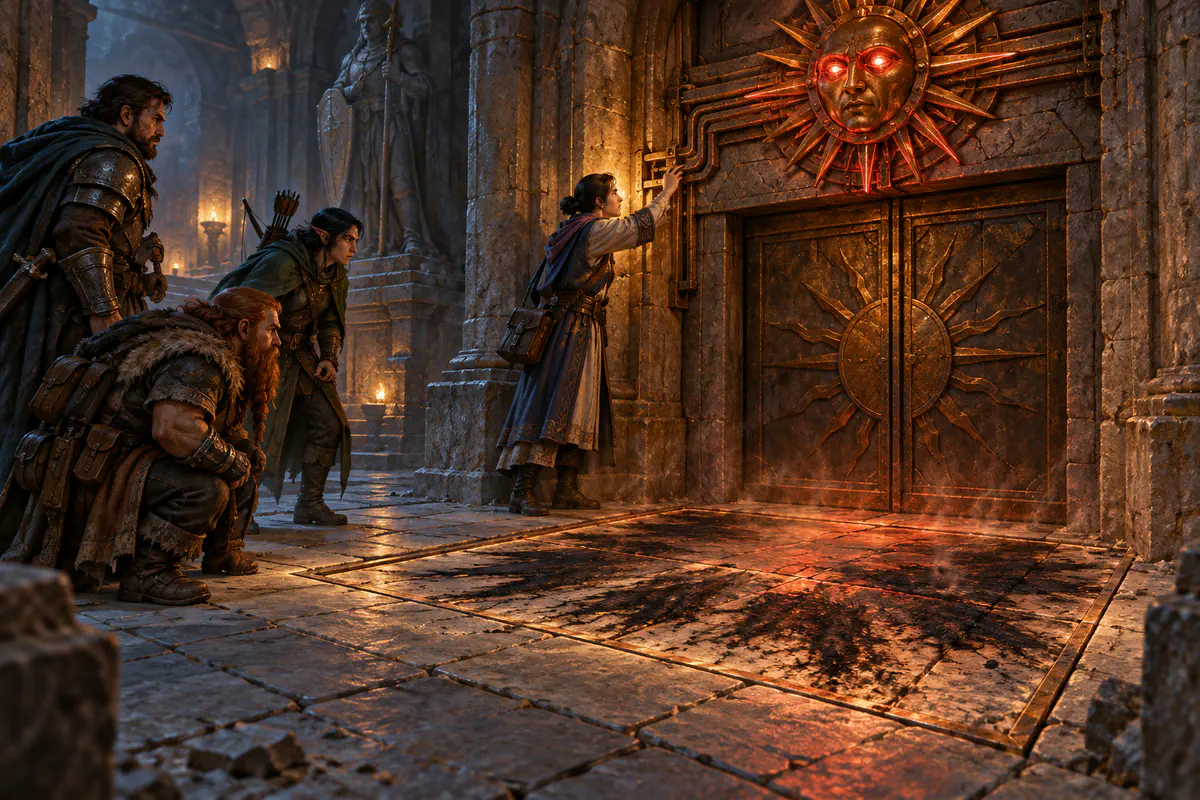
Purpose and warning: a bronze sun above a treasury door carries an original magical ward. Its rays brighten when someone approaches within 10 feet. The floor in front of the door is scorched.
Trigger and effect: touching the door without saying the phrase “Dawn follows dusk” starts the ward. Announce the sun turning red, then roll initiative for the scene. At initiative count 10 on the next round and each round thereafter, the ward emits fire into a marked 10-foot square directly before the door. Creatures there make a DC 12 Dexterity save: 1d6 fire damage on failure, none on success. The ward stops after three pulses or when disabled. This fixed initiative is part of this original trap’s design.
Solutions: leave the marked area; say the phrase; or use an action and a DC 13 Intelligence (Arcana) check to interrupt the exposed runes. A failed Arcana check spends the action but causes no extra pulse. The phrase is written in Common on a caretaker’s plaque beside the previous room’s entrance, freely readable in adequate light. For this original magical device, an action casting Dispel Magic on the sun also disables it without a check.
Reset: it rearms at the next dawn if not disabled. This is a bespoke magical device, not a Glyph of Warding spell. Do not apply its dispelling procedure to every magical trap. Its gradual activation demonstrates time pressure with a visible escape.
5. The quarry gate
Purpose and warning: quarry workers use a sliding grille to keep animals away from stored food. A sign reads “Secure the gate before unloading.” A crate rests on a clearly outlined floor plate; lifting it releases the grille across the doorway.
Trigger and effect: removing the crate’s weight closes the gate at once. It divides the room but does not hit or damage creatures; anyone in the doorway chooses which adjacent side to occupy. The enclosed room has air and another unlocked maintenance exit, visible behind movable sacks. Searching that wall exposes it without a check.
Solutions: leave equivalent weight on the plate, secure the gate with its visible locking bar before moving the crate, or use the maintenance exit. A DC 13 Strength check raises the closed gate long enough for one companion to pass; failure leaves it shut and can be retried, so if there is no urgency, resolve eventual passage without repeated rolling.
Reset: replace the weight and raise the gate. During a pursuit, track who remains on each side and let helping become a real decision. The chase guide provides ways to run the surrounding pursuit.
Handle unexpected solutions consistently
Ask what a tool, spell, or attack actually changes. A pole may press a plate from safety. Teleportation may bypass a barrier. Breaking a mechanism may stop the trap or release it, depending on its stated construction. Decide from those facts, not from whether the players found your preferred answer.
If an object can be attacked, provide its AC, hit points, and relevant material properties when that becomes necessary. Avoid turning every rope into an indestructible plot device. If you did not establish a special defense, do not add it only after a player uses a suitable spell.
For a longer trap sequence, use skill-only encounter guidance or integrate the mechanism into a heist. Several meaningful actions are better than five identical disarm rolls.
Trap preparation sheet
Write: purpose; obvious warning; concealed details and detection DC; exact trigger; affected area; effect and timing; reset; two solutions; failed-attempt consequence; and what changes after activation. A short, complete mechanism is easier to run fairly than a long description with an unspecified trigger.
Rules sources: 2014 trap guidance.
This work includes material taken from the System Reference Document 5.1 (“SRD 5.1”) by Wizards of the Coast LLC and available at https://dnd.wizards.com/resources/systems-reference-document. The SRD 5.1 is licensed under the Creative Commons Attribution 4.0 International License available at https://creativecommons.org/licenses/by/4.0/legalcode.