Stealth and Hiding 5e: Perception, Cover, and Attacks
Stealth is one of my favorite parts of exploration because it turns the environment into a puzzle. It is also a rule that depends heavily on circumstances: a high Stealth roll cannot hide someone standing in plain view, and invisibility does not automatically make a creature silent or unnoticed.
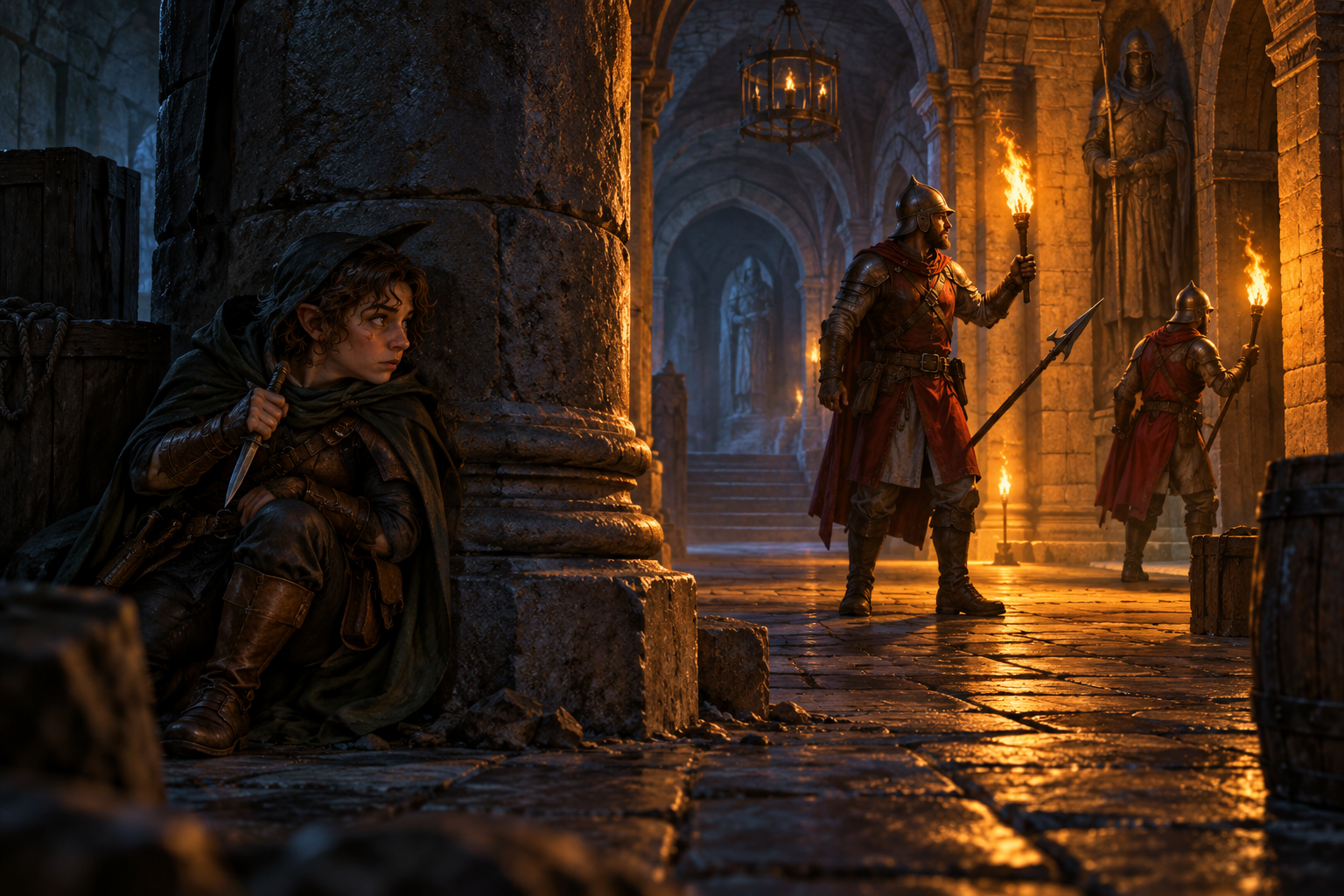
Stealth and Hiding 5e: Quick Answer
Under the 2014 rules, the DM decides whether circumstances allow a creature to hide. A creature that can be clearly seen cannot hide. When an attempt is possible, the creature makes a Dexterity (Stealth) check; its result is compared with active Wisdom (Perception) checks and with the passive Perception of creatures that might notice it.
Being hidden generally means an enemy does not know where you are well enough to see you. It is not a condition with one universal checklist in the 2014 rules, so sight, sound, movement, and the environment all matter.
How to Hide in the 2014 Rules
Resolve a hiding attempt in this order:
- Describe where and how the creature is trying to hide.
- The DM determines whether the circumstances make hiding possible.
- If the creature is clearly visible to an observer, it cannot hide from that observer.
- Make a Dexterity (Stealth) check and record the total.
- Compare that total with the passive Wisdom (Perception) scores of creatures that might notice the character.
- A creature that actively searches can make a Wisdom (Perception) check against the recorded Stealth result.
The same Stealth result normally continues until the hidden creature is discovered or stops hiding. The DM can call for another check when circumstances materially change.
Cover, Obscurement, and Line of Sight
Cover and obscurement often make hiding possible, but neither automatically hides a creature. A wall, pillar, thick foliage, darkness, or opaque fog may break sight long enough to attempt the check. The DM still considers whether the observer can see or hear signs of the creature.
Cover protects against attacks and some Dexterity saving throws; it is not itself the hidden state. Similarly, a heavily obscured area prevents normal sight into the area, but a creature may still reveal its location through noise or other evidence.
Passive Perception and Active Searching
Passive Perception represents what a creature notices without deliberately searching. Its usual value is 10 plus the creature’s Wisdom (Perception) modifier. If the creature has advantage on the relevant check, add 5; if it has disadvantage, subtract 5.
An active search uses a Wisdom (Perception) check. Under the 2014 hiding rule, that check contests the hidden creature’s recorded Dexterity (Stealth) result. The DM decides whether sight, hearing, distance, distractions, or obscurement affect the check.
Example: Sneaking Past a Guard
A rogue rolls 17 on Dexterity (Stealth). A distracted guard has passive Perception 13, so the guard does not notice the rogue automatically. If the guard hears something suspicious and actively searches, the guard must meet or beat the relevant DC under the table’s normal check procedure. The rogue’s roll never makes the rogue invisible; it represents how successfully the rogue avoids detection in the circumstances the DM allowed.
Does Invisibility Automatically Hide You?
No. An invisible creature is unseen, which is a major requirement for hiding, but creatures can still detect its location from footsteps, breathing, disturbed dust, tracks, or other signs. The 2014 hiding rule explicitly says an invisible creature can always try to hide, while also noting that signs of its passage can be noticed and it must remain quiet.
Invisibility can therefore make the attempt possible without making it succeed automatically. If the invisible creature has not hidden, enemies may still know its location even though attacks involving sight are affected.

Attacking While Hidden
When a hidden creature attacks a target that cannot see it, the unseen-attacker rule normally grants advantage on the attack roll. The attack reveals the attacker’s location when it hits or misses.
The timing means the attacker can receive advantage on that attack and then cease to be hidden. A feature that says otherwise can override the general rule.
Walking into clear view before attacking is different. The 2014 rules say that a creature approaching an alert enemy in combat is usually seen, although the DM can allow it to remain hidden when the enemy is sufficiently distracted. That is a circumstance-based DM determination, not a benefit granted by a high Stealth total alone.
Noise and Other Ways Hiding Ends
The 2014 rules specifically identify noise as a way to give away your position. Shouting a warning or knocking something over are straightforward examples. Leaving cover, entering clear sight, carrying a bright light, opening a visible door, or crossing a noisy surface may also make hiding impossible depending on the scene.
Because the 2014 rule leaves those circumstances to the DM, the fairest approach is to tell the player what their character can perceive before an action obviously exposes them.
Stealth and Hiding: 2014 vs. 2024 Rules
The 2024 Hide action is much more formalized. It requires a DC 15 Dexterity (Stealth) check while heavily obscured or behind three-quarters or total cover, and the creature must be outside every enemy’s line of sight. On a success, the creature has the Invisible condition while hidden and records the check total as the DC to find it.
The 2024 rule also lists explicit ways hiding ends: making a sound louder than a whisper, being found, making an attack roll, or casting a spell with a Verbal component. Those fixed requirements and ending triggers should not be imported into a 2014 game as though they were the original rule.
Stealth and Hiding FAQ
Can you hide in dim light?
Not automatically. Dim light lightly obscures an area and hinders sight-based Perception, but whether it conceals a particular creature enough to hide remains the DM’s decision in the 2014 rules.
Does a natural 20 always succeed on a Stealth check?
No. A natural 20 does not automatically succeed on a normal ability check, and the DM may determine that hiding is impossible before any roll is made.
Can you hide from one enemy but not another?
Yes. Different observers can have different lines of sight and Perception scores. A pillar might conceal you from a guard on one side while leaving you visible to another.
Does moving while hidden require another Stealth check?
Not automatically. The DM decides when changed circumstances require a new check or expose the creature. Speed, noise, terrain, and crossing open ground can all matter.