Black Pudding 5e: Split, Corrosion, and Dungeon Tactics
This guide uses 2014 D&D 5e and SRD 5.1. Open the for its statistics. The cistern, movement choices, and diversion procedure below are original DM suggestions.
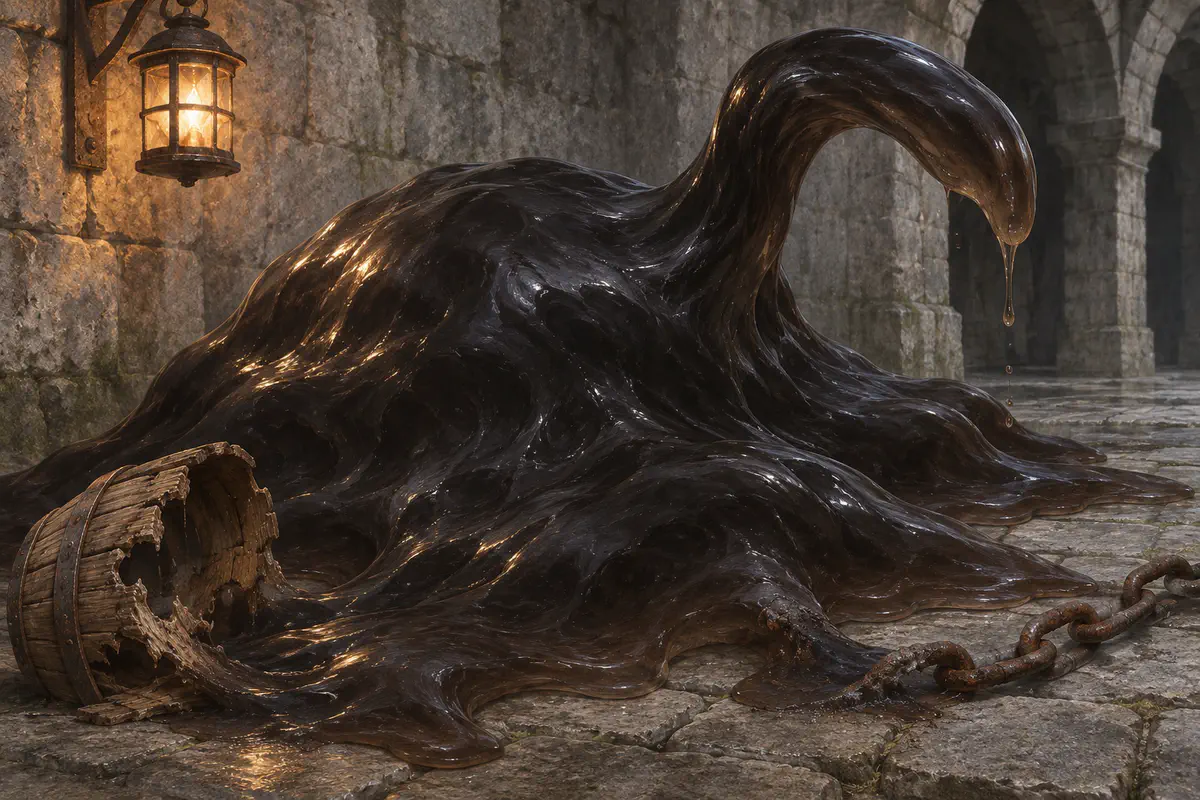
Monster overview
A black pudding is a Large ooze, an amorphous mass of dark material that creeps across stone and climbs walls or ceilings. Its body corrodes wood and metal. A chamber with half-eaten fittings and a glossy stain spreading over a pillar can introduce the creature before anyone recognizes an active threat.
Its adventure role suits ruined workshops, subterranean drains, and neglected storage chambers. It has Intelligence 1 and no language, making a dangerous obstacle or persistent scavenger a useful starting point for its behavior. Give the party an objective beyond defeating it, such as opening a sluice or recovering something from a safe shelf. The resulting encounter rewards noticing its route and choosing effective tools.
Damage types and the Split reaction
A black pudding is CR 4, with AC 7 and 85 hit points. Its low AC makes it easy to hit, but it is immune to acid, cold, lightning, and slashing damage. Those immunities also apply to magical damage of the listed types. Fire, force, piercing, and bludgeoning are examples of damage types this stat block does not resist or ignore.
Lightning and slashing can also trigger Split. As a reaction, a pudding that is Medium or larger and has at least 10 hit points divides into two puddings, each one size smaller. Each receives half its current hit points, rounded down. A Large pudding at 85 hit points becomes two Medium puddings at 42 each. The triggering damage is still subject to its immunity.
Splitting changes the number of creatures taking turns. It supplies no immediate free attack. For this encounter, keep the new puddings on the original initiative count and give them their first turns on that count in the next round. This is an initiative ruling for replacement creatures.
A Medium pudding can split into two Small ones if it still qualifies. Small puddings cannot use Split. The reaction changes size and current hit points without reducing attack damage, so each smaller pudding retains the full Pseudopod damage. Keep each creature’s hit points and reaction available in the initiative tracker. Avoid increasing its challenge by secretly adding splitting triggers beyond the listed damage types.
How Corrosive Form damages equipment
A creature touching the pudding, or hitting it with a melee attack from within 5 feet, takes 1d8 acid damage. This can apply to an unarmed strike or melee spell attack as well as a weapon hit. A magical weapon avoids the equipment corrosion described below, but the wielder can still take the acid damage for a qualifying melee hit.
Any nonmagical metal or wooden weapon that hits corrodes, acquiring a permanent, cumulative −1 penalty to damage rolls after damage is resolved. At −5, the weapon is destroyed. The trait also destroys nonmagical metal or wooden ammunition after a hit. Reach can help a wielder stay outside the 5-foot acid trigger while still leaving a qualifying weapon exposed to corrosion.
The separate Pseudopod attack deals bludgeoning and acid damage. When it hits a target wearing nonmagical armor, the armor also takes a cumulative −1 penalty to the AC it offers. The armor is destroyed if that penalty reduces its AC to 10. Track the armor’s contribution separately from the wearer’s Dexterity, shield, and other bonuses.
The weapon penalty affects damage rolls, rather than attack rolls. Corrosion is permanent, so the party should account for lost protection and damaged weapons after the fight. Budget a replacement route when using this monster far from town. The rust monster guide offers another encounter built around threats to equipment.
Walls, ceilings, and escape routes
The pudding moves and climbs at 20 feet. Spider Climb lets it traverse difficult surfaces and hang upside down without a check. Amorphous lets it pass through an opening as narrow as 1 inch. A raised platform can buy distance, but reachable walls give it a route upward.
It also eats through 2 inches of nonmagical wood or metal in a round. A wooden door can delay pursuit, depending on its thickness and the creature’s approach. In contrast, its printed corrosion trait supplies no ability to dissolve stone. Make those materials and routes clear to players.
Its blindsight reaches 60 feet, beyond which it is blind. Darkness alone provides little protection inside that radius. Describe eaten hinges, surviving ceramic pipes, and movement overhead early enough to prompt a change of plan. Use the normal resistance and immunity rules as the party tests different attacks.
Ready to run — the blocked cistern sluice

Situation. One black pudding occupies a cistern’s maintenance room. The party must turn a sluice wheel to restore the settlement’s water supply. The water steward offers 100 gp for opening it. The creature is near the mechanism, making access the immediate problem.
Layout. The room is 60 feet long and 40 feet wide, with a southern entrance. A central stone pier stands 30 feet inside. The wheel is fixed to its northern face. The pudding begins on the pier’s southern face. A 5-foot-wide limestone ledge runs along the eastern wall, 5 feet above a shallow channel, reaching a landing beside the wheel. Stone steps connect both ends of the ledge to the floor. A separate wooden inspection door opens west.
Opening. A lantern reveals dissolved bars and the ooze moving over the pier. The ledge and ceramic pipes remain intact. Start initiative when someone enters within 30 feet of the pier. In this scene, the pudding advances toward the nearest creature it can perceive.
Choices. One character can draw it toward the western door while companions take the eastern ledge. Movement and the pudding’s climbing speed govern how much time they gain. Turning the unjammed wheel requires two actions by adjacent characters, who can share the work. There is no check. The diverted water does not damage the pudding. Leaving and returning with suitable ranged attacks is also possible.
If combat begins. The pudding moves toward the nearest accessible target and uses Pseudopod when within reach. It uses Split when eligible. It can climb after anyone on the ledge. When everyone withdraws beyond its perception, it follows their last known direction toward the southern passage, then searches there. It does not acquire knowledge of their route beyond its senses.
Finish. Opening the sluice earns the reward even if the pudding survives. The steward then bars access to the maintenance room until a crew can clear it. If the party retreats first, the town continues rationing water while they prepare another attempt.
Adjust the encounter for your party
A Pseudopod hit averages 24 total damage before defenses, and lost armor can make later hits easier. Use the encounter balancing guide with effective damage types and escape options in mind. For an easier objective, one action opens the wheel from the eastern landing. For a harder objective, reopening a second wheel requires crossing the chamber again. Compare the pudding with the gelatinous cube and browse Underdark encounters for the next chamber.