Enthrall 5e: Perception, Stealth, and Distraction Rules
I like Enthrall for a plan where one character becomes the obvious person to watch while companions work quietly elsewhere. Its value depends on what those companions can actually hide behind and whether the audience keeps listening. This guide explains the 2014 spell before comparing the revised version.

Enthrall 5e Quick Spell Reference
- Casting time
- 1 action
- Range
- 60 feet
- Components
- V, S
- Duration
- 1 minute
- Classes
- Bard, Warlock
You weave a distracting string of words, causing creatures of your choice that you can see within range and that can hear you to make a wisdom saving throw. Any creature that can’t be charmed succeeds on this saving throw automatically, and if you or your companions are fighting a creature, it has advantage on the save. On a failed save, the target has disadvantage on Wisdom (Perception) checks made to perceive any creature other than you until the spell ends or until the target can no longer hear you. The spell ends if you are incapacitated or can no longer speak.
How Does Enthrall Work in 2014?
Choose creatures you can see within 60 feet that can hear you. Each makes a Wisdom save against your spell save DC. The spell has no stated numerical target cap, though every target must meet those requirements when selected.
On a failed save, a target has disadvantage on Wisdom (Perception) checks to perceive creatures other than you. The effect lasts up to a minute, provided the target can still hear you and the spell has not otherwise ended. The audience can still perceive the caster normally.
The 2014 spell requires an action, verbal and somatic components, and no material component. It uses no concentration, so the caster can maintain another concentration spell while Enthrall is active, subject to normal casting rules.
There is no shared-language requirement in the spell. The targets need to hear the distracting words, but the text does not require them to understand those words. An actual conversation or cover story may still depend on a language the audience understands.
Who Automatically Saves, and What Changes in Combat?
A creature that cannot be charmed automatically succeeds on the 2014 save. A creature you or your companions are fighting instead has advantage on the save. The combat exception does not automatically defeat the 2014 spell, but it makes the distraction less reliable.
Despite that charm-immunity clause, Enthrall itself does not apply the charmed condition. Its benefit is the specified Perception disadvantage. A target retains its actions, can attack the caster, and receives no instruction to become friendly or follow orders.
The spell also grants no advantage on Persuasion or Deception checks. Those checks still resolve according to the interaction. Treat the audience’s attention as an opening for a plan, with the printed Perception modifier as its mechanical support.
The 2014 spell lists no repeat Wisdom save each round. Damage to a target is not one of its stated ending triggers either. An attack can still reveal a hidden companion’s position or prompt guards to act on information they already have.
How Does Enthrall Affect Passive Perception?
Under the 2014 passive-check rules, disadvantage on the relevant Perception check subtracts 5 from passive Perception. Enthrall applies that adjustment when the target is trying to notice another creature. It leaves detection of the spellcaster alone.
For example, a guard with passive Perception 14 who fails the spell’s save uses 9 when noticing a concealed rogue. If the guard actively searches for that rogue, roll its Perception check with disadvantage instead of subtracting 5 from an ordinary roll.
Apply the ordinary cancellation rules if another effect grants advantage on the same relevant check. A circumstance producing both advantage and disadvantage uses neither. A guard’s exact senses and the way the rogue is concealed can therefore change the calculation.
Can Enthrall Help a Rogue Sneak Past Guards?
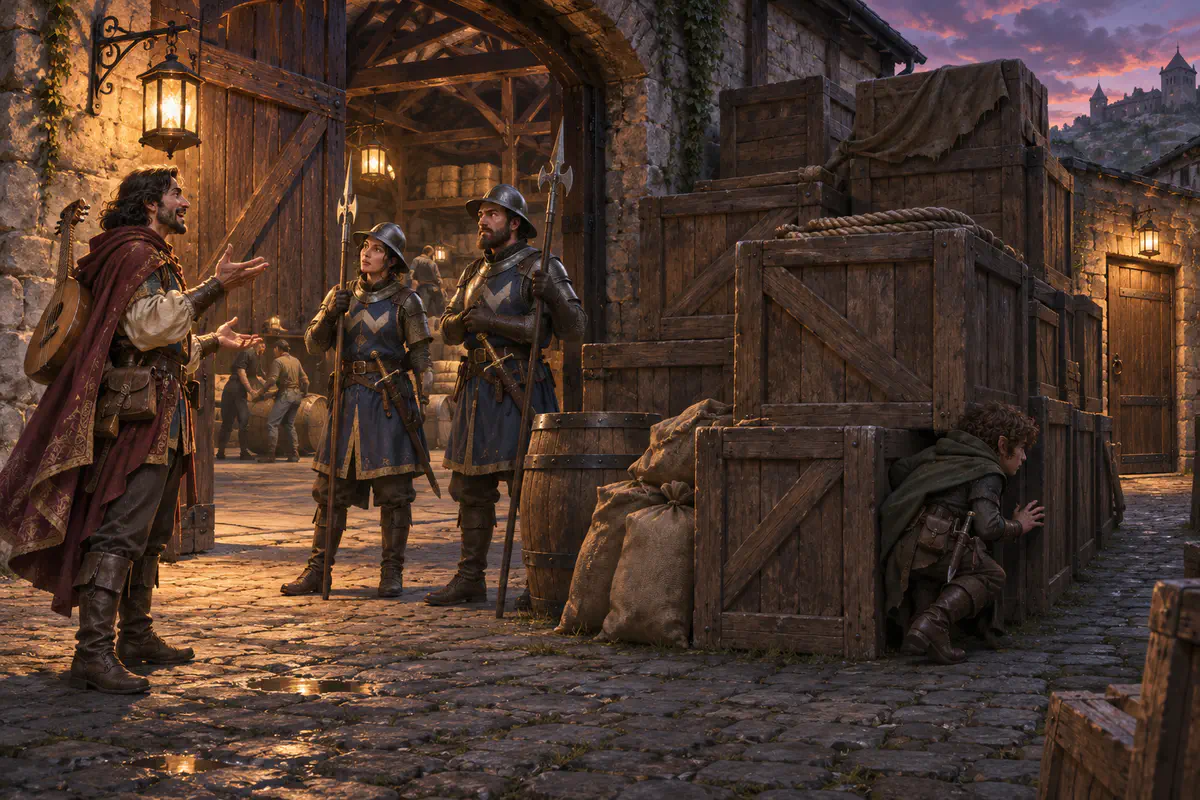
It can help when the rogue has a route that permits hiding. A side passage behind tall crates or a wall can provide the needed concealment. Enthrall then makes an affected guard worse at noticing the concealed creature.
Suppose the rogue’s Dexterity (Stealth) total is 12 and the guard’s relevant passive Perception has fallen from 14 to 9. The new comparison favors the rogue. The DM still decides whether the circumstances permit that attempt to hide. Walking openly through a clearly watched doorway gives the guard direct visual information, regardless of a good roll.
An unhurried plan can place the caster in view, wait for the distraction to take effect, and send companions along the concealed route. If the situation becomes a timed confrontation, use initiative and resolve the actual actions in order. The spell supplies no automatic surprise round or free movement for allies.
Its verbal and somatic components can also make the casting noticeable. Enthrall does not erase the audience’s awareness that someone just spoke and gestured. Decide how the guards respond to that before relying on it as an unnoticed intrusion.
What Ends Enthrall?
For an affected target, losing the ability to hear the caster ends the effect on that target. A closed, sound-blocking barrier or a silence effect can matter for that reason. The whole 2014 spell ends if the caster is incapacitated or can no longer speak. It also ends when its one-minute duration expires.
The spell assigns no additional action that must be spent each turn. The caster can take other actions while continuing to meet the speech and hearing requirements. It also gives no option to add newly arriving listeners to an existing casting.
The 60-foot range governs target selection. Moving beyond 60 feet after casting is not, by itself, a listed ending condition. Hearing still has to continue, and the spell supplies no fixed distance at which a voice remains audible through every environment.
Enthrall: 2014 vs. 2024 Rules
Both versions are 2nd-level bard and warlock spells with a 60-foot range and verbal and somatic components. Their effect and upkeep change substantially.
| Feature | 2014 version | 2024 version |
|---|---|---|
| Duration and upkeep | One minute, with speech and continued hearing requirements | Concentration, up to one minute |
| Perception effect | Disadvantage when perceiving creatures other than the caster | −10 to Wisdom (Perception) checks and passive Perception generally |
| Targets already fighting the caster or companions | Advantage on the initial save | Automatic success on the initial save |
| Immunity to being charmed | Automatic success on the initial save | The revised text has no charm-immunity exception |
| Hearing | Target must hear the caster, and the effect ends for it if that stops | The revised targeting text requires sight from the caster but has no target-hearing requirement |
The revised spell still imposes its stated penalty without giving the charmed condition. Its broader Perception penalty can also affect noticing the caster, and it competes with other spells for concentration. The caster still needs to provide the verbal component when casting it.
Enthrall FAQ
Does Enthrall prevent opportunity attacks?
It changes Perception checks. A target that can see a creature leave its reach can still make an opportunity attack under the normal rules. A successful hiding plan may change what the target can see, but that requires resolving the actual circumstances.
Does Enthrall make the audience forget what happened?
The spell gives no memory-altering effect. Observers can remember the performance and whatever else they noticed.
Does upcasting Enthrall improve its effect?
Neither the 2014 spell nor the revised version provides a higher-slot improvement. Using a larger slot adds no listed targets, duration, or stronger penalty.