Earthquake 5e: Fissures, Building Damage, and Save Timing
I like Earthquake as a spell that makes the battlefield itself the problem. A gate, a tower, and the routes beneath everyone’s feet can become more important than an enemy’s Armor Class. That scale also makes timing and collateral damage worth settling before casting. This guide starts with the 2014 rules.

Earthquake 5e Quick Spell Reference
- Casting time
- 1 action
- Range
- 500 feet
- Components
- V, S, M (A pinch of dirt, a piece of rock, and a lump of clay.)
- Duration
- Concentration, up to 1 minute
- Classes
- Cleric, Druid, Sorcerer
You create a seismic disturbance at a point on the ground that you can see within range. For the duration, an intense tremor rips through the ground in a 100-foot-radius circle centered on that point and shakes creatures and structures in contact with the ground in that area.
The ground in the area becomes difficult terrain. Each creature on the ground that is concentrating must make a constitution saving throw. On a failed save, the creature’s concentration is broken.
When you cast this spell and at the end of each turn you spend concentrating on it, each creature on the ground in the area must make a dexterity saving throw. On a failed save, the creature is knocked prone.
This spell can have additional effects depending on the terrain in the area, as determined by the GM.
Fissures. Fissures open throughout the spell’s area at the start of your next turn after you cast the spell. A total of 1d6 such fissures open in locations chosen by the GM. Each is 1d10 x 10 feet deep, 10 feet wide, and extends from one edge of the spell’s area to the opposite side. A creature standing on a spot where a fissure opens must succeed on a dexterity saving throw or fall in. A creature that successfully saves moves with the fissure’s edge as it opens.
A fissure that opens beneath a structure causes it to automatically collapse (see below).
Structures. The tremor deals 50 bludgeoning damage to any structure in contact with the ground in the area when you cast the spell and at the start of each of your turns until the spell ends. If a structure drops to 0 hit points, it collapses and potentially damages nearby creatures. A creature within half the distance of a structure’s height must make a dexterity saving throw. On a failed save, the creature takes 5d6 bludgeoning damage, is knocked prone, and is buried in the rubble, requiring a DC 20 Strength (Athletics) check as an action to escape. The GM can adjust the DC higher or lower, depending on the nature of the rubble. On a successful save, the creature takes half as much damage and doesn’t fall prone or become buried.
What Area Does Earthquake Affect?
Choose a point on the ground you can see within 500 feet. The tremor affects a 100-foot-radius circle, making a 200-foot-wide area of difficult terrain for up to a minute while you maintain concentration. The described shaking affects creatures and structures in contact with the ground there.
The area includes allies and the caster if they occupy affected ground. Positioning outside that radius matters even when the chosen center is within casting range. The spell gives no option to exempt selected friends.
Walking through the difficult terrain normally costs an extra foot of movement per foot traveled. Being knocked prone then creates a separate choice about standing or crawling. The spell does not reduce every affected creature’s speed to zero.
When Do Creatures Save and Structures Take Damage?
The 2014 spell has several distinct triggers.
| Timing | Printed 2014 effect |
|---|---|
| When the spell is cast | Grounded creatures in the area make Dexterity saves against falling prone. Qualifying structures take 50 bludgeoning damage. |
| End of the caster’s casting turn | Grounded creatures make the end-of-turn Dexterity save if concentration continues. |
| Start of the caster’s next turn | One batch of fissures opens if that additional terrain effect is used. Qualifying structures take another 50 damage. |
| End of each later turn spent concentrating | Grounded creatures repeat the Dexterity save. |
| Start of each later caster turn while the spell continues | Qualifying structures take another 50 damage. |
Casting and the end of that same turn are separate triggers. A creature can therefore need two Dexterity saves during the casting turn. The structural damage repeats at the start of later turns in the 2014 spell.
There is also a separate Constitution save for grounded creatures that are concentrating, with failure breaking their concentration. Use the caster’s spell save DC. The 2014 paragraph does not specify a repeat schedule for this save. A workable DM ruling is to resolve it when the tremor first affects a concentrating creature, with any later repeats agreed before play. Keep that adjudication distinct from the explicit recurring Dexterity saves.
This spell-specific Constitution save is also separate from a normal concentration saving throw caused by damage. A creature injured by falling or collapsing masonry can face that ordinary rule as well.
How Do Earthquake’s Fissures Work?
In 2014, the DM determines additional effects based on the terrain. If fissures occur, 1d6 fissures open at the start of the caster’s next turn in locations the DM chooses. Each is 10 feet wide, 1d10 × 10 feet deep, and stretches from one edge of the spell’s area to the opposite edge.
That is a single batch of fissures. The spell does not generate a fresh 1d6 every round. A creature standing where a fissure opens makes a Dexterity save. Success carries it with the opening edge; failure drops it into the gap.
Use the normal falling rules for the distance actually fallen. A 40-foot drop, for example, normally deals 4d6 bludgeoning damage. Abilities that prevent a fall or change falling damage still need their own requirements met.
A fissure opening beneath a structure causes automatic collapse in the 2014 spell. That can matter even if repeated 50-damage pulses have not reduced the structure to zero hit points. The caster cannot guarantee a particular fissure placement.
Does Earthquake Deal 50 Damage to Every Creature?
The fixed 50 bludgeoning damage applies to structures in contact with affected ground. The basic tremor makes creatures save against falling prone. Creature damage comes from further consequences such as falls or collapsing structures.
The DM must establish what counts as a structure and assign its hit points. The spell supplies no universal hit-point total for a fortress, bridge, or wall section. Describe the intended target and agree on how its parts are represented before relying on demolition timing.
For example, suppose the DM gives a freestanding gatehouse 120 hit points and no relevant damage defenses. If no fissure opens beneath it, the initial pulse leaves 70 hit points, the next start-of-turn pulse leaves 20, and the following pulse collapses it. That is an example using assigned building statistics.
Collapsing Structures and Escaping Rubble
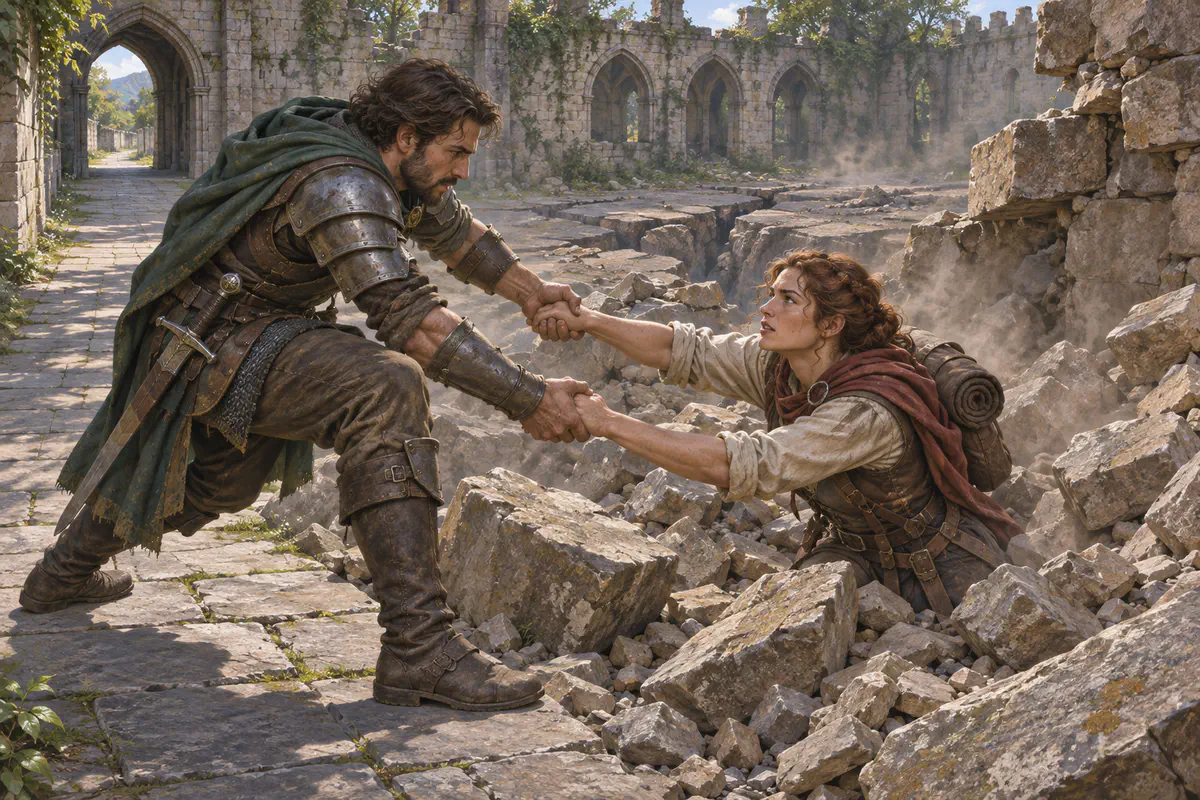
When a structure reaches zero hit points, it collapses. Creatures within a distance equal to half its height make a Dexterity save. A 40-foot tower therefore threatens creatures within 20 feet of it under this rule.
On a failed save in 2014, a creature takes 5d6 bludgeoning damage, falls prone, and is buried. On a successful save it takes half damage and avoids being knocked down or buried by that collapse.
Escaping the rubble requires an action and a DC 20 Strength (Athletics) check. The DM can adjust that DC for the rubble’s nature. The printed procedure does not itself add the restrained condition, ongoing crushing damage, or a fixed suffocation timer. Further environmental consequences and assistance from allies need the DM’s ruling.
The ground-contact requirement protects a flyer from the basic shaking, but the separate collapse rule can still threaten a flying creature within its stated distance. Before casting, identify people above, beneath, and beside the target structure.
Concentration, Ending the Spell, and Higher Slots
Concentration keeps the tremor running and can end voluntarily at any time. If you end it before your next turn begins, the delayed fissure trigger and later damage pulses never arrive. The initial effects have already happened.
Stopping the tremor provides no rebuilding effect for destroyed structures or healing for injured creatures. Decide how the damaged site can be crossed and repaired afterward. The spell gives no special benefit for using a 9th-level slot.
Earthquake: 2014 vs. 2024 Rules
The revised spell keeps its 8th-level slot, 500-foot range, 100-foot radius, and concentration duration. Several resolution details change substantially.
| Feature | 2014 version | 2024 version |
|---|---|---|
| Concentration disruption | Separate Constitution-save paragraph | Failing the recurring Dexterity save both knocks the creature prone and breaks its concentration |
| Fissure timing | Start of the caster’s next turn | End of the turn on which it is cast |
| Fissure placement | DM chooses locations; a fissure beneath a structure automatically collapses it | Caster chooses locations, which cannot be beneath structures |
| Repeating structural damage | Start of later caster turns | End of the caster’s turns, including the casting turn |
| Failed collapse save | 5d6 bludgeoning damage, prone, buried | 12d6 bludgeoning damage, prone, buried |
| School and materials | Evocation, with dirt, rock, and clay | Transmutation, with a fractured rock |
The 2024 wording lets the caster also cause the listed fissure and structural effects. Its end-of-turn structural pulse can cause 100 total structural damage on the casting turn when that effect is used. Use the 2014 timing with the SRD 5.1 reference above.
Earthquake FAQ
Can Earthquake knock over any building automatically?
A qualifying structure collapses when damage reduces it to zero hit points. In 2014, a fissure directly beneath it is another explicit collapse trigger. Whether the terrain produces fissures and where they appear are DM decisions in that version.
Can the caster be knocked prone by their own Earthquake?
Yes, if the caster is on affected ground when a Dexterity-save trigger occurs. Falling prone by itself does not end concentration, but the separate concentration-disruption rule and any damage still matter.
Does Earthquake affect a creature that walks into the area later?
The difficult terrain applies immediately. The next explicit recurring prone-save trigger is the end of a caster turn spent concentrating. Entering the area alone is not listed as an extra Dexterity-save trigger.