Tarrasque 5e: Reflective Carapace, Swallow, and Tactics
This guide uses 2014 D&D 5e and SRD 5.1. Open the for its statistics and legendary actions. The ferry evacuation and the creature’s priorities in that scene are original DM suggestions.

Monster overview
The tarrasque is a Gargantuan monstrosity with the titan tag, a colossal reptilian creature whose horns, teeth, claws, and armored body make it a walking threat to a settlement. Its reflected magic and ability to swallow adventurers make fighting it at close range exceptionally dangerous. Its Intelligence 3 and lack of language give it a different adventure role from a calculating dragon or undead ruler.
Use the tarrasque when location and consequences deserve as much attention as reducing hit points. A harbor evacuation, a threatened bridge, or an exposed district can give a party a concrete goal while the creature advances. Describe its route and the people in danger early enough for players to plan. Its stat block alone gives no scripted sequence of targets or guaranteed response to a distraction.
What are the tarrasque’s main defenses?
The SRD creature is CR 30, with AC 25 and 676 hit points. It is immune to fire, poison, and bludgeoning, piercing, and slashing damage from nonmagical attacks. Magical weapons can bypass the last immunity. It also has advantage on saves against spells and other magical effects, plus three daily Legendary Resistances that can replace failed saves with successes.
Its condition immunities cover charmed, frightened, paralyzed, and poisoned. Check the listed damage types and conditions when the party proposes a tactic. The resistance and immunity guide helps resolve mixed-damage attacks.
The 2014 SRD stat block has no regeneration trait or requirement to finish it with wish. Its danger comes from its defenses, attacks, and extra actions. Use the usual rules for resolving a defeated monster.
Which spells does Reflective Carapace stop?
Reflective Carapace applies when the tarrasque is targeted by magic missile, a line spell, or a spell requiring a ranged attack roll. Roll a d6. On 1–5 the creature is unaffected. On 6 it remains unaffected and the effect reflects at the caster, making that caster the target.
The feature has no reaction cost, so using it does not consume the creature’s reaction. It also has no limit of once per round.
| Attack or spell | Relevant defense |
|---|---|
| Magic missile | Reflective Carapace applies despite the absence of an attack roll. |
| Lightning bolt | The line shape triggers Reflective Carapace despite its saving throw. |
| Eldritch blast or ray of frost | The ranged spell attack triggers Reflective Carapace. |
| Fireball | Its sphere and saving throw avoid the reflection trigger, but fire immunity prevents its fire damage. |
| Sacred flame | Its Dexterity save and radiant damage avoid those particular barriers. Magic Resistance and available Legendary Resistances still matter. |
| Magical bow attack | Reflective Carapace concerns spells. The attack still has to hit AC 25. |
Read the actual spell’s targeting, shape, and damage type before deciding. Having a saving throw does not, by itself, settle whether a spell is a line.
Bite, Swallow, and getting someone out
The tarrasque’s Multiattack can include Frightful Presence and then five attacks. Its Bite grapples a creature it hits, with escape DC 20, and restrains that creature while the grapple lasts. It cannot bite a different target during that grapple.
Swallow makes another Bite attack against a Large or smaller creature the tarrasque is already grappling. A hit deals Bite damage, swallows the target, and ends the grapple. Multiattack can replace its Bite with Swallow. A legendary Chomp can also use Swallow, so a grappled character may face it before their next turn.
Inside, a swallowed creature is blinded and restrained, has total cover from outside attacks and effects, and takes 16d6 acid damage at the start of each tarrasque turn. Check any rescue spell’s targeting requirements against that cover. A swallowed character can still use actions that its conditions and the action’s requirements permit.
If one creature inside deals 60 or more damage on a single turn, the tarrasque makes a DC 20 Constitution save at the end of that turn. Failure regurgitates all swallowed creatures, who land prone within 10 feet. Damage spread across several turns does not meet the trigger. If it dies, a swallowed creature can exit the corpse using 30 feet of movement, emerging prone. Review grappled and restrained before running the sequence.
Can a flying character defeat the tarrasque?
Flight can create a real advantage in open terrain. The 2014 creature has no listed flying speed or ranged attack. A character staying beyond its reach still needs an attack that works against its defenses, sufficient range, and enough time to deal with 676 hit points.
Account for its extra movement. Its speed is 40 feet, and its legendary Move supplies another 20 feet per use. With three available legendary actions and enough other turns, it can move another 60 feet between turns. Dash can add movement on its own turn if it gives up its action for that purpose.
Measure vertical separation against the attack being used. Tail reaches 20 feet, Claw 15, and Bite 10. A modest hover height may still leave a character exposed. State any added rock throw or special leap as a homebrew change before relying on it.
A flying hero can remain safe while buildings below are destroyed. Siege Monster doubles damage to objects and structures, so an evacuation objective makes time and positioning consequential without changing the printed creature.
Ready to run — the last ferry
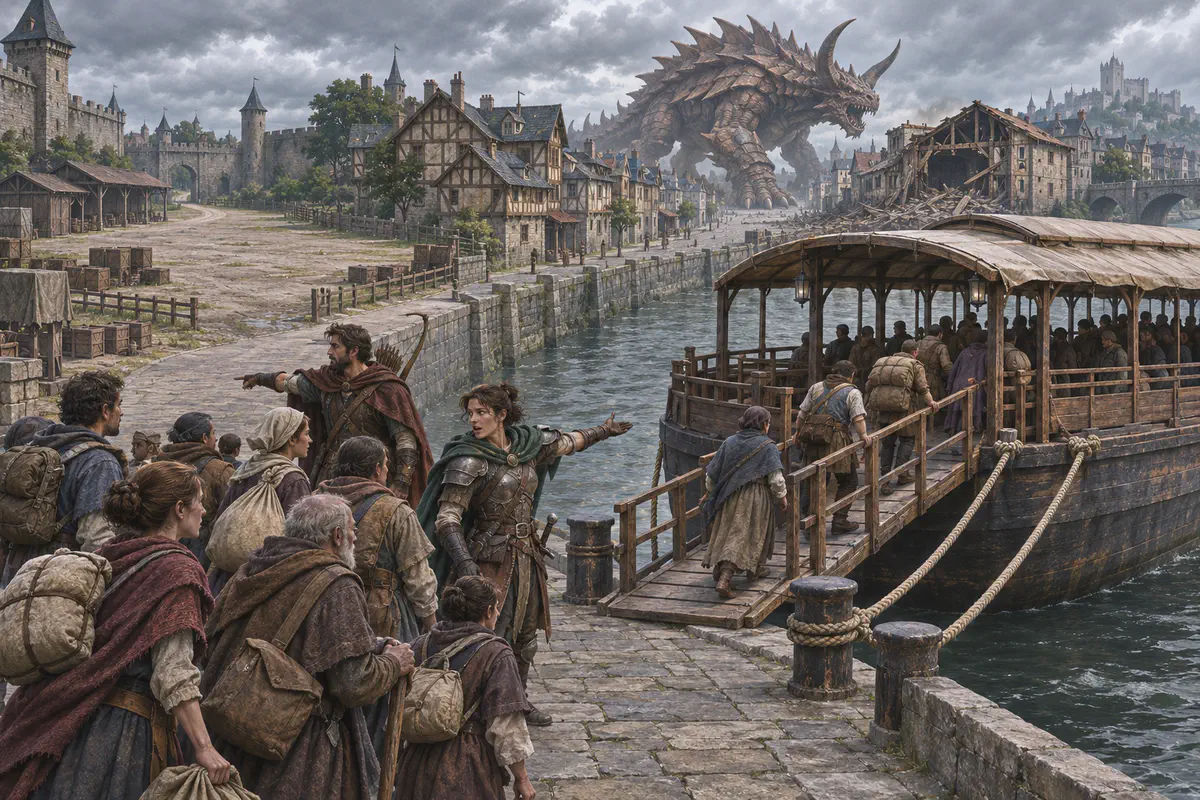
Situation. One tarrasque has reached a river district. Twenty civilians are waiting beside the last passenger ferry, and the party must get them aboard and release the vessel. The ferryman can steer once they are clear. Success is the evacuation.
Layout. The ferry sits at the southern end of a broad stone quay. The characters start beside its gangplank. The tarrasque starts 180 feet north of the gangplank, beside an already empty warehouse. An open freight yard leads west, away from the passengers. Place all waiting civilians within 20 feet of the gangplank. Mark the creature’s occupied space and measure movement and reach from its edges.
Opening. Roll initiative as the warehouse timbers begin to break. The ferryman explains that the rescue needs six actions of work at the gangplank or moorings, shared among the party. Four actions guide the passengers aboard, five people at a time. The last two release the mooring lines. No check is required. Explain these tasks before the first player acts.
Choices. The party can divide the work, use appropriate transport magic, or draw the creature toward the empty freight yard. For this scene, a damaging attack from a source it can perceive makes it pursue that source on its next turn. That is its prepared behavior, with movement still governed by its statistics. The party can also flee west on foot, helping any passengers who follow.
If combat begins. On its first turn, and with its legendary actions until its next turn, the tarrasque attacks the empty warehouse. On following turns it advances toward the ferry or a successful diversion, using legendary Move when useful. Use Multiattack against reachable targets and Dash when closing distance is more useful. Resolve Frightful Presence when it uses that feature, including its repeat saves. Frightened characters can still retreat away from it. Once the six work actions are complete and the rescuers are aboard, the ferryman casts off at the end of that turn. Track actual distances throughout.
Finish. The loaded ferry carries the civilians to the opposite bank, and the city pays the party 2,000 gp. The tarrasque continues through the district in this scenario. If the party abandons the ferry, the civilians scatter west and the city loses the opportunity to evacuate them together. Survivor recovery becomes the next objective.
Adjust the encounter for your party
Use the encounter balancing guide before allowing this evacuation to become a direct CR 30 battle. For an easier rescue, begin with the creature 300 feet away and two boarding actions already complete. For a harder objective, an injured passenger waits in a nearby doorway and needs an escort to reach the gangplank. Use the initiative tracker for legendary movement, and browse urban encounters for the aftermath.