How to Run Time-Pressure Encounters in D&D 5e: Ticking Clocks, Countdowns, and Urgent Stakes
Time-pressure encounters turn “we take our time” into “we have to act now.” A good ticking clock creates tension, forces meaningful choices, and keeps the table moving—without needing to ramp up monster damage. When done well, time pressure makes the world feel alive because events continue whether or not the party acts.
Key Takeaways
- Time pressure works best when players clearly understand the deadline and consequences.
- Use a visible clock so urgency feels real and decisions happen faster.
- Advance the clock on in-game actions or decisions, not real-world minutes (most of the time).
- Design outcomes as “fail forward.” Missing the deadline should change the situation, not stop the story.
- Add tradeoffs, not just danger—players should have to choose what matters most.
- Give players ways to buy time with clever skills, spells, or sacrifices.
What Is a Time-Pressure Encounter?
A time-pressure encounter is any scene where time itself is a resource. The party has a limited window to act before something changes:
- A ritual completes
- A building collapses
- Reinforcements arrive
- An alarm is triggered
- A flood, fire, or poison spreads
Every ticking clock has three parts:
- The deadline — what happens when time runs out
- The tracker — how you measure remaining time
- The consequences — what changes as the clock advances
Time doesn’t need to be literal seconds. A “clock” can represent progress, attention, danger, or opportunity slipping away.
Why Time Pressure Makes Encounters Better
Time pressure naturally creates:
- Momentum — less overplanning, more action
- Tension — every choice feels risky
- Meaningful decisions — you can’t do everything
Even simple scenes become memorable when players must decide what they’re willing to give up to beat the clock.
Choose the Right Type of Clock
Soft Clocks (Flexible and Narrative)
Best for: investigations, travel, social scenes, stealth, heists
- The clock advances based on player choices or failed checks
- Ideal when you want urgency without strict round-by-round timing
Examples:
- Each failed check advances the guard patrol clock
- Each room searched advances the villain’s plan
Hard Clocks (Fixed Countdown)
Best for: collapsing rooms, flooding chambers, chases, disasters
- The clock advances at a predictable rate (rounds or turns)
- Excellent for environmental threats
Example:
- “In 6 rounds, the chamber is fully flooded.”
Hybrid Clocks (Predictable but Interactive)
Best for: cinematic set pieces
- The clock advances steadily, but players can slow, redirect, or pause it
- Rewards clever thinking and teamwork
This is often the most satisfying option for big scenes.
5 Easy Ticking-Clock Mechanics
1) Progress Clock (6 or 8 Segments)
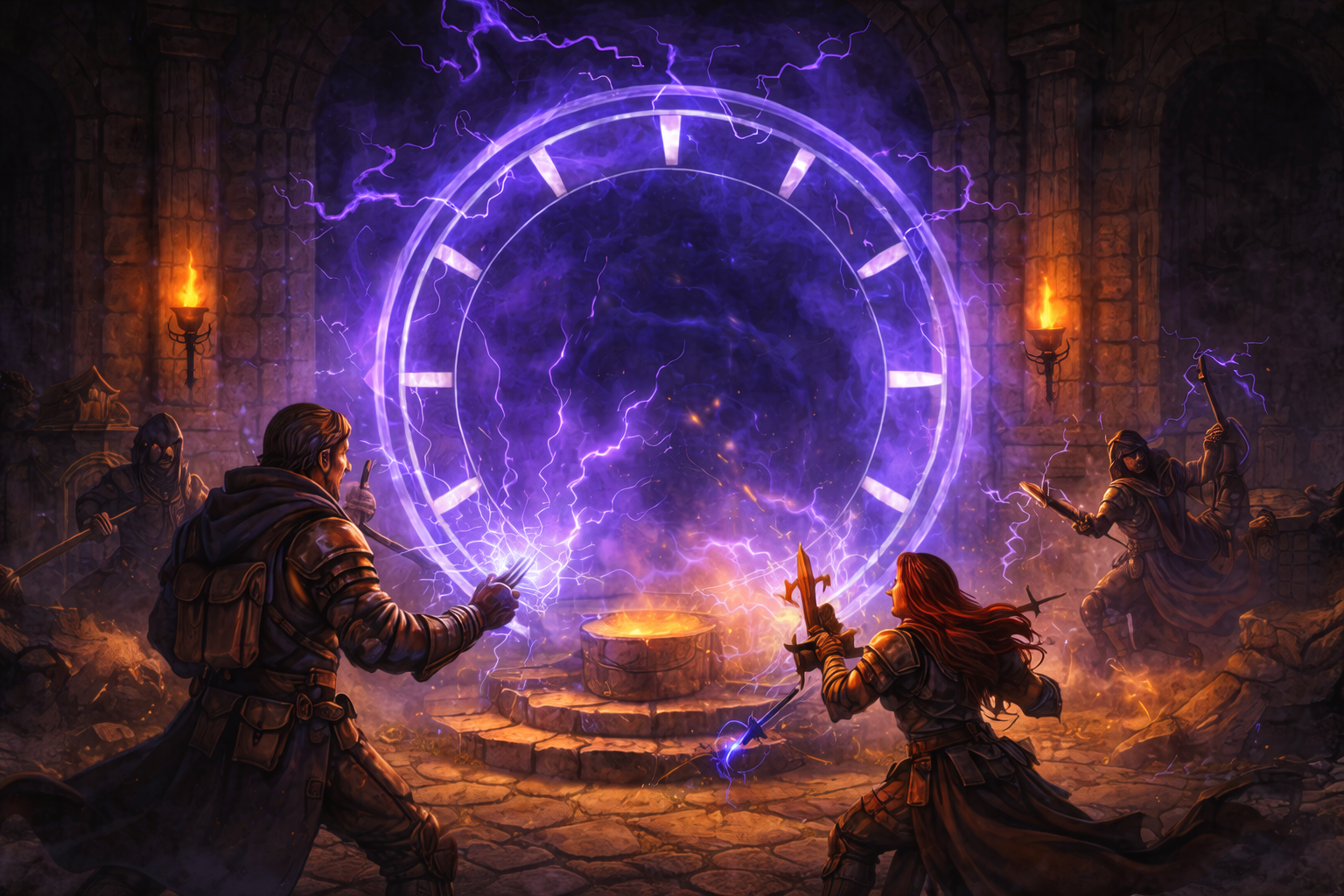
Draw a circle with 6–8 segments. Fill one segment each time the clock advances. When full, the event triggers.
Great for: rituals, alarms, patrol routes, reinforcements
2) Countdown Die
Place a d6 on the table set to 6. Each tick lowers the number by 1. When it hits 0, time’s up.
Great for: fast, high-tension scenes where visibility matters
3) Rounds Remaining
State the countdown clearly:
“You have 5 rounds before the ceiling collapses.”
Great for: tactical, combat-adjacent encounters
4) Dungeon Turns (10-Minute Turns)
Each major action (searching, forcing doors, mapping) advances time.
Great for: dungeon crawls and exploration-heavy play
5) Decision-Point Clock
The clock advances on choices, not time:
- Long planning discussions
- Backtracking
- Slow or cautious approaches
Great for: groups that love to plan everything
How to Build a Time-Pressure Encounter (Step-by-Step)
1) Declare the Objective and the Deadline
Be explicit:
- Objective: “Stop the ritual.”
- Deadline: “When the clock fills, the portal opens.”
Clarity makes urgency feel fair.
2) Make the Clock Visible
Visible clocks increase tension and speed up play.
Hidden clocks work best only in horror or mystery scenes.
3) Define What Advances the Clock
Choose one main trigger:
- Each round
- Each failed check
- Each loud action
- Each room explored
- Each delay or hesitation
Optional: add a secondary trigger for extra pressure.
4) Add Tradeoffs
The best clocks force hard choices:
- Save prisoners or stop the villain?
- Grab loot or escape?
- Hold the door or chase the enemy?
These decisions are where drama lives.
5) Give Players Ways to Buy Time
Players should be able to interact with the clock:
- Jam a mechanism (Tools)
- Counter a ritual (Arcana / Religion)
- Hold a door (Athletics)
- Create a diversion (Deception / Performance)
Possible effects:
- Remove 1 tick
- Prevent the next tick
- Slow ticking for several rounds
6) Escalate at 25%, 50%, 75%, and 100%
Instead of waiting for the end, let the clock change the scene:
- 25%: warning signs, tremors, rising tension
- 50%: hazards appear, patrols tighten
- 75%: major complication or partial trigger
- 100%: full consequence—but play continues
7) End with a Strong Resolution Beat
When the clock ends (success or failure), change the situation:
- New location
- New objective
- New threat
Avoid “nothing happens” endings.
Difficulty Tuning Tips
- Keep DCs moderate (10–15). Time pressure already adds difficulty.
- Increase challenge through limited attempts and consequences, not higher numbers.
- Adjust clock length to your table’s pace:
- Short scenes: 6 ticks
- Big set pieces: 8 ticks
- Multi-phase scenes: multiple smaller clocks
Three Plug-and-Play Time-Pressure Encounters
Ritual Countdown
- Clock: 8 segments
- Ticks: +1 per round; +1 on failed Arcana or Religion checks
- Goal: disrupt 6 rune anchors
Escalation:
- 2/8: environmental effects begin
- 4/8: magical hazards
- 6/8: enemy reinforcement
- 8/8: portal opens
Burning Building Rescue
- Clock: d6 countdown
- Ticks: -1 per round; -1 when doors are opened
- Goal: rescue trapped NPCs and escape
Fail-forward:
- At 0, the roof collapses and becomes a chase scene
Heist Alarm Meter
- Clock: 6 segments
- Ticks: loud actions and failed Stealth checks
- Goal: steal the target and escape unnoticed
At 6/6:
- Alarms sound, exits lock, guards mobilize
Common Mistakes (and Fixes)
Mistake: The clock feels arbitrary
Fix: Show it and explain what advances it.
Mistake: Players can’t affect the clock
Fix: Add at least two “buy time” options.
Mistake: Failure ends the adventure
Fix: Failure should complicate the story, not stop it.
Mistake: Using real-time timers constantly
Fix: Save real-time pressure for special moments.
DM Script (Quick Use)
“This scene has a ticking clock.
Your goal is [objective].
When the clock hits zero, [consequence] happens.
The clock advances when [trigger] occurs.
You can slow or stop it with clever actions.”
Final Thoughts
Time-pressure encounters are one of the easiest ways to make your game feel tense, cinematic, and alive. A good ticking clock doesn’t rush players—it forces meaningful choices. Start simple with a visible 6-segment clock, let your players learn how time pressure works, and then experiment with more complex, interactive countdowns.
Once your table gets comfortable with them, ticking clocks will become your go-to tool for upgrading chases, rescues, heists, rituals, and dungeon crawls into moments your players will remember.