How to Run Stealth Missions in D&D 5e
In my games, players get a clear path to sneak or strike, not a coin-flip between hiding and open combat. I reframe sneaking as exploration and lean on vision, movement, passive checks, and travel pace to make the outcome feel earned. I explain why the game can push groups toward fighting and how a few rule flips change that. You’ll get practical information I use in my campaign: when to skip extra rolls, how lighting shifts detection, and when group checks keep things moving.
Expect clear cadence for encounters, a simple homebrew for initiative, and templates you can run tonight. By the end, your party will know the way forward and your NPCs will react like real people, not dice fodder.
Key Takeaways
- Reframe sneaking as exploration to reduce swingy outcomes.
- Use vision and passive rules to limit needless rolls.
- Keep movement rules simple so play stays fast.
- Give each character clear roles—rogue, fighter, spell support.
- Use a light initiative layer to signal risk before it blows up.
What I Mean by Stealth Missions in 5e (and Why They’re Exploration, Not Combat)
I treat a heist as a map to be read rather than a fight to be won. That shift changes how I set up an encounter and what I ask of my players.
Player vs. environment means the challenge is the space: light, walls, patrol routes, traps, and sound. Guards become moving hazards with simple rules instead of the central obstacle.
Player vs. Environment: Guards, Light, Sound, and Space
I lay out light sources, cover, and patrol timing so the way forward is visible if the group looks. Obvious tells—footsteps, torchlight, echoes—teach players how the map works.
Designing for discovery: turning the mission into a solvable puzzle
I frame the run as exploration first, which reduces instant failure and clarifies when to roll. Each player has a role: scout, distraction, route-maker, or extractor.

- Make guards predictable hazards.
- Use light and distance to create choices.
- Offer multiple routes so the mission is not brittle.
| Environment Element | Player Action | Likely Outcome |
|---|---|---|
| Torchlight & shadows | Use cover or extinguish light | Safer passage; higher chance to gather info |
| Patrol patterns | Time movement or create distraction | Bypass guards or split their attention |
| Acoustics (echoes) | Move slow, test doors, listen | Reveal traps or routes without combat |
Stealth missions 5e: the core rules I actually use at the table
I keep vision, movement, and group perception simple so play moves fast. Light matters: I call lightly obscured as a -5 to a seeker’s passive Perception that relies on sight. Heavily obscured? They’re effectively blinded for seeing you. Darkvision helps up to 60 feet but does not turn night into daylight.
Movement gets the same treatment. I skip needless rolls. Climbing uses half walking speed. Long jump equals your Strength score in feet; high jump is 3 + Strength modifier. I only ask for a DC 10 Athletics or Acrobatics check when footing or surfaces are truly bad. If a character is loaded, I halve jump distance.
Group checks and passive Perception
I use group checks when the party moves together. If at least half succeed, the group passes. Help applies when two people can reasonably assist. Passive Perception is 10 + modifiers; I treat advantage as +5 to the DC and disadvantage as -5.
| Rule | Practical effect |
|---|---|
| When to roll | Before movement for planning, during for risky actions, after for consequences |
| Speed tracking | Half speed clear for timing patrols and windows |
| Stealth DC | Usually a guard’s passive Perception, adjusted by advantage/disadvantage |
The messy Hide action: how I call it and keep play moving
The Hide action reads simple on paper but becomes a rules tangle at the table. The scattered language in the rules creates a real problem for DMs and players, so I set a few clean mechanics to keep the flow.
I allow a Hide attempt only when a player is actually concealed: heavy obscurity or solid cover that breaks line of sight. No “I close my eyes and roll” tricks.
I make the player roll a single check when they change position, not every five feet. That keeps the encounter moving and avoids repeat rerolls.
- Concealment gate: heavy darkness or 3/4 cover required to hide.
- Breaking hidden: coming into view, speaking loudly, or noisy interaction ends it.
- Perception context: sight-based rolls suffer in obscurity; hearing still works—no automatic disadvantage unless the situation demands it.
- Combat parity: Hide is an action in fights with the same visibility gate as out of combat.
- Snipe solution: make the check from proper cover, take the shot, and accept you become visible afterward.
- Niche features: characters get a bit more leeway only when their text clearly allows it.
I answer questions at the table fast and consistently: if visibility drops below my threshold, hidden ends immediately. Short rulings keep the mission from stalling.
Planning the mission: goals, routes, and fail states before dice hit the table
Before dice roll, I lock down the goal, the exit, and the alarm so everyone knows what counts as success. That single sentence keeps the party focused and speeds decisions at the table.
I define the objective plainly: the intel to grab, the item to extract, and the route to safety. Then I map an alarm threshold and its consequence. For example: one bell triggers reinforcements in three rounds.
- I sketch at least three ways in: a high route, a low route, and a timing window via patrol gaps. That gives players real options.
- I place lights, doors, and cover so the environment shows usable advantages. Shadows and alleys become puzzles, not traps.
- I mark where sound carries and which floors creak, so dropping gear or a failed check has sensible consequences.
- I assign one clear check per chokepoint and a fail-forward result that keeps the heist moving under pressure.
Show options, set time, and keep notes light
I tell the players the approximate time until a guard shift or alarm escalation—human terms like “ten minutes” work best. That creates urgency without cheap surprises.
Keep notes tight: objective, routes, guard postures, alarm track, and the single expected check at each obstacle. That way the party can pick the right character for the job and make choices that matter.
Running stealth checks the smart way: cadence, DCs, and consequences
I keep checks short and meaningful so every move counts, not every step. That makes play brisk and gives players real choices.
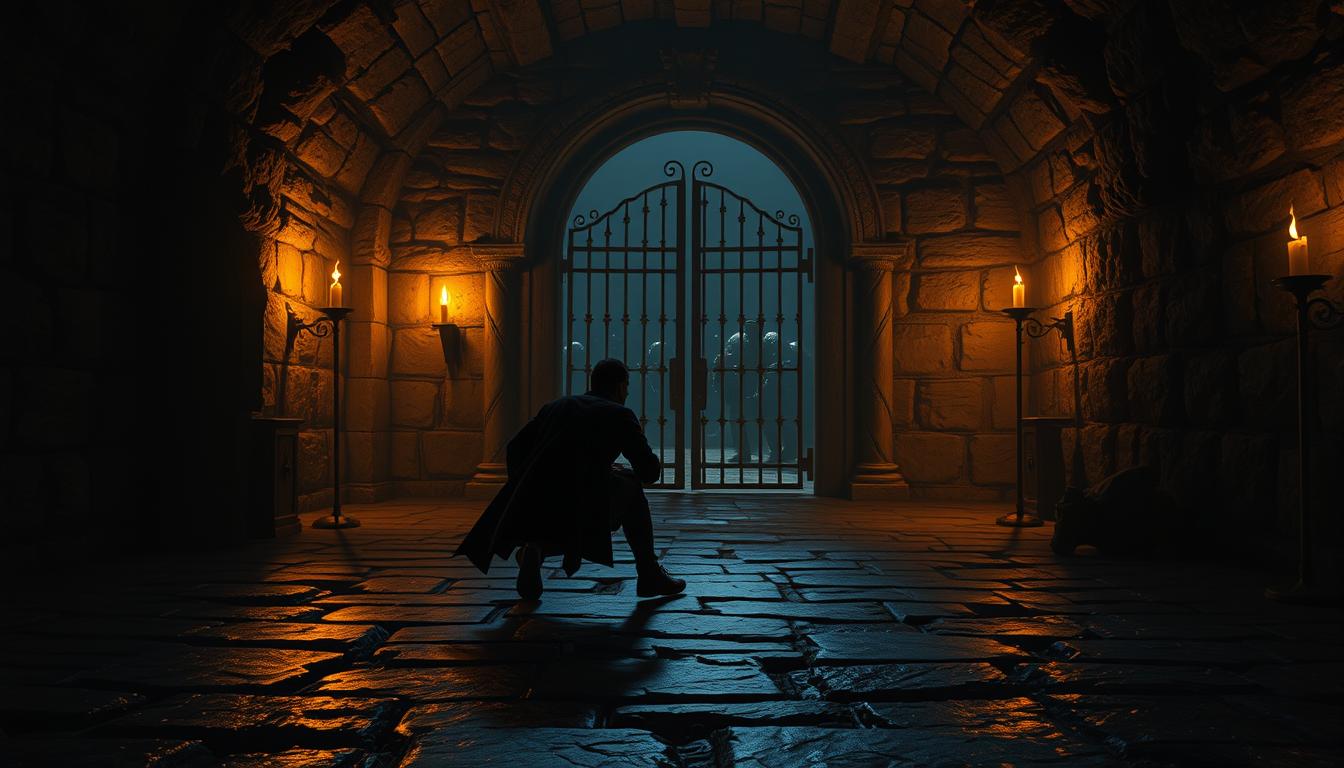
Passive vs. active Perception: I default to passive Perception for guards. Set the DC to 10 + modifiers and only switch to active rolls when an NPC is clearly searching or investigating.
When guards roll, and when they don’t
I apply advantage/disadvantage by shifting the DC by +5 or -5. That keeps math fast and consistent with light and vision rules.
Cadence matters: players declare movement, I resolve a single check for a meaningful segment, then I narrate the result. This avoids rolling every five feet and keeps the encounter moving.
Escalation on failures
Failure is staged: first suspicion, then investigation, then alarm. I rarely jump from a failed check straight to combat unless the fiction supports it.
- I use group checks when the party moves together; Help applies only when characters truly cooperate.
- Active Perception answers visible searching—then NPCs roll and the party can react.
- Consequences include locked routes, rerouted patrols, or alarms, not just HP loss.
| Action | Mechanics | Typical Result |
|---|---|---|
| Move as a group | Group check against passive Perception | Pass: silent passage. Fail: guard grows suspicious. |
| Someone looks for trouble | NPC makes active Perception roll | Finds clue or spot hidden party members. |
| Repeat failure | Escalate through stages | Investigation then alarm and reinforcements. |
I answer the same questions about who rolls when every time. That clarity lets players plan counters and keeps the tempo brisk.
Party composition and gear: making every class useful in a stealth mission
Every party needs roles so each character can matter when the map gets tight. I give players clear jobs—scout, distraction, carrier, opener—so no one feels benched. That keeps decisions fast and the fiction tight.
Non-rogue play: fighters and others pull weight
I tell my fighter and paladin players to carry lighter armor for runs or swap before an op. Timing movement with patrol gaps and using the Help action makes bulky classes viable.
Dexterity and Stealth proficiency matter, but smart choices and teamwork often beat a single high check.
Spells, items, and ways to change the math
I lean on a few spells to shift DCs: Pass without Trace (+10), Invisibility, Fog Cloud, and short teleports to bypass open zones. Tools like caltrops or ball bearings create options that don’t hinge on one roll.
| Role | Typical character | Useful tools |
|---|---|---|
| Scout | rogue | Dexterity, Stealth kit |
| Distraction | fighter | loud gear, timed salvo |
| Support | spellcaster | Pass without Trace, Fog Cloud |
Homebrew that helps: my take on Stealth Initiative and an Awareness Track
I use a compact initiative order that keeps actions meaningful and avoids full combat pacing. When foes are nearby, I drop into a light initiative so players and NPCs get turns without the full combat grind.
Awareness states track each NPC: Unaware (0), Cautious (-1), Alert (-2), Aware (-3). The state controls behavior: patrol, investigate, actively search, or raise the alarm and attack.
I move the track based on checks. Fail a Stealth check and an NPC moves -1; fail by 5 or more moves -2. Succeed by 5 or more moves and you calm an NPC by +1. This gives clear feedback for each action.
- Distract: Deception vs Perception; on success move target up to 10 feet and give -5 to Perception until your next turn; on fail you take -2 to your next Stealth check.
- Dash: costs height—Dash imposes disadvantage on your next Stealth check.
| State | Value | NPC Behavior | Typical Result |
|---|---|---|---|
| Unaware | 0 | Patrol or idle | Passive Perception only |
| Cautious | -1 | Move toward sounds | Spends action to Perception check |
| Alert | -2 | Active search, call for help | Search patterns, faster movement |
| Aware | -3 | Attack or trigger alarm | Engage party or sound reinforcements |
I keep the mechanics light. This system shows the party how their actions change the environment and gives a simple solution for tense encounters.
Solving common problems before they blow up into combat
Before things get noisy, I set tidy rules that keep a small slip from turning into all-out combat. That way the party knows what counts as a failure and how fixable a problem is.
Heavy armor noise and speed: options, tradeoffs, and timing windows
I offer simple choices for armor: stash plate, swap before the run, or accept slower movement and narrower windows. Climbing and tricky surfaces use half speed, and I only call checks on difficult terrain.
Result: fighters can still help, but a rogue may lead on thin beams.
Group stealth without auto-fail: role splits and staged entry
I use group checks only at shared chokepoints. Let Help and staged entry spread the risk so one noisy person doesn’t sink the whole group. That keeps players engaged and responsible.
When players want to fight: guard responses, reinforcements, and escape vectors
I tie guard reactions to awareness states. A single stumble raises suspicion, not immediate alarm. If combat starts, I want the party to know escape routes, fallback points, and which reinforcements matter.
- Practical beats: bribes, distractions, or cover IDs to downgrade heat.
- Fail-forward: closed shortcuts and rerouted patrols absorb mistakes.
- Clear roles: fighter holds a door, rogue makes the takedown.
| Issue | Fix | Typical result |
|---|---|---|
| Heavy armor | stash plate or split entry | Less noise; tighter timing |
| Group move | group check at chokepoints | Shared risk, focused rolls |
| Alert | awareness states | Escalation, not instant combat |
Quick-start templates: plug-and-play stealth encounters for tonight’s session
I give you six plug-and-play runs you can drop into your table tonight. Each template lists a starting awareness state, one alarm consequence, and a fail-forward route so you can improvise without breaking tension.
- Temple Heist — Objective: relic in the sanctum. Ways in: rooftop oculus, side door, catacombs. Guards circle every 2 minutes (start Unaware). Key spells: Pass without Trace, Misty Step. Alarm: bells summon reinforcements. Fail-forward: trapped corridor reroutes party to a secret drain.
- Noble’s Ball Lift — Objective: signet from a study. Options: impersonation or balcony infiltration. Single kitchen check (DC 10) sets tone; fail moves awareness to Cautious. Useful spells: Invisibility, Dimension Door. Alarm: household search; fail-forward: servants close off a wing.
- Warehouse Snatch-and-Go — Objective: crate by dock office. Environment: stacked boxes for moving cover. Guard dog forces a group check; a Distract action bypasses it. Start Unaware. Spells: Fog Cloud for a gap. Alarm: docklights raised; fail-forward: crane route opens an alternate exit.
- Prison Whisper Escape — Objective: transfer ledger. Timing: guard change window. Climbing on catwalks is at half speed; DC 10 only for tricky beams. Fog Cloud breaks a lit gap. Start Unaware. Alarm: lockdown; fail-forward: tunnel access under the yard.
- Crypt Switcheroo — Objective: swap a cursed idol. Traps are sound-based; checks focus on handling objects quietly. Start Unaware. Spells: Pass without Trace and Invisibility help. Alarm: tomb seals trigger a guard patrol; fail-forward: concealed passage appears when pressure plates trip.
How I pace these: one meaningful check covers segments like entry, chokepoint, or extraction. Use the Awareness Track and Distract action to shift NPC behavior quickly. That keeps rolls low and suspense high.
| Template | Start State | Key Spells/Gear | Alarm / Fail-forward |
|---|---|---|---|
| Temple Heist | Unaware | Pass without Trace, Misty Step | Bells summon guards / secret drain |
| Noble’s Ball Lift | Unaware | Invisibility, Dimension Door | House search / wing sealed off |
| Warehouse Snatch-and-Go | Unaware | Fog Cloud, rope, crates | Dock alarm / crane exit |
| Prison Whisper Escape | Unaware | Fog Cloud, climbing kit | Lockdown / tunnel access |
Quick tip: a fighter with decent dexterity can hold doors and make distractions while a rogue takes the objective. Keep time tight and let one check cover a whole way to avoid death-by-rolls and keep players moving.
Conclusion
When I make checks predictable, players stop gambling and start plotting. Reframing covert runs as exploration makes the table lean into choices. This keeps the game moving and helps people enjoy the tense moments without constant rolls.
Use a light system that gates checks by sight and sound, applies passive DC shifts of +5/-5, and saves active rolls for real risks. That simple solution buys time to act before things turn into full-on combat.
Plan routes so every class and character can pull a bit of the job. Give clear roles, set readable consequences, and the campaign will reward teamwork over lucky dice.