How to Handle Meta-gaming
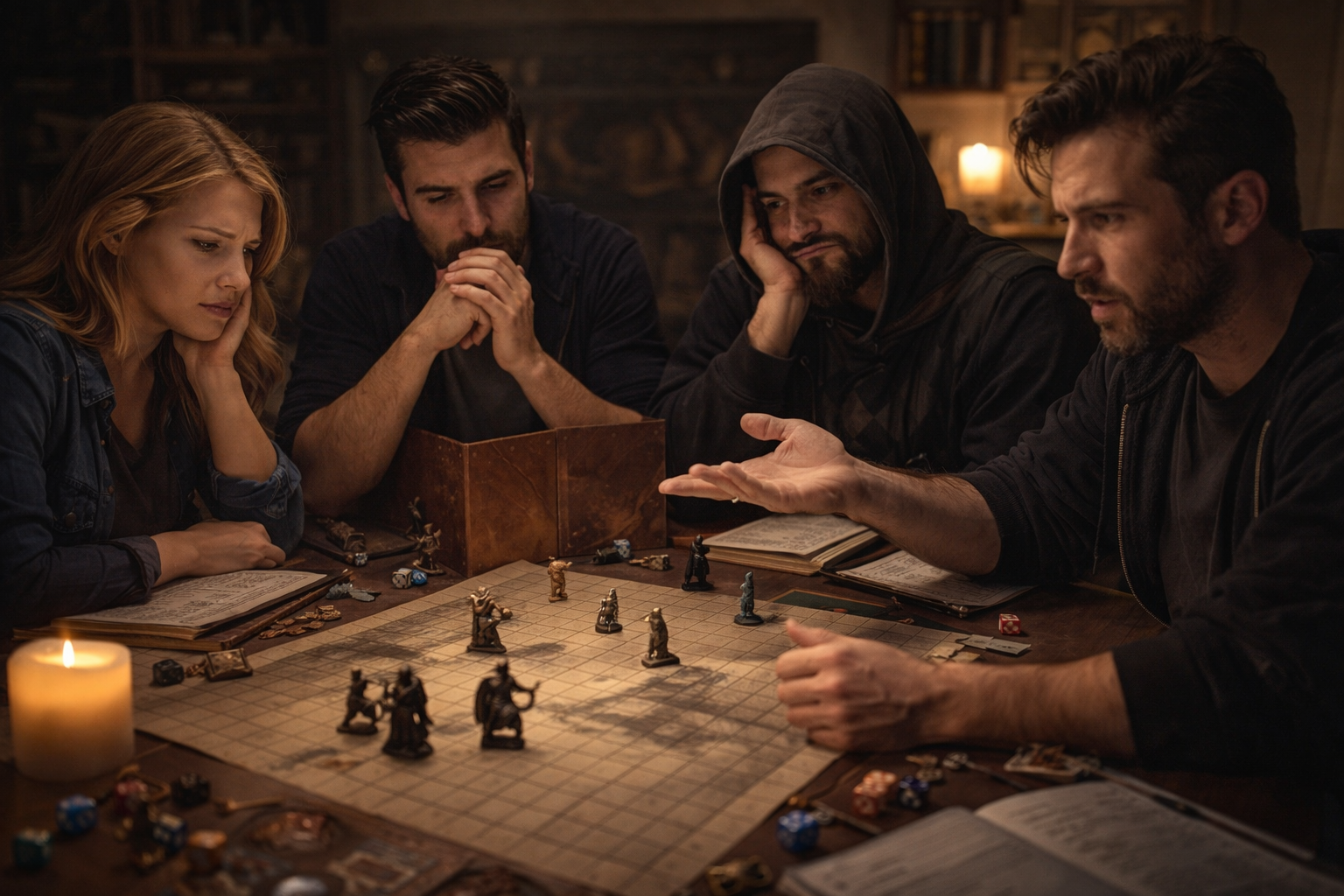
Meta-gaming is one of the most common frustrations a Dungeon Master faces.
A player knows the troll needs fire.
Someone avoids the trapped chest because they “have a feeling.”
A character acts on information they couldn’t possibly know in the story.
Sometimes this is harmless. Sometimes it drains tension from the game and makes choices feel less meaningful.
The good news is that meta-gaming usually isn’t a sign that your players are trying to ruin the game. More often, it’s a table habit, a communication issue, or a mismatch in expectations.
You do not need to police every decision.
You just need to know when meta-gaming is actually a problem — and how to respond without turning the table against you.
Key Takeaways
- Not all meta-gaming is bad. Some table knowledge helps the game run smoothly.
- Meta-gaming becomes a problem when it replaces character decision-making or removes tension.
- The best fix is usually clarity and table expectations, not punishment.
- If players act on out-of-character knowledge, shift the focus back to what their characters know.
- Meaningful uncertainty, consequences, and changing situations reduce harmful meta-gaming naturally.
What Is Meta-Gaming?
Meta-gaming happens when a player uses out-of-character knowledge to influence in-character decisions.
That might include:
- knowledge from reading the Monster Manual
- information overheard while another player had a private scene
- assumptions based on game structure rather than story logic
- acting on clues the character never actually received
In simple terms:
Meta-gaming is when the player knows something the character does not, and that knowledge changes what the character does.
Not All Meta-Gaming Is Bad
It helps to separate harmless meta-gaming from harmful meta-gaming.
Harmless Meta-Gaming
Some forms of meta-gaming are normal and even useful:
- players understanding initiative and action economy
- players helping each other remember rules
- a new player making a smarter choice because a veteran explains the system
- players leaning into drama because they know a scene will be more fun
This kind of meta-gaming usually improves flow and keeps the table moving.
Harmful Meta-Gaming
Meta-gaming becomes a problem when it:
- removes mystery
- bypasses investigation or tension
- gives characters knowledge they did not earn
- undermines roleplay and immersion
- makes challenges feel trivial
If a player is making decisions based on player knowledge instead of character perspective, that is when you need to step in.
Why Players Meta-Game
Most meta-gaming is not malicious. It usually comes from one of these causes:
1. They Want to Succeed
Players are trying to make good choices. If they know something useful, it is natural to use it.
2. They Are Used to Thinking Like Gamers
Some players approach D&D like a strategy game. They focus on optimization first and fiction second.
3. The Table Expectations Are Unclear
If you have never talked about what counts as acceptable meta-gaming, players will draw their own line.
4. They Are Afraid of Missing Something
Sometimes players meta-game because they worry a wrong decision will punish them unfairly.
5. The Game Has Become Too Predictable
If every troll works the same way and every trap follows obvious patterns, players will start solving the game from outside the fiction.
Step 1: Decide Whether It Is Actually a Problem
Before correcting meta-gaming, ask:
- Did this hurt the game?
- Did it remove tension or mystery?
- Did it deny another player a meaningful moment?
- Is it a one-time slip or a repeating habit?
Not every instance needs intervention.
If a player knows trolls hate fire because they have played D&D for years, that may not be worth a confrontation. But if every monster is instantly “solved” by player knowledge, that is a different issue.
Focus on the meta-gaming that changes the experience for the whole table.
Step 2: Set Expectations Clearly
The best way to handle meta-gaming is to talk about it before it becomes a pattern.
You might say:
“I’m not worried about minor rules-level meta-gaming, but I do want characters to act on what they actually know in the story.”
Or:
“Try to make choices from your character’s perspective, especially when it comes to secrets, monster knowledge, and hidden information.”
This works better than calling out players in the moment because it frames the issue as a shared table norm, not a personal accusation.
Step 3: Redirect to Character Knowledge
When meta-gaming happens at the table, the cleanest response is often a question:
- “How does your character know that?”
- “What in the scene makes you think that?”
- “Did anyone actually tell your character that?”
- “What would your character be acting on here?”
This does two useful things:
- It slows the meta-gaming impulse
- It gives the player a chance to justify the action in-fiction
Sometimes they have a reasonable explanation. Sometimes they realize the problem themselves and adjust without embarrassment.
Step 4: Reward In-Character Play
Players are more likely to avoid meta-gaming when acting in character feels worthwhile.
Reward:
- investigation
- asking questions
- testing assumptions
- roleplaying uncertainty
- learning through action
For example, if the party suspects a monster has a weakness, let them discover it through observation, skill checks, experimentation, or lore.
That turns “the player knows this already” into “the character earns this knowledge.”
This is also one reason skill-based scenes work so well. When information and decisions are tied to what characters do in the world, players are less likely to skip straight to out-of-character logic.
How to Run Skill-Only Encounters
Step 5: Let the World Push Back Naturally
If players rely too heavily on meta-knowledge, the best correction is often not a lecture — it is a living world.
Examples:
- not every troll in your world behaves exactly the same
- a villain changes tactics after being studied
- rumors are incomplete or wrong
- traps vary
- enemy motives matter more than stat blocks
This does not mean you should constantly “gotcha” your players.
It means the world should feel real enough that memorized answers do not solve everything.
When situations are dynamic, players are more likely to engage with the fiction instead of the template in their head.
Step 6: Separate Player Skill From Character Skill
One of the trickiest parts of meta-gaming is that D&D naturally blends player thinking and character ability.
That is normal.
A smart player may notice a pattern their character would miss. A low-Intelligence character may still be controlled by a clever human being sitting at the table.
You do not need to enforce perfect separation.
Instead, aim for this balance:
- let players be creative and engaged
- but anchor major decisions in what the character could reasonably know or infer
If needed, use ability checks to bridge the gap:
- Arcana to identify magical behavior
- Nature to recognize creatures
- Insight to read motives
- Investigation to connect clues
This turns player suspicion into character-earned certainty.
Step 7: Handle Repeat Problems Privately
If one player constantly meta-games in a way that hurts the table, talk to them outside the session.
Keep it calm and specific.
Try something like:
“I’ve noticed you sometimes act on information your character hasn’t learned yet. I know you’re trying to play well, but it can undercut tension for the group. I’d love your help keeping decisions more in-character.”
This is much more effective than correcting them in front of everyone every time it happens.
Public embarrassment creates defensiveness. Private clarity creates buy-in.
What Not to Do
Do Not Punish Every Slip
If you turn meta-gaming into a constant rules violation, the game becomes tense in the wrong way.
Do Not Use “Gotchas” Constantly
Changing every monster and trap just to beat player knowledge feels adversarial.
Do Not Confuse Table Communication With Meta-Gaming
Players helping each other understand the game is often healthy, not harmful.
Do Not Demand Perfect Separation
D&D is a game. Players will always bring some outside knowledge to the table. The goal is not perfection. The goal is better play.
Practical Fixes You Can Use Right Away
If meta-gaming is becoming a pattern, these small changes help immediately:
Ask for Marching Order and Intent Before the Reveal
This prevents players from retroactively “guessing” the safest option after new information appears.
Use More Partial Information
Instead of immediately naming every creature and effect, describe what the characters perceive first.
Let Discovery Matter
Make knowledge feel earned through investigation, lore, and experimentation.
Put Pressure on Decisions
When players hesitate and start solving the scene from outside the fiction, let the world keep moving.
Soft urgency is especially useful here.
How to Run Time-Pressure Encounters
Keep Stakes Visible
When players know what matters in the scene, they spend less time trying to “beat the module” and more time making meaningful choices.
A Simple DM Script for Meta-Gaming Moments
When a player acts on information they should not have, try:
“That might be true, but what is your character acting on in this moment?”
Or:
“I’m fine with the idea, but help me connect it to what your character knows.”
This keeps the tone collaborative instead of confrontational.
When Meta-Gaming Can Actually Help
Sometimes a little meta-awareness improves the game.
Examples:
- a player chooses not to steal the spotlight because they know another character’s backstory scene is coming
- the table leans into danger because they know it will create a better moment
- players avoid pointless argument because they understand what kind of session you are trying to run
This kind of meta-awareness is often a sign of a healthy table.
The goal is not to eliminate all meta-thinking.
The goal is to stop the kind that weakens the story.
Final Thoughts
Meta-gaming is not really about knowledge.
It is about where decisions are coming from.
When players make choices from their characters’ perspective, mystery matters, roleplay deepens, and tension feels earned. When every problem is solved from outside the fiction, the game gets flatter.
So do not treat meta-gaming like a crime.
Treat it like a table habit you can shape.
Set expectations clearly, redirect gently, reward in-character thinking, and let the world stay dynamic enough that discovery matters.
Done well, you will not just reduce meta-gaming.
You will make the whole game more immersive and more fun.